






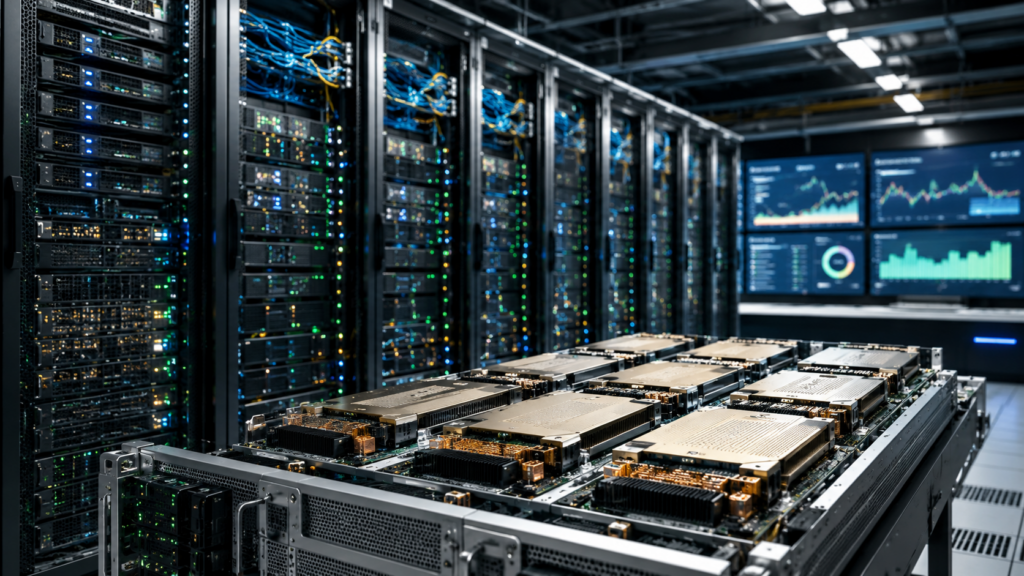
Alphabet Inc. (NASDAQ: GOOGL), through Google LLC, has entered into a major cloud services agreement with Space Exploration Technologies Corp., doing business as SpaceX, for access to large-scale artificial intelligence compute capacity. The agreement covers approximately 110,000 NVIDIA GPUs, CPUs, memory, and related infrastructure, with Google LLC paying $920 million per month from October 2026 through June 2029 after a reduced-fee ramp-up period. The deal matters because it shows that even one of the world’s largest cloud and AI companies is still looking outside its own infrastructure base to meet surging demand for advanced computing. GOOGL stock recently traded at $356.38, below its 52-week high of $408.61, suggesting that investors are rewarding Alphabet Inc.’s AI positioning while still questioning the scale and efficiency of its capital commitments. For SpaceX, the contract strengthens the revenue story behind its expected public market debut and gives investors a clearer commercial anchor for its expansion beyond rockets, Starlink, and orbital ambitions.
Why does Alphabet’s SpaceX compute agreement matter for the artificial intelligence infrastructure market?
Alphabet Inc.’s agreement with SpaceX is important because it reveals how tight the market for advanced AI compute has become. Google LLC already owns one of the world’s largest cloud infrastructure platforms, has deep semiconductor expertise through its tensor processing unit strategy, and has the balance sheet to build data centers at scale. Yet this agreement shows that internal capacity may still be insufficient when AI model development, Gemini Enterprise demand, inference workloads, and cloud customer requirements are all expanding at once.
The strategic message is blunt. AI competition is no longer only about model quality or application distribution. It is also about who can secure enough compute at the right time, in the right configuration, and at tolerable cost. If Google LLC is willing to pay $920 million per month for external capacity, it signals that compute access has become a strategic bottleneck rather than a routine procurement issue.
The deal also changes the competitive reading of Alphabet Inc.’s AI strategy. Investors have often debated whether Alphabet Inc. has an advantage because it controls search, YouTube, Android, Google Cloud, proprietary AI models, and custom chips. This agreement does not weaken that advantage, but it does show that vertical integration has limits when demand rises faster than physical infrastructure can be deployed. Data centers are not software updates. They need chips, power, cooling, land, networking, permitting, and time, which is the one input even Big Tech cannot buy in unlimited quantities.
How does the $920 million monthly structure change the financial reading of Google Cloud’s AI strategy?
The size of the payment makes this more than a tactical capacity rental. A full monthly fee of $920 million from October 2026 through June 2029 implies a multibillion-dollar commitment that will need to be justified by either direct AI product revenue, Google Cloud customer demand, internal model training benefits, or strategic protection against competitors. For Alphabet Inc., the financial question is whether the incremental capacity produces enough monetizable AI usage to offset the cost.
This is where the market will become more demanding. Investors have generally been willing to tolerate large AI capital expenditure because the perceived prize is enormous. However, the tolerance is not unlimited. If AI spending begins to look like defensive overbuilding rather than high-return growth investment, valuation support can weaken quickly. Alphabet Inc. has enough cash generation to absorb large infrastructure commitments, but shareholders will still expect clearer evidence that AI workloads are improving cloud margins, search relevance, enterprise adoption, and developer stickiness.
The contract structure also gives Google LLC some protection. SpaceX must provide access to the committed GPU capacity by September 30, 2026, subject to a one-month grace period. If that delivery target is missed, Google LLC can terminate the agreement or accept a smaller allocation with lower monthly fees. After December 31, 2026, either party can terminate the contract with 90 days’ notice. Those provisions reduce lock-in risk, but they also show that both sides understand how quickly AI infrastructure economics can change.
Why is SpaceX using AI compute contracts to strengthen its IPO narrative?
For SpaceX, the Google LLC contract is strategically powerful because it broadens the company’s growth narrative at the exact moment investors are examining its proposed public market valuation. SpaceX is already associated with reusable rockets, Starlink broadband, defense-related launch services, and space infrastructure. The compute agreement adds a more immediate, recurring revenue stream tied to one of the most aggressively funded areas in global technology.
That matters because IPO investors tend to reward visible, contracted revenue more than distant concept revenue. Orbital AI data centers may be a compelling long-term idea, but they remain operationally and technologically uncertain. A large cloud services contract backed by real compute capacity is easier for institutional investors to model. It gives SpaceX a nearer-term bridge between its existing infrastructure, its AI ambitions, and its proposed public-market story.
The risk is that SpaceX may be asking investors to value several growth stories at once. Launch dominance, Starlink cash flow, AI data centers, GPU leasing, and future orbital compute all sit in different risk categories. Combining them can create a powerful narrative, but it can also blur valuation discipline. Investors will need to separate what is contracted, what is under construction, what is experimental, and what is still more PowerPoint than power bill.
What does this agreement mean for NVIDIA, AI chips, and data center supply chains?
NVIDIA Corporation is not the contracting party between Alphabet Inc. and SpaceX, but the deal reinforces NVIDIA Corporation’s central role in the AI infrastructure economy. The agreement covers approximately 110,000 NVIDIA GPUs, making the chipmaker a critical indirect beneficiary of the capacity scramble between hyperscalers, AI labs, and infrastructure operators. NVIDIA Corporation shares recently traded at $200.42, down sharply on the day, with a 52-week range of $140.85 to $236.54, showing that the market remains highly sensitive to any sign of AI demand strength or valuation fatigue.
The larger implication is that AI compute capacity is becoming an asset class. Companies that can secure chips, power, land, networking, and cooling may increasingly behave like infrastructure landlords for AI model developers and enterprise software platforms. That is a shift from the earlier phase of the AI boom, when the debate centered mainly on model leadership. The next phase may reward firms that can finance and operate high-density compute environments at scale.
However, supply-chain risk remains high. GPU availability, energy constraints, grid interconnection delays, transformer shortages, cooling technology, and data-center permitting can all affect whether promised capacity arrives on time. The agreement’s delivery protections show that Google LLC is not simply buying a headline number of chips. It is buying usable capacity, and that is a much harder promise to keep.
How should investors read GOOGL stock after Alphabet’s expanding AI infrastructure commitments?
GOOGL stock’s recent performance captures the tension in Alphabet Inc.’s investment case. Shares closed at $356.38 on June 10 after falling 2.16 percent that day, and recent historical data show the stock down from $368.53 on June 5. The shares are also below their 52-week high of $408.61, even though Alphabet Inc. remains one of the largest winners from the AI and cloud infrastructure cycle. That gap suggests that investors are no longer treating every AI spending announcement as automatically bullish.
The market appears to be asking a more mature question. Is Alphabet Inc. spending aggressively because demand is extraordinary, or because competitive pressure requires enormous defensive investment? The answer may be both. Strong Gemini Enterprise demand and Google Cloud expansion would support the bullish interpretation. Rising infrastructure costs, uncertain AI monetization, and intensifying competition from Microsoft Corporation, Amazon.com Inc., OpenAI, Anthropic, and xAI would support the more cautious reading.
For institutional investors, the key metric will not be the size of the compute agreement alone. It will be whether Alphabet Inc. can convert external capacity into higher-value enterprise contracts, stronger cloud backlog, improved AI product economics, and sustained margin expansion. If the deal helps Google LLC avoid capacity shortages while competitors struggle to serve demand, it could strengthen Alphabet Inc.’s strategic position. If it merely adds another large cost layer without visible revenue conversion, the market will be less forgiving.
Why could this SpaceX and Google deal reshape the cloud services competitive map?
The agreement introduces an unusual competitive dynamic because SpaceX is not a traditional cloud infrastructure provider. Google LLC buying compute capacity from SpaceX suggests that the boundary between AI labs, cloud providers, chip customers, data-center operators, and infrastructure owners is becoming more fluid. The companies that control compute may increasingly sell it to the same firms that compete with them elsewhere.
That creates strategic complications. Alphabet Inc. is buying capacity from a company closely associated with Elon Musk’s broader AI ecosystem, including xAI. Google LLC will retain ownership of its content, AI models, and related data, which is important for enterprise trust and intellectual property protection. Still, the optics matter. A leading AI company is paying a major future competitor for compute infrastructure, which shows how scarce usable capacity has become.
The deal could also influence how other hyperscalers behave. Microsoft Corporation, Amazon.com Inc., Oracle Corporation, and other cloud infrastructure providers may look for more flexible capacity arrangements, especially if customer demand becomes hard to forecast. The old model was simple: build data centers, fill them, and expand. The new AI model is messier. Demand can spike quickly, chip cycles change rapidly, and customers want capacity before infrastructure owners can finish pouring concrete.
What could go wrong if the SpaceX compute deal fails to deliver on time?
The most immediate risk is execution. SpaceX must deliver access to the committed GPU capacity by the specified deadline, and any delay could weaken the economics of the agreement for both sides. Google LLC may have structured termination and fee-reduction protections, but a delay would still matter if the capacity is needed to support customer demand or internal model development. In AI infrastructure, late capacity can be almost as damaging as no capacity because customers and developers move quickly.
The second risk is utilization. Paying for capacity only makes sense if that capacity is heavily used and monetized effectively. If AI workload demand is lower than expected, if inference costs fall faster than anticipated, or if more efficient models reduce compute intensity, Alphabet Inc. could find itself with expensive external capacity that delivers weaker returns. That does not mean the deal is reckless. It means the financial return depends on demand remaining strong enough to justify the bill.
The third risk is valuation spillover. SpaceX’s IPO story benefits from large contracted revenue, but public-market investors may eventually ask whether compute leasing deserves the same valuation multiple as launch services, satellite broadband, or software-like AI revenue. Contracted revenue is attractive, but compute infrastructure can be capital intensive, power constrained, and exposed to hardware obsolescence. The market loves recurring revenue until it remembers that someone has to keep the machines cool.
Why is this development bigger than a single Google and SpaceX contract?
This agreement points to a broader restructuring of the technology economy around AI infrastructure scarcity. The companies with the strongest balance sheets are no longer just buying talent, models, and distribution. They are buying time, power, chips, and optionality. That is why the deal matters for investors beyond Alphabet Inc. and SpaceX.
For Alphabet Inc., the contract is a signal that AI demand may be strong enough to justify external capacity even alongside massive internal infrastructure spending. For SpaceX, it is a way to transform compute capacity into a more bankable IPO growth story. For NVIDIA Corporation, it reinforces the durability of GPU demand even as investors debate whether semiconductor valuations have run too far. For the cloud sector, it suggests that infrastructure partnerships may become a defining feature of the next AI cycle.
The cleanest strategic reading is that AI infrastructure has moved from competitive advantage to competitive necessity. Companies that lack capacity risk falling behind. Companies that secure too much capacity risk margin pressure. The winners will be those that balance speed, cost, utilization, and customer demand better than rivals. That is a harder game than simply shouting “AI” on an earnings call, although Wall Street has survived on less elegant poetry before.
Key takeaways on what Alphabet’s SpaceX compute agreement means for AI infrastructure and GOOGL stock
- Alphabet Inc.’s $920 million monthly SpaceX compute agreement shows that even the largest AI and cloud companies face capacity constraints when demand for advanced infrastructure accelerates faster than data centers can be built.
- Google LLC’s access to approximately 110,000 NVIDIA GPUs gives Alphabet Inc. near-term flexibility, but the contract will need to convert into enterprise AI revenue, model performance gains, or stronger cloud economics.
- The agreement strengthens SpaceX’s IPO narrative by adding large contracted AI infrastructure revenue to a business already built around launch services, Starlink broadband, and long-term space infrastructure ambitions.
- The deal suggests that AI compute is becoming a strategic infrastructure market in its own right, with capacity owners able to sell access to hyperscalers and AI platforms under long-term agreements.
- GOOGL stock’s recent pullback from its 52-week high shows that investors remain supportive of Alphabet Inc.’s AI strategy but are increasingly focused on capital discipline and return on infrastructure spending.
- NVIDIA Corporation remains an indirect winner from the AI compute race, although NVDA stock volatility shows that investors are still questioning whether chip valuations fully reflect future demand risks.
- The contract’s termination and delivery protections reduce Alphabet Inc.’s exposure to non-performance, but they also highlight the operational risk involved in turning GPUs into usable cloud capacity.
- For cloud competitors, the agreement may accelerate a shift toward more flexible infrastructure sourcing, especially as AI workload demand becomes harder to forecast and more expensive to serve.
- For SpaceX, the biggest risk is that investors assign too much value to future AI and orbital data-center ambitions before the economics of large-scale compute leasing are fully proven.
- For the broader market, the deal confirms that the AI race is now as much about infrastructure logistics as software intelligence, and that the next competitive battleground may be power, chips, and delivery speed.
Share this:
Discover more from Business-News-Today.com
Subscribe to get the latest posts sent to your email.

