





The U.S. House Appropriations Committee has advanced a fiscal 2027 Transportation, Housing and Urban Development funding bill that would sharply reduce federal support for public transit, Amtrak and major rail grant programmes while redirecting emphasis toward selected transportation safety, aviation, road and bridge priorities. The bill’s headline numbers are politically significant because it proposes a 22 percent cut to public transit funding, a 78 percent reduction in Capital Investment Grants and a 69 percent cut to Amtrak grants compared with fiscal 2026 enacted levels. The measure is not yet final law, but it gives cities, transit agencies, rail operators, contractors and state transportation departments an early warning about the next federal funding fight. Strategically, the bill matters because it could reshape which U.S. infrastructure projects move forward, which are delayed and which are forced back to the drawing board.
The stakes are larger than one annual budget cycle. Federal transportation funding often acts as the confidence layer beneath local and state capital plans. Transit agencies use federal commitments to structure long-term programmes, award contracts, issue debt, plan match funding and negotiate construction timelines. When Washington signals a deep cut to rail and transit programmes, the immediate effect is not always a cancelled project the next morning. The deeper effect is uncertainty, and uncertainty is costly.
For infrastructure contractors, the bill complicates a market that has been supported by federal grants, megaproject funding and the post-pandemic infrastructure spending cycle. For cities, it threatens the reliability of capital pipelines for bus rapid transit, light rail, subway extensions, commuter rail upgrades and station improvements. For passengers, the consequences may emerge more slowly through deferred expansions, slower fleet replacement, weaker service reliability and more pressure on agencies already facing operating and capital deficits.
How could the proposed public transit funding cuts affect city rail, bus and commuter projects?
The proposed reduction in public transit funding would hit a sector already dealing with a difficult mix of ridership recovery, inflation, ageing assets and rising operating costs. Many transit agencies have seen passengers return unevenly after the pandemic, while labour, maintenance, insurance, safety and infrastructure costs have kept rising. Federal capital funding does not solve every transit problem, but it gives agencies the ability to replace vehicles, modernise stations, upgrade signals, improve accessibility and advance expansion projects that local revenue cannot support alone.
The Capital Investment Grants programme is especially important because it supports large fixed-guideway projects such as light rail, heavy rail, commuter rail, streetcar and bus rapid transit projects. A 78 percent reduction would not merely trim a discretionary line item. It would narrow the path for dozens of projects that depend on federal participation to reach construction. Cities often spend years developing environmental documents, engineering plans and local funding commitments before entering the federal grant pipeline. If the federal portion shrinks suddenly, those sunk planning costs become politically painful.
The second-order effect could be a slowdown in project awards. Local agencies may delay procurement if they do not know whether federal funds will arrive. Contractors may face less predictable bid pipelines. Suppliers for railcars, buses, signalling systems, track components, elevators, escalators and charging equipment could see demand volatility. Transit infrastructure is a chain, not a single agency cheque. When the federal link weakens, the entire chain feels it.
There is also an equity dimension. Public transit funding supports mobility for workers, students, seniors and lower-income households that cannot easily substitute driving. In cities where housing affordability is already stretched, weaker transit investment can deepen the mismatch between where people live and where jobs are. A budget cut may look like fiscal discipline on a committee chart, but on the ground it can become another transfer, longer wait and missed shift.
Why would Amtrak and intercity rail face major consequences under the House proposal?
Amtrak funding is one of the most visible pressure points in the bill. A 69 percent reduction in Amtrak grants would test both the Northeast Corridor and the National Network at a time when passenger rail is being asked to do more, not less. The Northeast Corridor remains one of the country’s most economically important rail corridors, supporting commuting and intercity travel across Boston, New York, Philadelphia, Baltimore and Washington. The National Network provides long-distance and state-supported links in regions where rail service is thinner but politically meaningful.
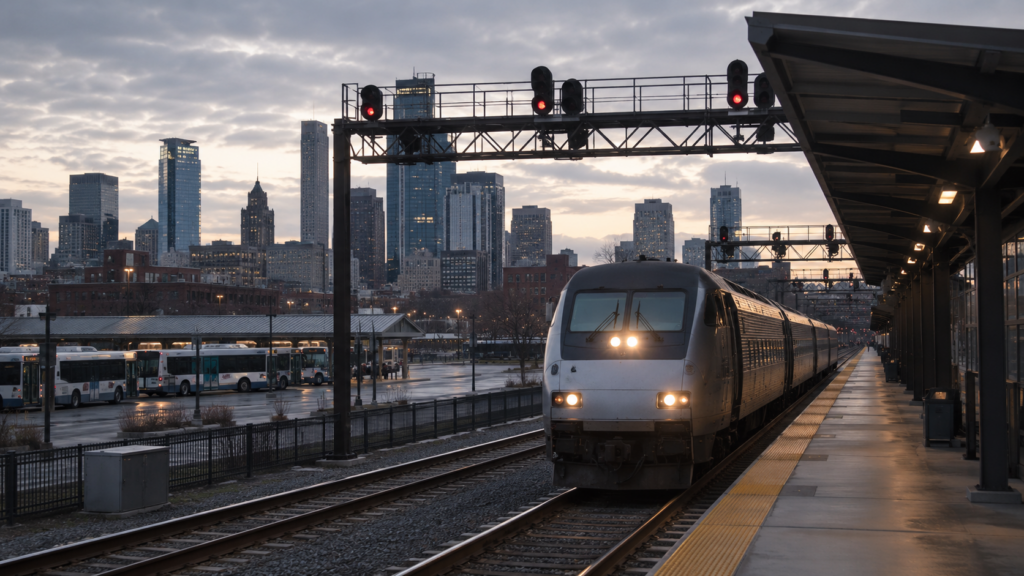
The risk is not limited to immediate service levels. Amtrak depends on federal support for capital renewal, fleet replacement, station work, safety improvements, bridge and tunnel upgrades, and state partnership planning. Passenger rail infrastructure has long replacement cycles, and deferred maintenance does not disappear politely. It compounds. If capital work slows, future repair bills can become larger and service disruptions more frequent.
The timing is also awkward. The United States is in the middle of a renewed passenger rail push, with projects tied to the Northeast Corridor, state-supported corridors, high-speed rail development and station modernisation. Cutting Amtrak and broader rail programmes while many projects are still being shaped could weaken confidence among states that are trying to expand service. State transportation departments may hesitate to commit matching funds if they suspect federal support could be reduced in future cycles.
There is also a contractor-market issue. Rail projects require specialised labour, suppliers and engineering capacity. If federal funding becomes more volatile, firms may be less willing to invest in the workforce and equipment needed for future rail construction. That would be a quiet but serious consequence. Infrastructure capacity is built over time. It can also be lost over time.
Why are bridge and road priorities becoming more attractive in the House funding debate?
The House bill’s emphasis on bridges and selected transportation safety priorities reflects a political calculation that roads and bridges remain easier to defend across districts than transit and passenger rail. Bridges are visible, widely used and often framed as core infrastructure rather than urban mobility policy. Lawmakers can point to bridge repairs as tangible benefits for freight, commuters, emergency services and local economies. Rail and transit, by contrast, often become entangled in debates over urban spending, ridership, climate policy and federal versus local responsibility.
That does not make bridge spending unimportant. Many U.S. bridges remain in need of repair or replacement, and freight corridors depend heavily on road and bridge reliability. Investment in bridge resilience, safety and maintenance can deliver real economic value. The problem is not that bridges are receiving attention. The problem is whether the bill creates a zero-sum trade-off that weakens transit and rail at the very moment when many metropolitan regions need multimodal capacity.
A road-and-bridge tilt may also reflect broader political messaging around fiscal restraint. Rail and transit grants can be portrayed as discretionary or project-specific, while highway and bridge funding can be presented as foundational. That framing has political power, but it oversimplifies infrastructure economics. A subway signal failure in New York, a commuter rail bottleneck in Chicago, a bus fleet shortage in Phoenix or an Amtrak tunnel constraint in the Northeast can all carry serious economic costs.
The deeper issue is that the United States needs both asset repair and capacity modernisation. Bridges, roads, transit, airports, ports and rail systems do not compete in separate economies. Freight workers ride buses. Airport employees use transit. Cities depend on roads and rail. A funding bill that prioritises one mode too aggressively risks creating bottlenecks somewhere else.
How could the bill affect contractors, engineering firms and infrastructure supply chains?
For contractors and engineering firms, the bill introduces uncertainty into the 2027 infrastructure outlook. The construction market has benefited from major federal infrastructure support, but project categories do not benefit equally. Firms exposed to highway and bridge work may see more stable opportunities if the House’s priorities survive the legislative process. Firms with heavier exposure to transit, passenger rail and fixed-guideway projects could face weaker procurement visibility.
Engineering firms may feel the impact before contractors do. Planning, environmental review, design, grant applications and project development work often depend on confidence that a project has a path to construction. If federal funding looks less reliable, agencies may slow preconstruction spending. That can affect consultants, programme managers, designers, construction managers and specialist advisers well before any shovel hits the ground.
The supply chain effect could be more uneven. Bus manufacturers, railcar suppliers, signalling firms, track component makers, station equipment providers and electrification specialists all depend on lumpy public procurement. A sharp reduction in federal transit and rail support could delay orders, weaken production planning and make it harder to sustain domestic supplier capacity. The United States has been trying to rebuild portions of its infrastructure manufacturing base. Funding volatility works against that goal.
There is also an inflation risk. Stop-start funding can raise costs rather than reduce them. When projects pause, agencies may lose favourable bid windows, contractors may remobilise later at higher prices, and suppliers may reprice materials. A budget cut can therefore produce headline savings in one fiscal year while increasing lifecycle costs later. Infrastructure has a habit of punishing short-term arithmetic.
Why should cities and states treat the bill as a planning risk rather than a final outcome?
The House bill is not the final federal budget. It must still move through the broader legislative process, including negotiations with the Senate and potential changes before any final appropriations agreement. Cities and states should therefore avoid treating the proposal as a settled funding reality. However, they also should not ignore it. The bill reveals a policy direction and a negotiation starting point that could influence final funding levels.
For transit agencies, the practical response is scenario planning. Agencies should identify which projects are most exposed to Capital Investment Grant reductions, which require near-term federal commitments and which could be phased differently if funding slips. That does not mean agencies should panic. It means chief financial officers, boards and project teams should understand the exposure before contractors and riders do.
States with passenger rail expansion plans should do the same. If Amtrak and federal-state rail partnership funding are reduced, states may need to reassess timelines, matching funds and corridor priorities. Some projects may survive because they are politically advanced or have strong state support. Others may become harder to justify if federal participation falls. The winners in this environment will be agencies with clean project scopes, strong benefit-cost cases and credible local funding.
Local governments should also communicate clearly with business communities. Transit and rail investments are often tied to downtown recovery, workforce access, airport connectivity, freight efficiency and real estate development. If federal funding becomes uncertain, private-sector stakeholders need to understand which projects could be delayed and what that means for regional competitiveness.
What are the political stakes for the fiscal 2027 transportation funding fight?
The political stakes are high because transportation funding sits at the intersection of fiscal policy, urban economics, climate priorities, labour markets and regional equity. Republicans backing the bill can argue that it restores spending discipline, prioritises core infrastructure and directs resources toward safety and roads. Democrats and transit advocates can argue that the bill undermines public transportation, passenger rail and the infrastructure commitments made through recent federal legislation. Both sides are likely to frame the debate around who is protecting taxpayers and who is protecting mobility.
The fight also carries regional tension. Transit and Amtrak cuts would hit major metropolitan areas, commuter corridors and rail-dependent regions more directly. Bridge and road spending may appeal more broadly across rural, suburban and freight-heavy districts. That geographic split can shape the politics of the bill, especially in swing districts where voters use roads daily but also care about rail connections, airports and downtown jobs.
The timing matters because fiscal 2027 is arriving as agencies move from infrastructure announcements to delivery. The early years of major infrastructure legislation created optimism. The next phase requires stable appropriations, grant execution and project completion. A shift toward deeper cuts could weaken the delivery confidence that infrastructure markets need.
The bill may also become a proxy fight over the future of U.S. mobility. Is federal transportation policy mainly about maintaining roads and bridges, or is it also about expanding rail, transit and cleaner urban mobility? That question has been around for decades, but the fiscal 2027 debate gives it a fresh budget line.
What happens next if the proposed cuts survive or are softened in negotiations?
If the proposed cuts survive largely intact, the immediate result would be a more constrained funding environment for transit agencies, Amtrak and rail capital programmes. Some projects could be delayed, resized or forced to seek more state and local funding. Agencies already facing budget pressure may become more cautious about expansion and more focused on state-of-good-repair work. Contractors exposed to transit and passenger rail could see procurement timing become more uncertain.
If the cuts are softened in negotiations, the bill may still leave a mark. Agencies and contractors will remember that federal support can become volatile. That may push project sponsors to seek diversified funding sources, stronger state commitments and more conservative delivery timelines. It may also make agencies more careful about entering federal grant pipelines without stronger political support.
For passengers, the impact will depend on the final bill and how agencies respond. A one-year funding shock may not immediately change every train schedule or bus route. The larger risk is deferred capital improvement. Riders usually experience underinvestment later through breakdowns, crowding, slower service and delayed expansions. Infrastructure decline is rarely dramatic on day one. It is cumulative, which is exactly why it is dangerous.
For the wider economy, the key question is whether the United States can maintain a balanced infrastructure strategy. Roads and bridges need investment. So do transit systems, rail corridors and passenger mobility networks. The fiscal 2027 debate will test whether Congress can fund transportation as an integrated system or whether the country drifts back into mode-by-mode fights that leave everyone stuck somewhere, just in different traffic.
Key takeaways on what the House transportation funding bill means for U.S. infrastructure
- The House fiscal 2027 transportation funding bill would sharply reduce support for public transit, Amtrak and Capital Investment Grants compared with fiscal 2026 enacted levels.
- Public transit agencies face planning uncertainty because federal funding is central to fleet replacement, station upgrades, accessibility work and major fixed-guideway projects.
- The proposed Capital Investment Grant reduction could slow light rail, commuter rail, subway and bus rapid transit projects that have spent years moving through federal review.
- Amtrak funding cuts would affect both the Northeast Corridor and National Network by weakening capital renewal, service planning and long-term rail investment confidence.
- Bridge and road priorities appear politically stronger in the House bill, reflecting the easier bipartisan appeal of visible repair work and highway infrastructure.
- Contractors exposed to highway and bridge work may see more stable demand, while firms focused on transit and passenger rail could face weaker procurement visibility.
- Engineering, design and project development firms may feel uncertainty early because agencies could slow planning work before construction contracts are affected.
- Cities and states should treat the bill as a planning risk, not a final outcome, because the Senate and final appropriations negotiations may change funding levels.
- The debate will test whether U.S. transportation policy remains multimodal or shifts more aggressively back toward roads, bridges and selected safety programmes.
- If the cuts survive, passengers may not feel every effect immediately, but delayed capital investment could show up later through weaker reliability, slower expansion and higher lifecycle costs.
Share this:
Discover more from Business-News-Today.com
Subscribe to get the latest posts sent to your email.