


Hindustan Copper Limited (NSE: HINDCOPPER, BSE: 513599) has approved a 20-year revenue-sharing contract with Lohum Materials Private Limited to restart operations at the Gujarat Copper Plant in Bharuch. The agreement gives India’s public-sector copper producer a new operational route for a secondary copper smelter and refinery asset capable of producing 50,000 tonnes per annum of LME-A grade copper cathodes. The deal matters because copper demand is becoming central to electrification, renewable energy, data centres, electric vehicles and transmission infrastructure, while India remains exposed to import dependence across several parts of the critical minerals chain. For investors, the announcement lands while Hindustan Copper Limited trades at ₹526.35, below its 52-week high of ₹760.05 but still far above its 52-week low, making execution and asset monetisation the real stock-market test.
Why does Hindustan Copper’s Lohum deal matter for India’s copper supply chain strategy?
Hindustan Copper Limited’s partnership with Lohum Materials Private Limited matters because India’s copper requirement is moving into a structurally higher phase. Power transmission, electric mobility, rail electrification, data centres, renewable energy systems, industrial automation and urban infrastructure all require copper-intensive supply chains. India can announce as many green infrastructure ambitions as it wants, but the metal bill eventually arrives, and copper is usually standing near the front of the queue.
The Gujarat Copper Plant revival is strategically relevant because it brings attention back to secondary copper processing and recycling. Primary mining and smelting remain important, but secondary copper can reduce import dependence, improve resource efficiency and support circular-economy goals. If the Gujarat asset is restarted effectively, Hindustan Copper Limited can use an existing industrial platform rather than depending only on greenfield capacity or upstream mining expansion.
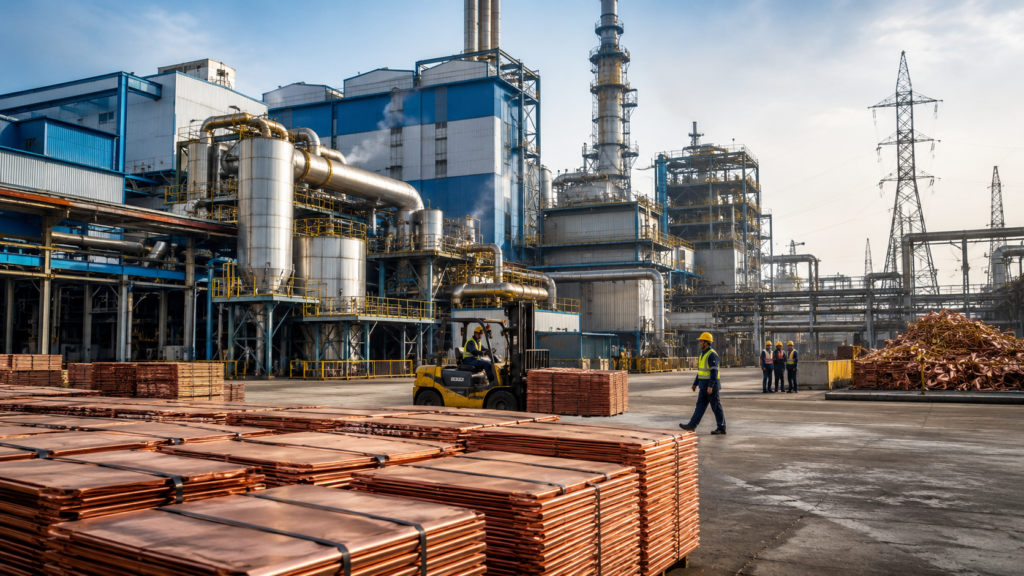
The use of a revenue-sharing structure is also significant. Instead of carrying the full operating burden internally, Hindustan Copper Limited appears to be using a specialist partner to reactivate the asset. That could lower execution strain, bring in technical and operational expertise and help the company unlock value from a plant that has not been central to its recent operating story. However, the success of the model will depend on commercial terms, feedstock access, operating discipline and the ability to produce copper cathodes at competitive cost.
How could the Gujarat Copper Plant restart reshape Hindustan Copper’s asset monetisation story?
The Gujarat Copper Plant offers Hindustan Copper Limited a chance to convert an underused industrial asset into a revenue-generating platform. The plant’s 50,000 tonnes per annum cathode capacity gives the asset strategic relevance at a time when copper demand visibility is improving across power, transport and manufacturing sectors. A restart could help Hindustan Copper Limited improve asset utilisation without waiting for longer-cycle mining investments to mature.
For investors, this is where the deal becomes more interesting than a normal operational update. Hindustan Copper Limited owns assets that are strategically valuable in a copper-constrained world, but market confidence depends on how effectively those assets produce cash. The Lohum Materials Private Limited contract could provide a route to monetise Gujarat Copper Plant through a partner-led operating framework. That may be more capital-efficient than attempting a full internal revival, especially if the plant requires technical upgrades, feedstock sourcing and operating stabilisation.
However, asset monetisation is not automatic value creation. The company will need to show that the revenue-sharing arrangement produces visible earnings contribution, not just a better headline around plant revival. The market will watch how quickly operations restart, whether production ramps smoothly and whether the arrangement improves return on capital. A dormant plant that restarts badly is still a problem, only now with electricity bills.
Why is Lohum Materials Private Limited a strategically relevant partner for copper recycling?
Lohum Materials Private Limited is strategically relevant because the company operates in the critical minerals and advanced materials ecosystem, with a focus on recycling, refining and circular supply chains. That background matters for a secondary copper smelter and refinery, where feedstock quality, recovery efficiency, waste management and environmental compliance are central to project economics. Copper recycling is not merely melting scrap. It is an industrial process that must manage impurity control, quality consistency and regulatory obligations.
The partnership also reflects a wider shift in India’s industrial policy priorities. Critical minerals are no longer viewed only through the lens of mining rights. Recycling, refining, recovery and domestic processing are becoming equally important because they reduce dependence on global supply chains and support strategic industries. Lohum Materials Private Limited brings a circular-materials profile that fits this policy direction, while Hindustan Copper Limited brings the plant asset, public-sector credibility and copper-sector relevance.
The competitive implication is worth noting. If the model works, other public-sector or legacy industrial asset owners may consider specialist revenue-sharing partnerships rather than letting old assets sit idle or attempting slow internal turnarounds. India has many industrial assets with hidden optionality. The real issue is whether management teams can match those assets with the right operators before they become monuments to yesterday’s capex.
What does the stock-market context say about Hindustan Copper investor sentiment?
Hindustan Copper Limited’s stock price of ₹526.35 places it meaningfully below its 52-week high of ₹760.05 but still well above its 52-week low of ₹226.70. That range tells a fairly clear story. Investors continue to value the company’s copper exposure, but the market is not pricing the stock as if every strategic move will automatically deliver smooth upside. The stock has already absorbed a major recovery from its lows, so fresh rerating now needs stronger operating proof.
The company’s market capitalisation of around ₹50,899 crore also puts the Gujarat Copper Plant revival in perspective. This is a strategic asset event, but not by itself a complete transformation of the investment case. Investors will likely treat the Lohum Materials Private Limited arrangement as a positive step if it improves asset utilisation and supports earnings visibility. However, the stock’s valuation sensitivity will still depend on copper prices, production growth, cost discipline, mine output and capital allocation.
The recent decline from the 52-week high also suggests that the market may be separating long-term copper optimism from near-term execution uncertainty. That is sensible. Copper is a powerful structural theme, but Hindustan Copper Limited still has to deliver production, manage regulatory obligations and improve operating consistency. The Lohum deal can strengthen sentiment, but only if the market sees actual operational restart milestones rather than another promising board approval.
How does the Gujarat Copper Plant fit into India’s circular economy and critical minerals policy?
The Gujarat Copper Plant fits neatly into India’s circular economy push because secondary copper production can recover value from copper-bearing scrap, e-waste and other recyclable materials. As electrification accelerates, waste streams containing valuable metals will rise. Countries that can recover metals domestically may reduce import pressure, improve resource efficiency and support local manufacturing resilience. This is particularly important for copper because demand growth is broad-based and long-duration.
The policy relevance also extends to critical minerals security. India’s industrial expansion cannot depend only on securing mines abroad or increasing domestic extraction. Processing and recycling capacity are equally important because they help close the loop between consumption and supply. A functioning copper recycling asset in Gujarat could support downstream users in electrical equipment, cables, renewable energy systems, power infrastructure and industrial manufacturing.
However, circular economy projects have to be judged on real performance, not labels. Recycling assets must meet environmental norms, handle feedstock responsibly and produce material that meets industrial quality requirements. Hindustan Copper Limited and Lohum Materials Private Limited will need to show that the Gujarat Copper Plant can produce reliable LME-A grade copper cathodes while managing waste, emissions and process controls. Circularity sounds good in presentations. It has to work on the plant floor.
What execution risks could affect the Hindustan Copper and Lohum partnership?
The first risk is feedstock availability. Secondary copper plants depend on access to consistent copper-bearing material at viable prices. If competition for scrap rises or feedstock quality varies, operating costs and output quality can be affected. Lohum Materials Private Limited’s ability to source and process material efficiently will be central to the commercial outcome.
The second risk is restart complexity. A plant that has not been operating at full relevance may require refurbishment, compliance checks, equipment upgrades, workforce mobilisation and process stabilisation. Restarting a smelter and refinery is not the industrial equivalent of switching a fan back on after summer. It involves technical validation, safety systems, environmental controls and quality assurance.
The third risk is revenue-sharing alignment. Such contracts work best when both parties have clear incentives around throughput, quality, cost control and compliance. If the commercial framework is not balanced, one party may take more operational risk while the other captures disproportionate upside. Investors will want more clarity over how revenue, costs, capex obligations and performance responsibilities are shared.
What does the deal mean for India’s industrial metals and recycling competitors?
The deal could increase competitive pressure in India’s copper recycling and non-ferrous metals ecosystem. If Hindustan Copper Limited and Lohum Materials Private Limited successfully restart Gujarat Copper Plant, the market may see stronger interest in secondary metal processing assets. Companies involved in e-waste recycling, battery recycling, non-ferrous scrap processing and copper products could face a more organised public-private operating model.
The move may also push legacy metals companies to reassess dormant or underutilised assets. In a high-demand copper cycle, inactive capacity becomes harder to justify. Companies that can reactivate old plants through partnerships may gain faster market access than those waiting for fresh greenfield approvals. This could create a more competitive domestic recycled copper market over time.
For downstream industries, more domestic copper cathode availability would be useful if production is reliable and pricing is competitive. Cable manufacturers, electrical equipment makers and infrastructure suppliers all benefit from secure copper availability. However, the impact will depend on scale. A 50,000 tonnes per annum plant is meaningful, but India’s copper demand is much larger. The deal is a useful building block, not the whole building.
How should investors track whether the Gujarat Copper Plant revival is succeeding?
Investors should first track operational milestones. These include restart timelines, refurbishment progress, feedstock sourcing agreements, commissioning updates and production ramp-up. Hindustan Copper Limited’s board approval is important, but the value unlock happens only when the plant moves from plan to production. The market will want evidence that operations are restarting on commercially viable terms.
The second indicator is financial contribution. Investors should watch whether the revenue-sharing arrangement improves Hindustan Copper Limited’s revenue, operating profit or cash flow without creating hidden capex or compliance liabilities. If the arrangement is asset-light and cash-generative, it could strengthen confidence in management’s ability to monetise non-core or underused assets. If the economics are unclear, the market may treat it as another strategic experiment.
The third indicator is strategic replication. If the Lohum Materials Private Limited partnership works, Hindustan Copper Limited may explore similar models across processing, recycling, downstream or international opportunities. That could broaden the company’s story beyond mining and price-linked copper exposure. For now, the Gujarat Copper Plant deal is a practical test of whether Hindustan Copper Limited can turn a legacy asset into a modern critical-materials platform.
Key takeaways on what Hindustan Copper’s Lohum deal means for investors and India’s copper market
- Hindustan Copper Limited’s 20-year revenue-sharing contract with Lohum Materials Private Limited could revive Gujarat Copper Plant as a secondary copper platform.
- Gujarat Copper Plant has the capacity to produce 50,000 tonnes per annum of LME-A grade copper cathodes, making the asset strategically relevant in a high-demand copper cycle.
- The deal supports India’s critical minerals and circular economy priorities by focusing on copper recycling, refining and domestic processing capacity.
- Lohum Materials Private Limited brings a critical materials and recycling profile that could help Hindustan Copper Limited restart the asset without carrying the full operational burden internally.
- Hindustan Copper Limited’s share price remains below its 52-week high, suggesting investors want operational proof before assigning full value to the Gujarat Copper Plant revival.
- The market will track restart timelines, feedstock availability, environmental compliance, production quality and revenue-sharing economics.
- The arrangement could become a model for monetising dormant or underused industrial assets through specialist operating partnerships.
- The deal may strengthen India’s recycled copper ecosystem, but its broader market impact will depend on scale, cost competitiveness and consistent cathode output.
- Execution risks include scrap sourcing volatility, plant refurbishment complexity, quality control and alignment of incentives between Hindustan Copper Limited and Lohum Materials Private Limited.
- The strategic upside lies in converting a legacy copper asset into a modern supply-chain platform linked to electrification, infrastructure and resource security.
Discover more from Business-News-Today.com
Subscribe to get the latest posts sent to your email.