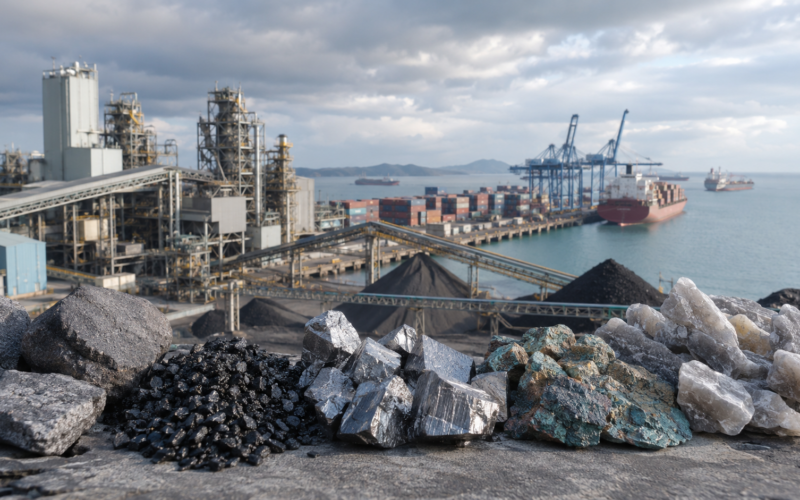
The Quad countries have moved to deepen cooperation on critical minerals and energy security, with India, Australia, Japan and the United States using their latest foreign ministers’ meeting in New Delhi to place supply chain resilience at the centre of Indo-Pacific strategy.
The four countries announced or advanced initiatives covering critical minerals, energy supply chains, maritime security, and Pacific infrastructure. The critical minerals push is expected to focus on mining, processing, recycling, investment coordination, and supply chain diversification for materials essential to electric vehicles, batteries, renewable energy systems, defence production, semiconductors, and advanced manufacturing.
The meeting has immediate strategic importance because China remains the dominant global player in several critical minerals supply chains, particularly processing and refining. Beijing has also used export controls on selected minerals in recent years, increasing concern among governments and industries dependent on Chinese supply for clean energy, electronics, and defence technologies.
The Quad’s latest moves signal that critical minerals are no longer treated only as a trade or industrial policy issue. They are now part of a wider security framework linking economic resilience, energy transition, military readiness, technology competition, and Indo-Pacific diplomacy.
The meeting in New Delhi also underlined the Quad’s effort to show operational relevance at a time when the grouping faces questions about momentum, leader-level engagement, and China’s criticism of what Beijing describes as exclusive bloc politics. China said cooperation among countries should promote regional peace and stability rather than target any third party.
Why are Quad countries prioritising critical minerals cooperation in the Indo-Pacific now?
The Quad countries are prioritising critical minerals because modern industrial power now depends on secure access to materials such as lithium, cobalt, nickel, graphite, rare earth elements, copper, and other minerals used in batteries, electric vehicles, wind turbines, solar infrastructure, semiconductors, and defence systems.
The confirmed policy direction from the New Delhi meeting is clear. India, Australia, Japan and the United States want to strengthen cooperation across critical minerals supply chains and reduce exposure to concentrated sources of mining, processing, and refining. The institutional response is to coordinate investment, mobilise private capital, support regional projects, and build supply chains that are less vulnerable to disruption.
The broader consequence is that critical minerals have become a strategic currency in the Indo-Pacific. Countries that control extraction, refining, processing technology, financing, and offtake arrangements can shape the pace of clean energy deployment and advanced manufacturing. Countries that depend heavily on one supplier face cost shocks, industrial bottlenecks, and national security risks if access is restricted.
For the Quad, the timing is especially important. China’s export restrictions and dominance in mineral processing have pushed governments to treat supply security as a diplomatic priority. The Quad’s critical minerals framework therefore sits at the intersection of trade policy, climate policy, defence planning, and industrial strategy.

How does China’s role in mineral processing shape the Quad critical minerals strategy?
China’s role is central because China has built a commanding position in several stages of the critical minerals value chain, especially processing and refining. Even where minerals are mined outside China, a significant share of downstream processing often runs through Chinese industrial capacity. That gives China influence over pricing, availability, technology inputs, and supply continuity.
The Quad response is not framed only as a search for new mines. It is also about building processing capacity, recycling systems, financing structures, and coordinated market demand across partner countries. Australia has large mineral resources and mining capability. Japan has advanced industrial and materials expertise. The United States has financial, technological, and defence-industrial demand. India has a large manufacturing base, growing clean energy ambitions, and a strategic need to reduce import dependence.
China’s criticism of the Quad highlights the geopolitical sensitivity of this shift. Beijing has said regional cooperation should not target a third party and has opposed exclusive groupings or bloc confrontation. The Quad countries, however, frame their cooperation around a free and open Indo-Pacific, resilient supply chains, and economic security.
The wider consequence is a gradual fragmentation of global mineral strategy. Instead of relying on purely cost-driven globalisation, governments are moving toward trusted supply chains, friend-shoring, strategic stockpiles, domestic incentives, and state-backed financing. Critical minerals are becoming a field where market logic and security logic increasingly overlap.
What does the Quad critical minerals framework mean for India’s clean energy and manufacturing ambitions?
For India, Quad critical minerals cooperation could support both energy transition and industrial policy. India needs reliable access to minerals for electric mobility, battery storage, renewable energy expansion, electronics manufacturing, defence production, and semiconductor ambitions. Supply insecurity can slow these sectors or increase costs for Indian manufacturers.
India’s position in the Quad framework is significant because India is both a major future demand centre and an emerging manufacturing alternative. India wants to expand domestic production of batteries, electric vehicles, solar equipment, electronics, and advanced defence systems. To do that, India needs stable mineral inputs and stronger processing capabilities.
The institutional benefit for India lies in cooperation with Australia, Japan and the United States. Australia can support resource access. Japan can contribute advanced materials and processing expertise. The United States can support financing, technology cooperation, and strategic demand. India can offer scale, manufacturing capacity, market growth, and geopolitical relevance in the Indo-Pacific.
The broader consequence is that critical minerals cooperation could help India move higher in strategic manufacturing value chains. If India remains only a consumer of imported processed minerals, its clean energy and defence manufacturing ambitions remain vulnerable. If India builds processing, recycling, component manufacturing, and supply-chain integration, it gains more economic and strategic leverage.
Why does the Quad’s Pacific infrastructure and maritime security agenda matter for critical minerals?
The Quad’s critical minerals agenda is linked to maritime security and regional infrastructure because supply chains do not stop at mines and refineries. Minerals must move through ports, shipping routes, logistics networks, energy systems, and industrial corridors. Any disruption in maritime routes can affect access to minerals and energy products.
At the New Delhi meeting, the Quad countries also moved forward with Indo-Pacific initiatives that include port infrastructure cooperation in Fiji and stronger maritime surveillance coordination. These initiatives show that the Quad is trying to connect economic resilience with physical connectivity and maritime domain awareness.
The institutional logic is straightforward. If the Quad wants secure supply chains, it must also support secure routes, functioning ports, reliable energy systems, and better real-time information across the Indo-Pacific. Pacific Island countries, Southeast Asian states, and Indian Ocean partners sit along routes that matter for energy flows, mineral shipments, and strategic access.
The wider consequence is that the Quad is trying to become a practical provider of regional public goods rather than only a diplomatic forum. Infrastructure projects, maritime surveillance systems, fuel security forums, and critical minerals frameworks help the grouping demonstrate relevance in concrete terms. That matters because Indo-Pacific countries often judge external partnerships by delivery, not statements.
How could the Quad critical minerals push affect electric vehicles, batteries and defence supply chains?
The Quad critical minerals push could affect electric vehicles, batteries, renewable energy, electronics, and defence production by encouraging investment in alternative supply chains and reducing reliance on single-country processing dominance. The practical effect will depend on how quickly projects receive financing, permits, technology support, offtake commitments, and regulatory alignment.
Electric vehicles and batteries are among the most visible sectors affected by critical minerals availability. Lithium, nickel, cobalt, graphite, manganese, and rare earth elements influence battery chemistry, motor design, cost, and production scale. If supply chains are concentrated, automakers and battery manufacturers face higher exposure to price volatility and policy disruption.
Defence supply chains are equally important. Rare earth elements and other strategic minerals are used in missiles, radar systems, aircraft, naval platforms, sensors, communications equipment, and precision-guided systems. For Quad countries, defence readiness depends not only on weapons production capacity but also on the reliability of mineral inputs.
The broader consequence is that critical minerals policy is becoming a foundation for both green transition and military preparedness. The Quad’s framework may help align demand from clean energy industries and defence industries, making it easier to justify investment in mining, processing, recycling, and stockpiling. The risk is that implementation will be slow if governments cannot coordinate financing, environmental approvals, community consent, and industrial demand.
What challenges could slow the Quad’s plan to build secure critical minerals supply chains?
The Quad faces several constraints. Critical minerals projects take time to develop, and new mining or processing facilities often require environmental approvals, infrastructure, skilled labour, community engagement, technology partnerships, and long-term financing. These constraints cannot be solved by diplomacy alone.
A second challenge is cost. China’s dominance in processing partly reflects scale, industrial policy, infrastructure, and cost advantages developed over many years. Building alternative supply chains may be more expensive, especially in countries with higher environmental, labour, and regulatory standards. Quad countries will need to decide how much premium they are willing to pay for resilience.
A third challenge is coordination. India, Australia, Japan and the United States have different industrial structures, domestic political priorities, regulatory systems, and commercial incentives. A framework can identify shared goals, but companies need bankable projects, predictable demand, and clear risk-sharing mechanisms before committing large capital.
The broader consequence is that the Quad’s critical minerals strategy will be judged by projects rather than declarations. If the framework produces financing, offtake agreements, processing capacity, recycling partnerships, and measurable supply-chain diversification, it will matter. If it remains a diplomatic statement without industrial execution, dependence on existing supply chains will persist.
What could happen next after the Quad’s New Delhi meeting on critical minerals and energy security?
The next phase is likely to focus on converting the critical minerals framework into specific financing and implementation mechanisms. The Quad countries are expected to explore ways to mobilise private capital and support projects across partner countries and the wider region. This could include mining projects, refining facilities, recycling networks, strategic stockpiles, and offtake arrangements.
The Quad’s energy security work is also expected to continue through forums and coordination mechanisms designed to address fuel and energy supply vulnerabilities. This is relevant not only to clean energy but also to short-term energy stability, especially when maritime routes in the Middle East and Indo-Pacific face disruption risks.
China’s response will remain part of the geopolitical backdrop. Beijing is likely to continue criticising the Quad if it sees the grouping as directed against Chinese interests. Quad countries will continue to frame their actions in terms of resilience, openness, supply security, and regional stability.
The most important test will be whether the Quad can deliver a credible alternative to mineral supply-chain concentration without forcing regional partners into rigid blocs. Many Indo-Pacific countries want investment, infrastructure, and market access, but they also avoid openly choosing between major powers. The Quad’s critical minerals agenda will therefore need to combine strategic clarity with practical economic value.
What are the key takeaways from the Quad critical minerals push in New Delhi?
- India, Australia, Japan and the United States used the Quad foreign ministers’ meeting in New Delhi to advance critical minerals cooperation. The initiative focuses on secure supply chains for minerals needed in clean energy, advanced manufacturing, defence systems, and technology sectors.
- China’s dominance in critical minerals processing is the central strategic backdrop to the Quad initiative. China has criticised exclusive groupings and said cooperation should not target any third party, while Quad countries emphasise supply-chain resilience and a free and open Indo-Pacific.
- The Quad critical minerals framework is expected to cover mining, processing, recycling, investment coordination, and supply diversification. The framework aims to mobilise capital and support more resilient mineral markets across partner countries and the wider Indo-Pacific region.
- India could benefit from more secure mineral access for electric vehicles, batteries, renewable energy, electronics, semiconductors, and defence manufacturing. The initiative also supports India’s broader goal of reducing strategic import dependence and building higher-value manufacturing capacity.
- The Quad’s critical minerals agenda is linked to maritime security, energy security, and Indo-Pacific infrastructure. Port connectivity, shipping routes, surveillance cooperation, and fuel security all affect whether mineral and energy supply chains can remain stable.
- Implementation will determine whether the Quad framework has real strategic impact. New mines, processing plants, recycling systems, financing tools, offtake agreements, and regulatory coordination will matter more than diplomatic language.
Discover more from Business-News-Today.com
Subscribe to get the latest posts sent to your email.