



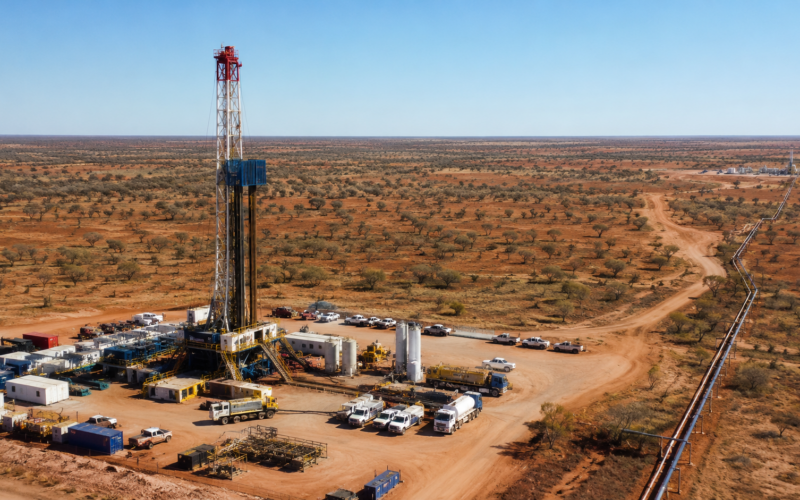
Tamboran Resources Corporation (NYSE/ASX: TBN) has completed its acquisition of Falcon Oil & Gas Ltd. subsidiaries after receiving final court approval from the Supreme Court of British Columbia, consolidating one of the most closely watched unconventional gas positions in Australia’s Northern Territory. The transaction gives Tamboran Resources Corporation, listed on the New York Stock Exchange and the Australian Securities Exchange under the ticker TBN, around 2.8 million net prospective acres across the Beetaloo Basin depocentre. The deal, reported at about C$239 million or $172.9 million, strengthens Tamboran Resources Corporation’s operating position at a time when Australia’s gas security debate is shifting from resource size to deliverability. For investors, the issue is no longer whether Tamboran Resources Corporation has scale in the Beetaloo Basin, but whether that scale can be converted into commercial gas flows, infrastructure access and durable returns.
Why does Tamboran Resources Corporation’s Falcon Oil & Gas acquisition matter for Beetaloo Basin control?
Tamboran Resources Corporation’s acquisition of Falcon Oil & Gas Ltd. subsidiaries is strategically important because it consolidates ownership in a basin where fragmented working interests can slow development, complicate farmout talks and dilute capital discipline. The Beetaloo Basin has long been promoted as a potential new gas province for Australia, but early-stage resource stories often run into the same roadblock: geology may be promising, yet shareholders still need clarity on cost, timing, market access and political support.
By absorbing Falcon Oil & Gas Ltd.’s subsidiaries, Tamboran Resources Corporation is effectively tightening control over a larger part of the Beetaloo development story. That matters because the company can now present a cleaner acreage position to potential infrastructure partners, strategic investors and future offtakers. Large-scale gas development usually rewards operators that can simplify decision-making, align capital priorities and offer counterparties a clearer development pathway.
The acquisition also arrives as Australia’s gas debate has become less theoretical. The country’s east coast gas market has seen repeated warnings around future supply tightness, even though near-term forecasts have improved in some official outlooks. For Tamboran Resources Corporation, the bigger opportunity is not merely owning more acreage. The bigger opportunity is positioning Beetaloo Basin gas as a credible future supply source in a market where policymakers, industrial users and LNG exporters are all watching domestic availability more closely.
How could the Falcon Oil & Gas deal strengthen Tamboran Resources Corporation’s gas development strategy?
The immediate strategic benefit for Tamboran Resources Corporation is greater scale. In upstream gas, scale is not just a trophy metric. It can influence drilling schedules, infrastructure economics, supplier negotiations, farmout discussions and eventual financing options. A larger consolidated acreage base can support a more coherent development model, especially where early wells must prove repeatability before institutional capital becomes more comfortable.
The transaction may also improve Tamboran Resources Corporation’s position in future partnership discussions. If a new partner wants exposure to the Beetaloo Basin, dealing with a larger consolidated operator may be more attractive than negotiating across multiple smaller interest holders. That could matter if Tamboran Resources Corporation seeks to sell down part of its position while retaining operational influence, a common path for resource developers trying to balance growth ambition with balance-sheet discipline.
However, scale does not automatically reduce execution risk. Tamboran Resources Corporation still has to demonstrate that Beetaloo Basin wells can deliver reliable production at costs that support commercial returns. The company also needs infrastructure to move gas from field to market, environmental and community engagement that withstands scrutiny, and a development cadence that avoids excessive dilution. In other words, the Falcon Oil & Gas acquisition gives Tamboran Resources Corporation a stronger hand, but the game is still very much being played.
Why is Beetaloo Basin gas becoming more relevant to Australia’s domestic energy debate?
The Beetaloo Basin sits at the intersection of three policy pressures: energy security, industrial gas demand and decarbonisation politics. Australia wants reliable gas supply for households, manufacturers and power systems that still need dispatchable fuel, but the country is also managing rising climate scrutiny and pressure to reduce long-term fossil fuel dependence. That makes Beetaloo Basin development commercially interesting and politically sensitive at the same time.
Official market commentary has pointed to improved near-term supply conditions, but the longer-term issue remains how Australia replaces declining legacy production while supporting electricity reliability and industrial users. Gas demand for power generation can fall as renewables and batteries expand, but gas still plays a role in firming, heating and industrial processes. That is the gap Tamboran Resources Corporation is trying to occupy.
The company’s strategy also has a Northern Territory dimension. Tamboran Resources Corporation has previously secured approvals linked to gas sales from the Shenandoah South Pilot Project, with the project targeting up to 40 terajoules per day of gas supply to the Northern Territory Government from mid-2026, subject to operational and weather conditions. That local supply pathway is important because early commercialisation can help validate the basin before larger-scale export or east coast supply options become realistic.
What execution risks could still limit Tamboran Resources Corporation after the Falcon acquisition?
The largest risk is that acreage consolidation creates investor excitement faster than operational proof. Resource markets have seen this movie before, and the sequel can get expensive. Tamboran Resources Corporation must show that Beetaloo Basin development can move from appraisal success to repeatable production, and then from pilot volumes to scalable commercial output.
Infrastructure remains a critical constraint. A gas resource is only valuable if it can reach customers at competitive delivered prices. The Sturt Plateau Pipeline and broader northern gas transport options are therefore central to the investment case. Pipeline capacity, timing, regulatory approvals and connection to larger markets will influence whether Beetaloo Basin gas becomes a strategic supply source or remains a regionally constrained development.
Environmental and social licence risk also cannot be ignored. Beetaloo Basin development has attracted scrutiny from climate groups and some community stakeholders because it involves unconventional gas extraction. For Tamboran Resources Corporation, this means technical execution must be matched by careful community engagement, transparent operating standards and credible emissions management. A company can win acreage and still lose momentum if political confidence weakens.
How should investors read Tamboran Resources Corporation stock after the Beetaloo consolidation?
Tamboran Resources Corporation’s NYSE-listed shares recently traded around $33.10, with the stock sitting below its 52-week high of $52.21 and comfortably above its 52-week low of $17.29. That range captures the market’s mixed view of the company: investors are assigning value to Beetaloo Basin optionality, but they are not yet pricing Tamboran Resources Corporation as a fully de-risked production story.
The stock’s current position suggests that the market is treating the Falcon Oil & Gas acquisition as strategically useful but not sufficient on its own to reset valuation. That is reasonable. The transaction improves Tamboran Resources Corporation’s resource control and development narrative, but the next valuation catalyst will likely come from operational milestones, farmout progress, gas sales execution, infrastructure advancement or clearer funding visibility.
For institutional investors, the key question is whether Tamboran Resources Corporation can reduce the discount usually applied to early-stage unconventional gas developers. If the company proves repeatability, secures infrastructure pathways and demonstrates disciplined capital management, the market may begin to view the company less as a speculative acreage holder and more as an emerging gas development platform. If progress slips, the larger acreage base could instead amplify funding risk.
What does the deal signal for future consolidation in Australian gas development?
Tamboran Resources Corporation’s acquisition of Falcon Oil & Gas Ltd. subsidiaries may also signal a broader consolidation phase in Australian gas. As capital becomes more selective, upstream developers with fragmented acreage, limited funding capacity or minority positions may find it harder to move projects forward alone. Larger operators or better-capitalised developers can use consolidation to simplify ownership structures and create more investable development platforms.
This is particularly relevant in frontier or semi-frontier basins. Investors are often more willing to fund companies that control a material position, have a clear operating plan and can negotiate with infrastructure providers from a position of scale. Tamboran Resources Corporation now has a stronger basis to argue that it is the central Beetaloo Basin vehicle, rather than just one of several companies trying to prove the same resource theme.
The competitive implication is that other gas developers may need to sharpen their own narratives. Santos Limited, Beetaloo Energy Australia Limited and other companies with exposure to Australian gas development will be watched through the same lens: resource size, near-term deliverability, infrastructure access, domestic supply relevance and social licence. The market is becoming less patient with acreage stories that do not show a path to cash flow.
Can Tamboran Resources Corporation convert Beetaloo Basin scale into long-term gas-market leverage?
The Falcon Oil & Gas acquisition gives Tamboran Resources Corporation the type of basin control that can matter in negotiations with partners, governments and infrastructure providers. It also gives the company a clearer platform from which to argue that Beetaloo Basin gas can support Northern Territory supply and, eventually, wider Australian energy security. That is the upside case.
The harder test is execution. Tamboran Resources Corporation must show that its enlarged position can produce gas at commercial rates, secure transport capacity, manage capital requirements and maintain regulatory and community support. The company’s expanded acreage may improve strategic optionality, but it does not eliminate the need for disciplined development.
A neutral reading suggests that Tamboran Resources Corporation has strengthened its strategic position without removing the major risks that define the stock. The Falcon Oil & Gas acquisition is a meaningful consolidation move, especially in a gas market increasingly focused on reliable future supply. Whether it becomes a value-creating transaction will depend on what happens next in the field, not just what changed on the map.
Key takeaways on Tamboran Resources Corporation’s Falcon Oil & Gas acquisition and Beetaloo Basin strategy
- Tamboran Resources Corporation has completed a strategically important consolidation by acquiring Falcon Oil & Gas Ltd. subsidiaries after court approval in British Columbia.
- The deal gives Tamboran Resources Corporation around 2.8 million net prospective acres across the Beetaloo Basin depocentre, strengthening its position in one of Australia’s most watched gas provinces.
- The acquisition is best viewed as a control and scale transaction, not a full de-risking event, because commercial production, infrastructure and funding risks remain central.
- The Beetaloo Basin story is gaining relevance as Australia balances domestic gas security, industrial demand, LNG policy and decarbonisation pressure.
- Tamboran Resources Corporation’s near-term credibility will depend on gas sales execution, drilling performance, infrastructure progress and the ability to manage capital without excessive dilution.
- The company’s NYSE-listed stock remains materially below its 52-week high, suggesting investors still want operational proof before assigning a higher confidence multiple.
- The Sturt Plateau Pipeline and wider gas transport options are crucial because Beetaloo Basin gas needs reliable market access to become commercially meaningful.
- Environmental scrutiny and community engagement remain important risks, especially because unconventional gas development is politically sensitive in Australia.
- The deal could encourage further consolidation across Australian gas developers if capital markets continue to favour scale, control and clearer development pathways.
- For investors, Tamboran Resources Corporation now has a stronger Beetaloo Basin platform, but the next phase is about turning acreage into bankable gas supply.
Discover more from Business-News-Today.com
Subscribe to get the latest posts sent to your email.