

NIO Inc. (NYSE: NIO; HKEX: 9866; SGX: NIO) reported a sharp first quarter revenue rebound as vehicle deliveries rose strongly across its NIO, ONVO and FIREFLY brands, giving investors a fresh reason to reassess the Chinese electric vehicle maker’s turnaround story. The company delivered 83,465 vehicles in the first quarter of 2026 and generated total revenue of RMB25.53 billion, up 112.2 percent from the same period last year. NIO Inc. also reported gross profit of RMB4.86 billion, up 428.4 percent year over year, signalling better operating leverage after a bruising period of losses, price competition and investor fatigue. The stronger results helped lift market interest in NIO stock, but the larger strategic question is whether NIO Inc. can sustain profitability as China’s electric vehicle market matures, competition intensifies, and domestic auto demand slows.
Why did NIO’s first quarter results trigger a stronger market reaction from $NIO investors?
NIO Inc.’s first quarter mattered because it gave investors three things they had been waiting for: stronger volume, better revenue conversion, and evidence that the company’s premium and mass-market brand strategy can begin to support profitability. The 83,465 vehicle delivery figure was not merely a headline number. It showed that NIO Inc. is gaining scale across a broader portfolio, including the core NIO brand, the ONVO family-oriented brand, and the FIREFLY compact electric vehicle line.
That matters because the old NIO investment case relied heavily on premium brand differentiation, battery swapping, customer experience, and technology positioning. Those strengths helped NIO Inc. stand out in China’s early electric vehicle growth phase, but they were not enough to shield the company from margin pressure once the market shifted into aggressive pricing, model proliferation, and consumer caution. The new investment case depends on whether NIO Inc. can combine premium pricing discipline with enough volume breadth to make the business model less fragile.
The stock reaction also reflected a broader relief trade in a sector where expectations had become low. NIO American depositary shares rose 9.32 percent to close at $5.75 on Wednesday, outperforming the broader market, while Hong Kong-listed shares also moved higher after management commentary and new product momentum. That rally was meaningful, but not euphoric in a long-term sense. The stock remains well below its 52-week high, which tells investors that the market is rewarding the quarter but not yet declaring the turnaround complete.
How does NIO’s Q1 delivery growth change the competitive read-through for China’s electric vehicle market?
NIO Inc.’s delivery growth is important because China’s electric vehicle market is no longer a simple story of demand rising fast enough to lift every brand. The market is now segmented, crowded, price-sensitive, and increasingly unforgiving. BYD Company Limited remains the scale leader, Tesla, Inc. continues to defend its position through pricing and software-led appeal, and newer Chinese brands are pushing fresh models into nearly every price band. In that environment, NIO Inc. has to prove that its brand architecture can do more than generate headlines.
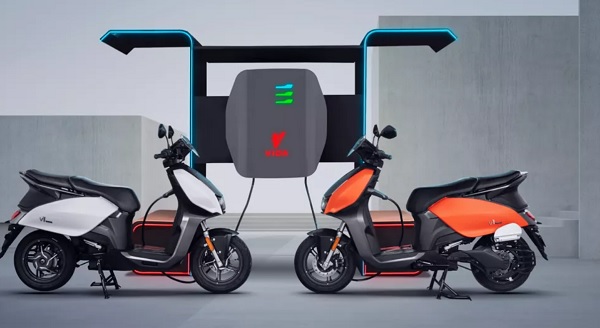
The ONVO and FIREFLY brands are strategically significant because they allow NIO Inc. to expand below its traditional premium positioning without diluting the main NIO badge too aggressively. That is a delicate balancing act. If ONVO and FIREFLY drive volume without destroying group margins, NIO Inc. gains a stronger portfolio model. If those brands require heavy discounting, marketing expense, and channel support, they could increase revenue while making profitability harder. In electric vehicles, more cars sold is not always the same thing as more value created. Just ask any spreadsheet that has survived a price war.
The first quarter suggests that the multi-brand model is gaining traction, but the next test is mix quality. Investors will watch whether higher-margin vehicles such as the ES8 and the newly launched ES9 can anchor profitability while ONVO and FIREFLY build scale. If the portfolio becomes too dependent on lower-priced volumes, NIO Inc. could face the same problem that has hurt many electric vehicle challengers: strong delivery growth paired with weak cash generation.
Why does William Li’s warning about China’s auto market matter for NIO’s strategy?
NIO Inc. founder and chief executive officer William Li has warned that China’s auto industry is unlikely to return to its earlier “golden era,” a comment that deserves attention because it reframes the company’s growth challenge. The message is not that China’s electric vehicle market lacks opportunity. The message is that the easy phase is over. China now has a mature vehicle base, intense domestic competition, and consumers who are becoming more selective about pricing, technology, brand value and after-sales support.
That is a sobering backdrop for NIO Inc. because the company remains heavily dependent on China. International expansion is part of the long-term story, but overseas volumes remain limited relative to domestic operations. That means NIO Inc. cannot simply rely on export markets to offset weakness at home. The company must win in China first, even as that market becomes harder to win in.
The strategic implication is that NIO Inc. needs to focus on operational discipline as much as product excitement. Premium electric SUVs, autonomous-driving chips, battery swapping, and smart cockpit features help the brand stand out. However, in a slowing market, consumers also care about affordability, resale confidence, service reliability, financing options, and perceived long-term brand stability. NIO Inc. must therefore compete as both a technology brand and a disciplined automaker. That is a much tougher assignment than being a high-growth EV darling during a liquidity boom.
Can the ES9 flagship SUV help NIO defend premium positioning without weakening margins?
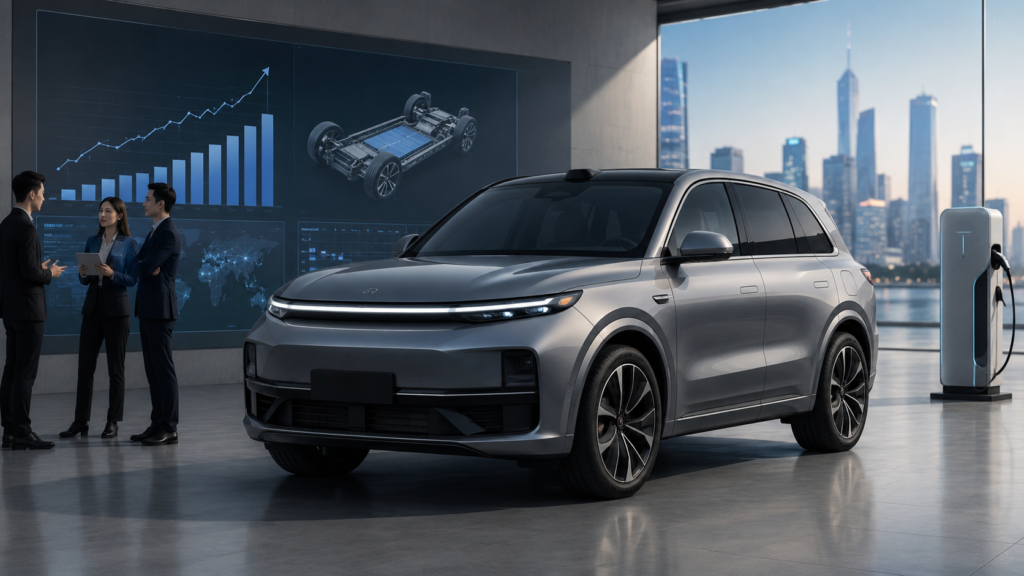
The ES9 launch gives NIO Inc. another chance to defend the premium electric sport utility vehicle segment, where brand image, interior space, smart-driving capability and family-use practicality all matter. The vehicle has been positioned as a large flagship electric SUV, with NIO Inc. using high-profile marketing and technology messaging to reinforce the company’s premium credentials. For investors, the ES9 is not just a product launch. It is a margin test.
Premium vehicles matter because they can support better gross margins if demand holds and pricing remains disciplined. NIO Inc.’s first quarter gross profit improvement was encouraging, but sustained profitability will require a healthier product mix. A strong ES9 cycle could help offset the margin pressure that may come from lower-priced ONVO and FIREFLY models. It could also help NIO Inc. retain its brand identity as the company expands into more affordable segments.
The risk is that premium electric SUVs are also becoming more crowded. Domestic rivals are moving quickly, technology cycles are short, and consumers now expect advanced driver-assistance systems, large cabin screens, high-performance batteries, and frequent software upgrades as part of the package. NIO Inc. can no longer rely only on being early or distinctive. It needs each flagship launch to convert into meaningful deliveries, healthy margins, and stronger brand loyalty. A beautiful SUV that does not improve unit economics is just an expensive brochure with wheels.
What does NIO’s current stock performance say about investor sentiment after the Q1 rebound?
NIO Inc. American depositary shares recently traded around $5.60, with an intraday range between $5.57 and $5.75 and a market capitalisation of about $11.69 billion. The stock remains below its 52-week high of $8.02 and above its 52-week low of $3.34, placing it in a middle zone where investors are neither abandoning the story nor fully repricing it as a durable recovery. That is an important distinction. The market is responding to improved execution, but it is not yet giving NIO Inc. the kind of valuation confidence reserved for companies with clearer profitability visibility.
Short-term performance has improved, with the stock advancing strongly during the latest session after recent product and earnings-related momentum. However, one-day rallies in electric vehicle names can be deceptive because the sector is heavily influenced by sentiment, short covering, China macro expectations, and broader risk appetite. The more important signal will come from whether the stock can hold gains as investors digest second quarter deliveries, margin trends, and ES9 order quality.
The sentiment backdrop is therefore cautiously constructive. Bulls can argue that NIO Inc. has achieved a volume inflection, improved gross profit, broadened its brand portfolio, and strengthened its product pipeline. Bears can argue that China’s auto market is slowing, competition remains severe, and profitability may prove vulnerable if pricing pressure returns. The stock is now in a prove-it phase rather than a hope-it phase. That is healthier, but also less forgiving.
What should investors watch next as NIO tries to convert delivery momentum into durable profitability?
The second quarter delivery guidance will be the first major test of whether NIO Inc.’s rebound has legs. Management has guided for continued delivery strength, and investors will compare that against April volumes, ES9 demand, ONVO traction, and FIREFLY ramp-up. The key question is not only whether deliveries rise. The key question is whether deliveries rise with a mix that supports gross margin and cash flow.
Gross margin will remain the cleanest indicator of business quality. NIO Inc. has already shown that revenue can rebound when volumes improve, but the electric vehicle sector has repeatedly taught investors that revenue growth without margin durability can disappoint quickly. If gross margin expands as deliveries scale, the market may become more willing to view NIO Inc. as a credible turnaround story. If gross margin stalls or declines, investors may assume that the company is buying volume through pricing and promotion.
Cash flow and capital discipline also deserve close attention. Battery swapping infrastructure, product development, autonomous-driving investment, brand expansion and international positioning all require capital. NIO Inc. has strategic reasons to keep investing, especially in smart-driving capabilities and computing resources. However, public-market investors are now less patient with electric vehicle companies that consume capital without showing a path to self-funded growth. NIO Inc. does not need to become a traditional automaker overnight, but it does need to show that innovation and financial discipline can sit in the same garage without fighting for the steering wheel.
Key takeaways on what NIO’s Q1 results mean for $NIO, China EV competition and investor sentiment
- NIO Inc.’s first quarter revenue growth and delivery performance gave investors a stronger basis to reassess the company’s turnaround prospects.
- The 83,465 vehicle delivery figure shows that the NIO, ONVO and FIREFLY portfolio is beginning to create broader volume reach.
- Gross profit growth was a key positive signal, but sustained margin improvement will matter more than short-term revenue acceleration.
- The ES9 flagship SUV is strategically important because it may help NIO Inc. defend premium pricing while broader brands expand volume.
- China’s electric vehicle market is becoming more mature, more competitive and less forgiving, which raises the execution bar for NIO Inc.
- NIO Inc.’s international expansion remains too small to offset domestic market risk, keeping China demand central to the stock story.
- The recent $NIO rally reflects improved investor confidence, but the stock remains below its 52-week high and still trades with turnaround risk.
- ONVO and FIREFLY could improve scale, but they may also pressure margins if lower-priced models require heavy promotion.
- Investors should watch second quarter deliveries, gross margin, ES9 order momentum and cash flow discipline as the next credibility tests.
- NIO Inc. is no longer just an EV growth story. It is becoming a test of whether Chinese electric vehicle challengers can scale profitably in a saturated market.
Share this:
Discover more from Business-News-Today.com
Subscribe to get the latest posts sent to your email.