



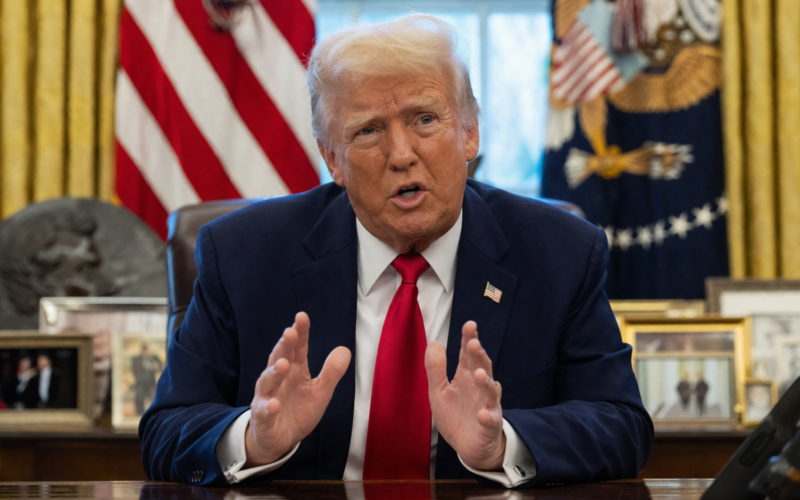
President Donald Trump has declined to commit to a new United States arms sale to Taiwan after Chinese President Xi Jinping warned that mishandling Taiwan could push United States China relations into a dangerous place, leaving one of Asia’s most sensitive security questions unresolved after high level talks in Beijing.
President Donald Trump said after the discussions that he had made no commitment either way on Taiwan and that a decision on the arms sale would come soon. The remarks followed direct discussions with Chinese President Xi Jinping during a Beijing visit in which Taiwan, arms transfers, trade, Iran and broader United States China tensions were all on the agenda.
The uncertainty centres on a proposed arms sale to Taiwan reportedly valued at about $14 billion. The issue has become a test of whether President Donald Trump will continue the longstanding United States practice of supplying Taiwan with defensive weapons, or whether Washington will use the package as leverage in its wider relationship with Beijing.
Chinese President Xi Jinping pressed the Taiwan issue during the talks and framed it as a core concern for China. China claims Taiwan as part of its territory and strongly opposes United States arms sales to Taiwan. Taiwan rejects Chinese sovereignty claims and says only the people of Taiwan can decide the island’s future.
President Donald Trump said he did not believe there was currently a conflict over Taiwan, but he also avoided giving a clear public answer on whether the United States would defend Taiwan if China launched an attack. President Donald Trump said only he knew how he would respond in such a scenario.
The result is a carefully balanced but politically charged pause. The United States has not announced a break from its Taiwan policy, but President Donald Trump’s refusal to immediately commit to the arms sale has introduced new uncertainty into the security equation across the Taiwan Strait.
Why does Donald Trump’s refusal to commit on Taiwan arms sales matter for United States China relations?
President Donald Trump’s comments matter because United States arms sales to Taiwan are not a routine commercial matter. They sit at the centre of a decades old strategic framework that tries to deter conflict without formally recognizing Taiwan as an independent state.
The Taiwan Relations Act requires the United States to make defensive articles and services available to Taiwan in quantities needed for Taiwan to maintain a sufficient self defence capability. The law also states that the United States should maintain the capacity to resist force or coercion that would endanger the security or social and economic system of the people on Taiwan.
That legal framework has long coexisted with the United States one China policy, under which Washington recognizes the People’s Republic of China as the sole legal government of China while maintaining unofficial relations with Taiwan. This structure has allowed the United States to support Taiwan’s defence without establishing formal diplomatic relations with Taipei.
President Donald Trump’s hesitation therefore carries strategic weight. A delay or reversal in the arms sale could be read in Beijing as a sign that arms transfers to Taiwan are negotiable in broader United States China diplomacy. In Taipei, the same hesitation could raise concerns about whether the United States remains willing to provide predictable security support at a time of rising Chinese military pressure.
The immediate diplomatic signal is also important. Chinese President Xi Jinping warned President Donald Trump that Taiwan could become a dangerous issue if handled improperly. President Donald Trump responded by avoiding a firm public commitment, while saying a decision would come soon. That posture gives Washington room to manoeuvre, but it also leaves Taiwan, China, Congress and regional allies watching closely for the next move.
How does the Taiwan Relations Act shape the debate over United States arms sales to Taiwan?
The Taiwan Relations Act remains the key United States legal foundation for arms sales to Taiwan. The law was enacted after the United States shifted formal diplomatic recognition from Taipei to Beijing in 1979, and it created a framework for continued commercial, cultural and security relations between the American people and the people on Taiwan.
The law does not require the United States to defend Taiwan automatically in every circumstance. It also does not create a formal defence treaty. Instead, the Taiwan Relations Act focuses on maintaining Taiwan’s self defence capability and preserving peace and stability in the Western Pacific.
That distinction is central to the current controversy. President Donald Trump can decide how and when to submit or advance specific arms packages, but the broader policy framework still expects the United States to provide Taiwan with defensive capabilities. Any major delay in arms transfers could therefore trigger questions in Congress over whether the administration is meeting the spirit of the Taiwan Relations Act.
Taiwan has framed United States arms sales as essential to regional peace. Taiwanese officials have argued that defensive weapons help deter aggression and maintain stability in the Taiwan Strait. China has taken the opposite position, arguing that arms sales encourage separatist sentiment and interfere in China’s internal affairs.
The arms sale now under discussion has become more than a weapons package. It is a signal about whether Washington sees Taiwan as a security partner whose defence needs remain separate from United States China bargaining, or whether Taiwan related decisions could become part of a wider transactional diplomatic strategy.
What did Xi Jinping’s warning reveal about China’s pressure campaign over Taiwan?
Chinese President Xi Jinping’s warning underscored Beijing’s view that Taiwan remains the most sensitive issue in United States China relations. China has repeatedly said it opposes any form of Taiwan independence and objects to foreign military support for Taipei.
China’s pressure campaign has several layers. Diplomatically, China seeks to isolate Taiwan by discouraging countries from formal contact with Taipei. Militarily, China has increased activities around Taiwan through aircraft, naval deployments and exercises designed to demonstrate capability and pressure. Politically, China presents Taiwan as a sovereignty issue on which Beijing will not compromise.
Chinese President Xi Jinping’s message to President Donald Trump was therefore consistent with Beijing’s broader approach. By warning that mishandling Taiwan could lead to dangerous consequences, Chinese President Xi Jinping sought to elevate the cost of any United States decision to proceed with a major arms package.
The warning also came during a summit where both sides had incentives to project stability. President Donald Trump praised the tone of his engagement with Chinese President Xi Jinping, while China used the Beijing meetings to frame itself as a central power in global diplomacy. Even so, Taiwan remained a hard limit in the relationship.
The key point is that Beijing is not only objecting to one sale. China is trying to shape the rules of United States behaviour toward Taiwan. If Washington delays or weakens arms transfers after Chinese pressure, Beijing may see that as evidence that sustained warnings can influence United States decision making.
How is Taiwan responding to uncertainty over the proposed United States weapons package?
Taiwan is trying to reinforce the argument that arms sales are a stabilising tool rather than a provocation. Taiwanese officials have said United States arms sales are a cornerstone of regional peace and are grounded in the Taiwan Relations Act.
Taiwan’s position is built around deterrence. Taipei argues that Taiwan needs sufficient defensive capability to make any military move by China costly and uncertain. In that logic, arms sales reduce the risk of war by strengthening Taiwan’s ability to resist coercion.
The political message from Taiwan is also clear. Taiwanese officials have reiterated that Taiwan’s future must be decided by Taiwan’s people. That point directly challenges Beijing’s claim that Taiwan is an internal Chinese matter and rejects any settlement imposed through force or coercion.
Taiwan also has domestic defence challenges. Taiwan’s parliament has faced debate over defence spending, even as the government has sought to strengthen the island’s military posture. The proposed United States arms package therefore matters not only as a bilateral transaction, but also as part of Taiwan’s broader effort to modernize its defences.
For Taipei, uncertainty from Washington creates a difficult planning environment. Taiwan needs predictable timelines for procurement, training, integration and deployment. A delayed decision from President Donald Trump could complicate Taiwan’s defence planning even if the sale is eventually approved.
Could Donald Trump’s Taiwan position reshape Indo Pacific security calculations?
President Donald Trump’s Taiwan position could affect calculations well beyond Taipei and Beijing. United States allies and partners in the Indo Pacific closely watch how Washington handles Taiwan because the issue is seen as a test of United States resolve, crisis discipline and alliance credibility.
Japan, South Korea, the Philippines and Australia all have security interests tied to the balance of power in the Western Pacific. None of these countries has the same legal relationship with Taiwan that the United States has under the Taiwan Relations Act, but all would be affected by instability in the Taiwan Strait.
The Taiwan Strait is also a critical corridor for global trade and technology supply chains. Taiwan’s role in semiconductor manufacturing adds economic weight to the security debate. A crisis over Taiwan would affect shipping, electronics, defence supply chains and global markets far beyond East Asia.
President Donald Trump’s approach appears to preserve ambiguity. He has not announced a policy reversal, but he has also not reassured Taiwan with a firm commitment on the arms sale. That ambiguity may be intended to give Washington leverage, but it also increases the risk of misreading by other governments.
The central danger is not only what President Donald Trump decides. The greater risk is how China, Taiwan and United States allies interpret the delay. In a region where signalling is often treated as strategy, even silence can move markets, ministries and militaries.
What are the key takeaways from Donald Trump’s Taiwan arms sale uncertainty after Xi Jinping’s warning?
- President Donald Trump said he made no commitment either way on a new United States arms sale to Taiwan after talks with Chinese President Xi Jinping.
- Chinese President Xi Jinping warned that mishandling Taiwan could push United States China relations into dangerous territory.
- The proposed Taiwan arms sale is reportedly valued at about $14 billion and remains undecided.
- The Taiwan Relations Act requires the United States to make defensive articles and services available to Taiwan for sufficient self defence capability.
- Taiwan has said United States arms sales are vital to regional peace and that Taiwan’s future must be decided by the people of Taiwan.
Discover more from Business-News-Today.com
Subscribe to get the latest posts sent to your email.