

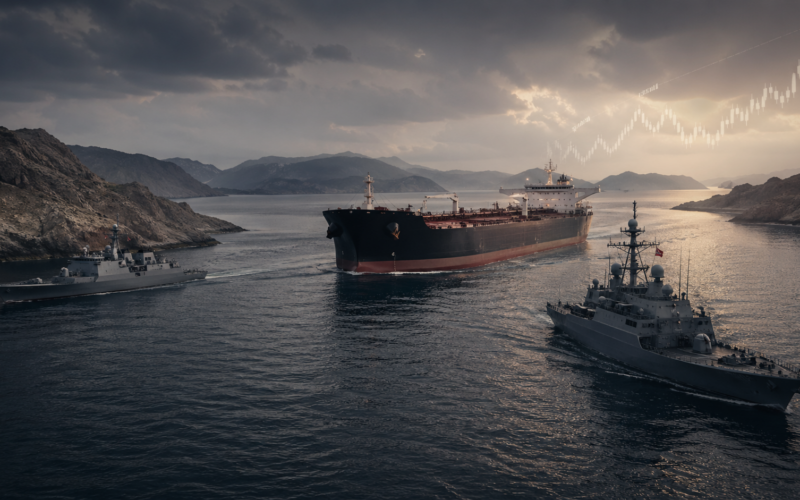
Oil prices climbed sharply on Monday, May 11, 2026, after the United States and Iran failed to bridge their differences on a peace proposal drafted by Washington, leaving the Strait of Hormuz largely closed to commercial shipping and global energy supplies under sustained pressure for the eleventh consecutive week.
United States West Texas Intermediate futures with June delivery advanced 3.08 per cent to 95.42 dollars per barrel. International benchmark Brent crude futures with July delivery rose 3.16 per cent to 104.49 dollars per barrel. The roughly three dollar per barrel jump followed United States President Donald Trump’s outright rejection of Iran’s counterproposal to end the Middle East conflict. In a post on Truth Social, Donald Trump stated that he had just read the response from Iran’s representatives and described it as totally unacceptable. The market reaction reflects a pattern that has defined energy trading since late February, with crude swinging sharply on every signal from Washington, Tehran, and the Pakistani mediation channel.
Why did Israeli Prime Minister Benjamin Netanyahu say the war with Iran was not over despite the ceasefire in place?
Israeli Prime Minister Benjamin Netanyahu added a further bearish layer to the peace prospects in an interview broadcast on the CBS News programme 60 Minutes on Sunday. Benjamin Netanyahu stated that there remained enriched uranium in Iran that had to be taken out, that enrichment sites still needed to be dismantled, that Iran continued to support proxies including remaining forces in Lebanon, and that ballistic missiles were still being produced. Benjamin Netanyahu indicated that diplomacy was the preferred path to removing the enriched uranium but did not rule out the use of force, adding that the work to be done against Iran’s military capabilities had not been completed.
The Israeli position carries significant weight in oil markets because the conflict that began on February 28, 2026, was launched jointly by the United States and Israel. Israel assassinated Iranian Supreme Leader Ali Khamenei in the opening phase of that war, and on March 26, 2026, killed Iran’s top naval commander Alireza Tangsiri, whom Israeli Defence Minister Israel Katz identified as having overseen the blockade of the Strait of Hormuz. Benjamin Netanyahu’s continued insistence that enriched uranium must be removed signals to oil traders that even a United States and Iran deal may not produce a durable cessation of hostilities, since Israel retains the capacity and stated intent to act unilaterally against Iranian nuclear infrastructure. Any renewed Israeli strike would almost certainly trigger fresh Iranian retaliation against shipping in the strait.
How did Iran respond to the latest United States peace proposal delivered through Pakistani mediators in Islamabad?
Iran handed over its response to the latest United States peace proposal on Sunday, May 10, 2026, through mediators in Pakistan, with Pakistani officials confirming receipt and onward delivery to Washington. Iranian state news agency ISNA reported that the main focus of Tehran’s response centred on ending the war and ensuring maritime security in the Persian Gulf and the Strait of Hormuz. The structure of the United States proposal, if accepted, would formally end the war and reopen the strait first, with talks on more contentious issues including the Iranian nuclear programme to follow.
Iran offered to transfer part of its stockpile of highly enriched uranium to a third country but rejected the dismantling of its nuclear facilities. Iran also called for separate nuclear negotiations rather than bundling them into the maritime security and ceasefire framework. Iran reportedly agreed to suspend uranium enrichment for a shorter period than the twenty-year moratorium proposed by the United States.
The gap between the two positions explains the rejection. Washington wants a single comprehensive agreement that ties the reopening of the strait to verifiable dismantlement of Iranian nuclear capability. Tehran wants to separate maritime security from nuclear questions, preserving its enrichment programme as leverage while extracting the lifting of the United States naval blockade on its ports. The geopolitical consequence is that the two-track approach Iran is offering shifts negotiation power back to Tehran in any subsequent nuclear talks, since the immediate economic pressure on Washington from the energy crisis would ease while Iran retains its strategic assets.
What did Iranian President Masoud Pezeshkian say about negotiations with the United States and the path forward?
Iranian President Masoud Pezeshkian took a defiant public posture even as the Pakistani-mediated talks continued. In a post on X, Masoud Pezeshkian stated that Iran would never bow its head before the enemy and that talk of dialogue or negotiation did not mean surrender or retreat. Masoud Pezeshkian added that the goal was to uphold the rights of the Iranian nation and to defend national interests with resolute strength.
The rhetorical posture is consistent with Iranian domestic political requirements following the assassination of Ali Khamenei and the elevation of Mojtaba Khamenei as Supreme Leader. Iranian military chief Ali Abdollahi met Mojtaba Khamenei and received new directives and guidance for the continuation of operations to confront the enemy, according to Iranian state television. The dual messaging, where Masoud Pezeshkian signals openness to indirect dialogue while military leadership receives directives for sustained operations, mirrors the pattern Iran maintained through earlier rounds of failed negotiation, including the Islamabad Talks that collapsed under Vice President JD Vance on April 12, 2026.
What is the current status of the Strait of Hormuz and the United States naval blockade of Iranian ports today?
The Strait of Hormuz has remained largely closed to commercial shipping since February 28, 2026, when Iran responded to the joint United States and Israeli air war by issuing warnings forbidding passage, boarding and attacking merchant ships, and laying sea mines across key transit corridors. The Iranian Revolutionary Guard Corps formally confirmed on March 2, 2026, that the strait was closed to unfriendly nations, allowing only Iran-approved vessels to pass. The United States imposed a counter-blockade on Iranian ports beginning April 13, 2026, after the Islamabad Talks failed under Vice President JD Vance.
Pre-conflict, around 3,000 vessels used the Strait of Hormuz each month, carrying approximately twenty per cent of the world’s seaborne oil trade and a similar share of liquefied natural gas. Transit volumes now stand at around five per cent of pre-war levels. Roughly 2,000 ships remain stranded in the Persian Gulf awaiting passage, and approximately 23,000 seafarers from vessels of 87 countries have been affected by the effective shutdown.
On May 4, 2026, the United States launched Operation Project Freedom, a military operation to restore navigation through the strait. The operation followed the failure of an initial round of peace talks and Donald Trump’s frustration with persistently low traffic despite the fragile ceasefire that had taken effect on April 8, 2026. On May 6, 2026, Donald Trump announced a temporary pause in Project Freedom, citing great progress toward a potential agreement. The Iranian response, delivered four days later, has now stalled that momentum.
How are oil markets responding to the prolonged Strait of Hormuz disruption and the failed United States and Iran talks?
Oil markets have moved through extreme volatility since the war began. Brent crude futures surged to a wartime high of 126 dollars per barrel on April 30, 2026, before retracing on hopes of a deal. Both Brent and West Texas Intermediate contracts have risen around sixty per cent since February 28, 2026. Andy Lipow, president of Lipow Oil Associates, has noted that energy flows through the strait, which carries about a fifth of the world’s oil and liquefied natural gas, remain severely disrupted with roughly 20 million barrels per day of crude, fuels, and petrochemicals affected.
The International Energy Agency has characterised the situation as the largest supply disruption in the history of the global oil market and the greatest global energy security challenge in history. The International Energy Agency separately estimated that the war is removing around 14 million barrels per day from global supply. International Energy Agency members have released 400 million barrels of oil from emergency stockpiles, of which the United Kingdom contributed 13.5 million barrels.
Warren Patterson, head of commodities strategy at the Dutch bank ING, has noted in research that a deal that normalises oil flows through the Strait of Hormuz is crucial, since roughly 13 million barrels per day of disrupted supply is being largely offset by inventory that is clearly declining rapidly. United States National Economic Council Director Kevin Hassett acknowledged on Fox News Sunday Morning Futures that consumers and businesses would face higher costs in the short run, but argued that once the strait was fully opened, a gusher of oil would be released into the market and bring prices down. Kevin Hassett added that reopening the strait could take a month or two.
Why will reopening the Strait of Hormuz take months even after a United States and Iran peace deal is signed?
Even if Washington and Tehran reach an immediate agreement, the operational reopening of the Strait of Hormuz faces structural obstacles that will keep oil prices elevated for an extended period. The Pentagon has informed the United States House Armed Services Committee that fully clearing the strait of mines deployed by the Iranian military could take six months. Mine clearance operations are being conducted by United States Navy guided-missile destroyers USS Frank E Peterson and USS Michael Murphy, joined by underwater drones to detect mines. Pete Hegseth, the United States Defence Secretary, has expressed confidence in the ability to clear identified mines but analysts have warned that sweeping the strait with complete certainty could be a near-impossible task.
Maritime insurers cancelled war-risk insurance for tankers transiting the strait early in the conflict, and the restoration of insurance coverage will be a separate hurdle even after mine clearance. War-risk ship insurance premiums had already increased from 0.125 per cent to between 0.2 and 0.4 per cent of insured value per transit before the strikes began, representing an increase of approximately a quarter of a million dollars for very large oil tankers. Andy Lipow has estimated that it would take at least four to six months for oil markets to stabilise even if hostilities ended immediately, with prices likely to remain elevated as inventories approach critical levels.
What are the regional and global consequences of the continued Strait of Hormuz disruption for Asia and Europe?
The economic spillovers from the prolonged closure now extend well beyond oil. Around eighty-four per cent of crude oil and condensate shipments through the strait in 2024 were destined for Asian markets, with China receiving roughly a third of its oil via the route. Japan sends seventy per cent of its Middle Eastern crude through the strait, and South Korea faces similar exposure. Europe receives between twelve and fourteen per cent of its liquefied natural gas from Qatar through the strait, all of which has been disrupted since QatarEnergy declared force majeure on liquefied natural gas shipments on March 4, 2026, after Iranian attacks on its Ras Laffan facilities.
The Persian Gulf accounts for roughly thirty to thirty-five per cent of global urea exports and around twenty to thirty per cent of ammonia exports, meaning fertiliser markets and global food production costs are also under sustained pressure. United States gasoline prices have risen approximately 1.16 dollars a gallon since the start of the war, with jet fuel in North America spiking ninety-five per cent. Bangladesh, Pakistan, and Vietnam have been among the worst affected economies, with Bangladesh projected to face recession-like conditions on account of fuel shortages.
The United Kingdom and France have hosted two conferences on reopening the Strait of Hormuz, focused on exploring sanctions, diplomatic initiatives, and insurance provision for ships. The British Royal Navy is deploying the destroyer HMS Dragon to the Middle East this week. French President Emmanuel Macron has stated that a planned international mission to secure shipping will not be a military deployment. Iranian Deputy Foreign Minister Kazem Gharibabadi has warned that the presence of French and British vessels or those of any other country cooperating with United States actions in the strait will be met with a decisive and immediate response from the Iranian armed forces.
What are the key takeaways from the United States and Iran failure to agree on a peace proposal and the resulting oil price jump?
- United States West Texas Intermediate futures with June delivery rose 3.08 per cent to 95.42 dollars per barrel and Brent crude futures with July delivery rose 3.16 per cent to 104.49 dollars per barrel on Monday, May 11, 2026, after Donald Trump rejected Iran’s counterproposal as totally unacceptable.
- Iran handed its response to the United States peace proposal to Pakistani mediators on Sunday, May 10, 2026, offering to transfer part of its highly enriched uranium stockpile to a third country but rejecting dismantlement of nuclear facilities and seeking separate nuclear talks.
- Benjamin Netanyahu told CBS News 60 Minutes that the war with Iran was not over and that enriched uranium and enrichment sites still needed to be removed and dismantled, signalling continued Israeli pressure even if Washington and Tehran reach a bilateral agreement.
- The Strait of Hormuz has been largely closed since February 28, 2026, with transit volumes at around five per cent of pre-war levels and approximately 2,000 ships and 23,000 seafarers from 87 countries affected by the shutdown and the United States counter-blockade on Iranian ports.
- The Pentagon estimates it will take up to six months to clear mines laid by Iran in the Strait of Hormuz, meaning oil prices are likely to remain elevated for an extended period even after any peace agreement, with analysts placing the new price floor at 80 to 90 dollars per barrel.
Discover more from Business-News-Today.com
Subscribe to get the latest posts sent to your email.