





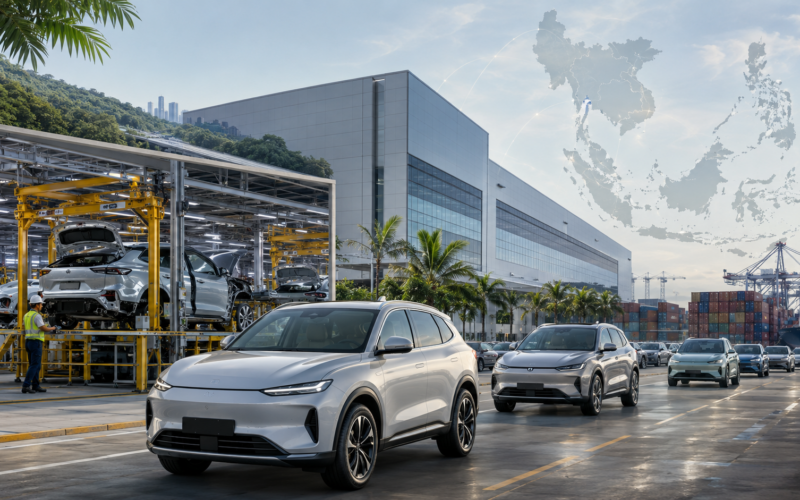
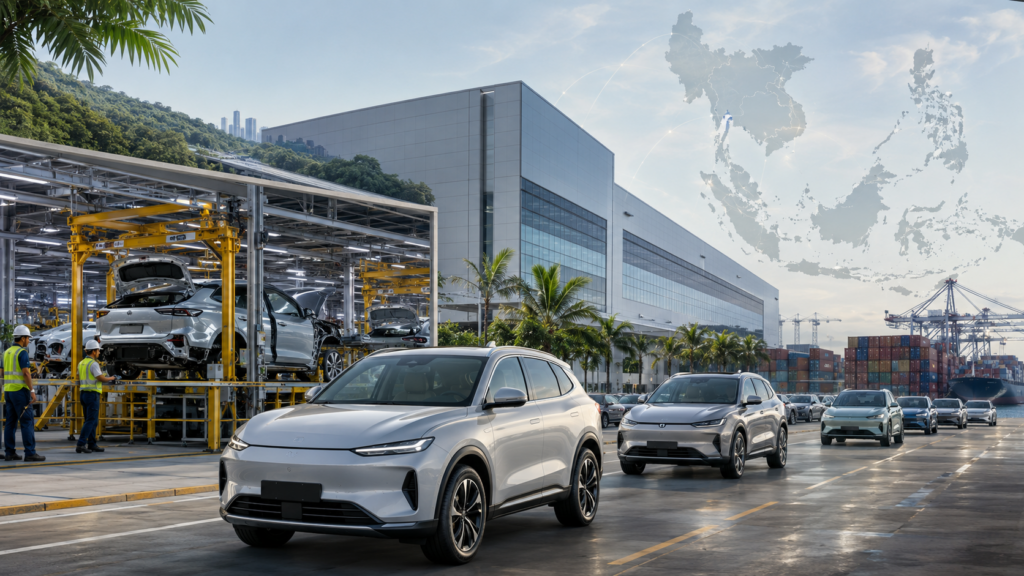
BYD Co. Ltd. (HKEX: 1211; OTCMKTS: BYDDY) has executed one of the most compressed market entry and manufacturing buildouts in modern automotive history across Southeast Asia, moving from zero regional passenger vehicle sales in early 2022 to operating one wholly-owned factory in Thailand, commissioning a second in Indonesia, and recording 1.08 million overseas sales globally in 2025, the first time the company’s international volumes have crossed that threshold. The Shenzhen-based manufacturer entered Thailand in October 2022, Indonesia in January 2024, and Vietnam through a wholly-owned distribution subsidiary, deploying a sequenced strategy that used import-phase sales to establish brand presence before replacing import dependence with local production. In each market the entry model has been consistent: arrive with competitively priced battery electric vehicles, secure government alignment through manufacturing investment commitments, absorb temporary duty exemptions as a subsidy for market development, and convert the resulting scale into a locally manufactured cost advantage that imports can never match. The speed and discipline of that execution have left Japanese incumbents with few strategic responses that can be deployed quickly enough to matter.
How did BYD Co. Ltd. build its Southeast Asia manufacturing footprint faster than any Japanese rival managed in a generation?
The Thailand plant in Rayong Province’s WHA Industrial Estate is the foundational piece of BYD Co. Ltd.’s ASEAN manufacturing architecture. Construction began in March 2023 and the facility was inaugurated on July 4, 2024, coinciding with the production of the company’s eight millionth new energy vehicle globally. BYD Co. Ltd. completed the Rayong plant in just 16 months, a timeline that veteran automotive manufacturing executives across the industry have noted as exceptional for a greenfield, fully integrated facility. The plant spans nearly 960,000 square metres, encompasses stamping, painting, welding, final assembly, and component production, carries an annual capacity of 150,000 vehicles, and employs a workforce that is over 92% Thai nationals. Thailand’s Minister of Industry Pimphattra Wichaikul attended the inauguration ceremony alongside BYD Co. Ltd. chairman and president Wang Chuanfu, a signal of the depth of government alignment the company had secured.
By July 2025, exactly one year after opening, the plant had delivered its 90,000th new energy vehicle. By November 2025, cumulative production had crossed 70,000 units through the rolling line, with the BYD Sealion 6 DM-i plug-in hybrid SUV marking that milestone. In August 2025, the Rayong facility achieved another strategic inflection: it exported its first batch of 959 BYD Dolphin electric vehicles to Europe, specifically to Germany, Belgium, and the Netherlands, transported aboard BYD Co. Ltd.’s own car carrier vessel, the BYD Zhengzhou. That export shipment was not logistically trivial. It represented a deliberate tariff arbitrage move, since China-made BYD vehicles face a 20.7% additional European Union anti-subsidy tariff on top of the existing 10% customs duty, while Thai-manufactured vehicles face no such surcharge. By 2025, the Thai plant had exported 10,250 units to Europe, ASEAN, and Oceania, confirming its role as a regional export hub rather than a domestic assembly centre alone.
In Thailand’s domestic market, BYD Co. Ltd.’s momentum has been equally striking. In the first half of 2025, BYD Co. Ltd. sold 24,072 vehicles in Thailand, a 64.1% increase year on year, making it approximately four times the volume of its nearest rival MG. In June 2025, BYD Co. Ltd. became Thailand’s second-best-selling car brand overall, overtaking Honda Motor Co. Ltd. with an 11.9% market share, a result that would have been considered implausible when the brand entered the country less than three years earlier.
What does BYD Co. Ltd.’s Indonesia entry and Subang plant commissioning mean for the region’s largest auto market?
Indonesia presented a structurally different and more complex challenge than Thailand. Cheap subsidised fuel at approximately 0.61 US dollars per litre, a motorcycle fleet estimated between 132 million and 150 million units, deep Japanese OEM entrenchment across every segment, and a consumer base with limited EV infrastructure familiarity all made Indonesia a market where BYD Co. Ltd. could not simply replicate the Thai playbook. The company’s response was to sequence the entry carefully, launch with three proven models simultaneously, secure a strong local distribution partner in the Arista Group, and move immediately toward local manufacturing to lock in the government policy alignment that imported-only brands could not access.
BYD Co. Ltd. entered the Indonesian market in January 2024, launching the Seal, Dolphin, and Atto 3. The M6 electric MPV followed in July 2024 at the GAIKINDO Indonesia International Auto Show, becoming the brand’s top-selling model in the initial phase. The Atto 1, launched in July 2025, produced the most dramatic single-month performance in Indonesian automotive retail history. Association of Indonesian Automotive Industries (GAIKINDO) wholesale data recorded the BYD Atto 1 as the best-selling vehicle model in the country in October 2025, posting 9,396 units and displacing the Toyota Kijang Innova, which had held a dominant position in the charts for years. The Atto 1 repeated that result in November 2025 with 8,333 units. For the full year 2025, GAIKINDO data shows BYD Co. Ltd. delivered 46,711 units wholesale in Indonesia, with the Atto 1 accounting for 22,582 of those, making BYD Co. Ltd. the sixth best-selling manufacturer in Indonesia less than two years after market entry.
The Subang manufacturing plant is the structural underpinning of everything that follows. Confirmed by Indonesia’s Investment Minister Rosan Roeslani and its Coordinating Minister for Economic Affairs Airlangga Hartarto, the facility sits on 126 hectares of the Subang Smartpolitan industrial estate in West Java, carries an investment value of approximately 1.3 billion US dollars, and is designed for an annual production capacity of 150,000 electric vehicles. BYD Co. Ltd.’s president director for Indonesia, Eagle Zhao, confirmed the plant was on track and targeting first-quarter 2026 production commencement. S&P Global Mobility analysis projects that combined NEV output by Chinese manufacturers in ASEAN will account for 68% of the region’s total NEV production by 2030, up from 20% in 2024. The Subang plant is the single largest contributor to that trajectory.
How is BYD Co. Ltd. using Southeast Asia as a global export platform beyond just serving regional demand?
The strategic architecture BYD Co. Ltd. has built in Southeast Asia is not designed to serve ASEAN alone. It is designed to serve the world from ASEAN. The Thai plant’s European export programme, the Cambodian assembly facility capable of processing 20,000 units annually for local and export markets, and the Indonesian plant’s stated long-term export ambitions collectively describe a manufacturer using Southeast Asia as a distributed global production network that sidesteps tariff barriers in Europe, avoids the diplomatic friction of exporting directly from China, and positions the company closer to the supply chains and consumer markets of the Asia-Pacific.
BYD Co. Ltd.’s general manager of branding and public relations, Li Yunfei, confirmed that the company’s overseas sales target for 2025 was 800,000 to one million units, against projected total sales of 4.6 million, representing a target overseas penetration of approximately 20% compared to less than 10% in 2024. The company exceeded that target, with overseas sales topping one million units for the full year 2025, a 150.7% increase from the prior year. Chairman and president Wang Chuanfu has publicly set a goal of 50% overseas sales contribution by 2030. At current domestic market scale, that implies overseas volumes approaching two million units annually within five years, a figure that would make BYD Co. Ltd. one of the largest vehicle exporters in the world by any measure.
Southeast Asia is central to that ambition. S&P Global Mobility data confirms that among China’s three largest vehicle exporters, Chery Automobile Co. Ltd., BYD Co. Ltd., and SAIC Motor Corp. Ltd., overseas production output still accounted for only 5% of total output in 2024, meaning the localisation of production is still in its early stages relative to what the investment commitments imply for 2026 through 2030. The ramp-up of both the Thai and Indonesian plants in 2025 and 2026 is where that ratio begins to shift materially.
What are the risks to BYD Co. Ltd.’s Southeast Asia strategy that investors and industry analysts should monitor?
No expansion at this pace is without execution risk, and BYD Co. Ltd.’s ASEAN strategy carries several that deserve clear-eyed assessment. The first is policy dependency. The Indonesian and Malaysian governments have both signalled the expiry of full import EV tax exemptions, with Indonesia’s incentives for fully built imported EVs ending at the end of 2025 and Malaysia’s tax exemptions for fully imported EVs ending on January 1, 2026. These policy transitions were known and factored into the localisation timeline, but any reversal, delay, or tightening of local content requirements could alter the economics of the manufacturing investment.
The second is domestic margin pressure. BYD Co. Ltd. chairman Wang Chuanfu acknowledged at an extraordinary shareholders’ meeting in December 2025 that the company’s technological lead is no longer as pronounced as in prior years, that homogenisation across the Chinese NEV market is increasing, and that gross margin had dropped from 22% in 2024 to approximately 20% in early 2025, with certain models falling to 14 to 16%. Rising inventory in China, which reached 154.4 billion renminbi by Q1 2025, and five consecutive months of year-on-year domestic sales declines from July through November 2025 indicate that the company is relying on overseas markets not just for growth but as a margin stabiliser. That creates a structural incentive to keep ASEAN pricing competitive even at the cost of margin, which is good for market share in the short term but creates vulnerability if a demand shock or currency movement in a key ASEAN market hits simultaneously.
The third risk is geopolitical scrutiny. The US Trade Representative’s Office opened an investigation into whether Southeast Asia was being used as a final assembly point for Chinese EVs to circumvent American tariffs, specifically examining BYD Co. Ltd.’s Thai operations. BYD Co. Ltd. formally denied shipping any Thai-made vehicles to the United States, with Liu Xueliang, general manager of Asia-Pacific Auto Sales, confirming zero US shipments from the Rayong plant. The investigation has not produced enforcement action as of early 2026, but the precedent of trade scrutiny applied to third-country manufacturing is one that could complicate future export strategy if political conditions shift.
Key takeaways: What BYD Co. Ltd.’s Southeast Asia expansion means for the regional auto industry, competitors, and investors
- BYD Co. Ltd. built its Rayong, Thailand plant in 16 months from groundbreaking to inauguration, producing 90,000 vehicles in its first year of operation, a buildout timeline that no Japanese OEM has matched in the region in recent memory.
- GAIKINDO wholesale data confirmed the BYD Atto 1 as Indonesia’s best-selling vehicle model in October and November 2025, the first time a non-Japanese model had led the country’s charts, arriving less than two years after BYD Co. Ltd. entered the market.
- The Subang plant in West Java, commissioned in early 2026 with a 1.3 billion dollar investment and 150,000 units of annual capacity, converts BYD Co. Ltd. from an imported brand into Indonesia’s largest single-brand EV manufacturer before its third year in the market.
- BYD Co. Ltd.’s Thai plant exported 10,250 vehicles to Europe, ASEAN, and Oceania in 2025, using Thai origin status to avoid the European Union’s 20.7% additional anti-subsidy tariff applied to China-made BYD vehicles.
- BYD Co. Ltd. surpassed one million overseas sales in 2025 for the first time, a 150.7% increase year on year, with Southeast Asia the largest single regional contributor to that volume.
- S&P Global Mobility projects that Chinese manufacturers will account for 68% of total NEV production across ASEAN by 2030, up from 20% in 2024, with BYD Co. Ltd.’s two ASEAN plants as the anchor of that trajectory.
- Chairman Wang Chuanfu’s public target of 50% overseas sales by 2030 implies BYD Co. Ltd. approaching two million units of annual overseas volume, a figure that would position it among the world’s largest vehicle exporters.
- Gross margin compression in China, five consecutive months of domestic sales declines in mid-2025, and rising inventory signal that BYD Co. Ltd. is increasingly reliant on ASEAN and other overseas markets as a profitability stabiliser, not merely a growth channel.
- US trade scrutiny of BYD Co. Ltd.’s Thai operations for potential tariff circumvention represents a geopolitical risk to the regional export model that investors should monitor through 2026.
- Japanese OEMs have no comparable response asset in the region: no Chinese brand-equivalent EV lineup at accessible price points, no new greenfield manufacturing investment pipeline of equivalent scale, and no product architecture that matches BYD Co. Ltd.’s vertical integration advantage on battery cost.
Share this:
Discover more from Business-News-Today.com
Subscribe to get the latest posts sent to your email.

