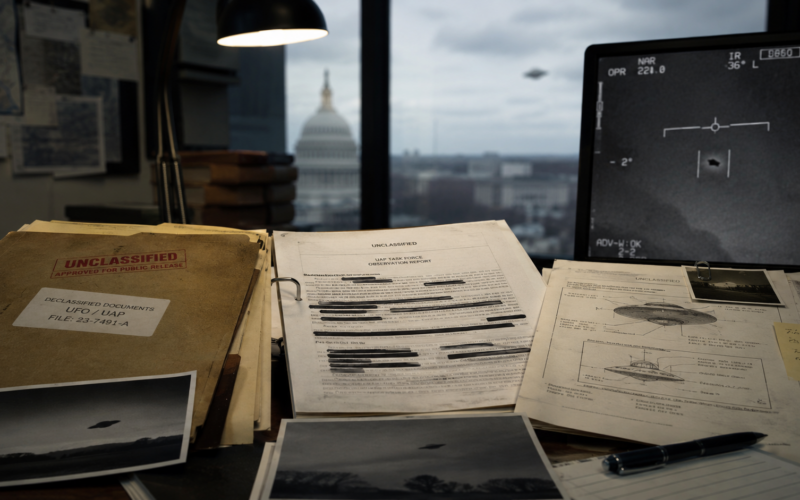
President Donald J. Trump’s administration has released the first batch of previously classified United States government files on unidentified anomalous phenomena, moving one of America’s most persistent secrecy debates from the realm of speculation into a new official disclosure process.
The release, announced on May 8, 2026, by the Department of War, covers a new set of declassified records, images, videos and source documents linked to unidentified anomalous phenomena, the official term now used for what the public has long called unidentified flying objects or UFOs. The files have been placed on a dedicated government website under the Presidential Unsealing and Reporting System for UAP Encounters, known as PURSUE.
The political importance of the release lies not in any confirmed evidence of extraterrestrial life, but in the administration’s decision to centralize and publish material that had previously been scattered across classified holdings, agency archives and long-running public records disputes. The Department of War has said this is only the first stage of a rolling disclosure process involving several parts of the United States government.
The initial release includes historical and recent material from across the federal system, including records linked to the Department of War, the Office of the Director of National Intelligence, the Department of Energy, the All-domain Anomaly Resolution Office, the National Aeronautics and Space Administration, the Federal Bureau of Investigation and other intelligence components.
What exactly did Donald Trump’s administration release in the first batch of UFO files?
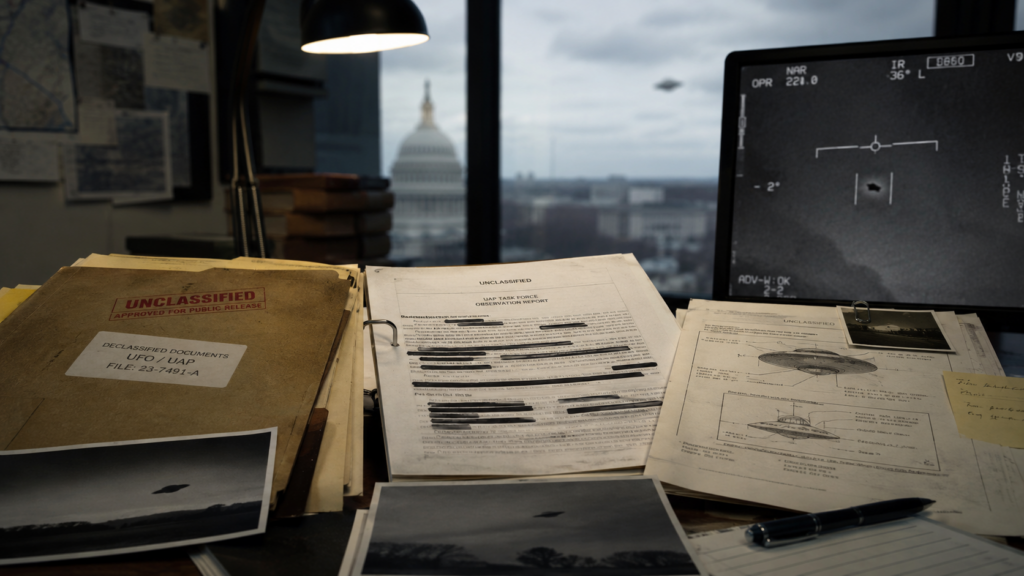
The May 8 release opened public access to a group of declassified files related to unidentified anomalous phenomena, including videos, photographs, original documents and historical records. The Department of War described the publication as an initial release, meaning the archive is expected to expand as more material is reviewed and declassified.
The records include material connected to earlier United States space missions, historical sightings and military or civilian reports of unexplained objects. Public reporting on the release noted that the files include Apollo mission material, older government documents, flight transcripts and incident accounts stretching across several decades.
Among the documents that attracted immediate attention were materials linked to NASA missions and older aerial sightings. Reports highlighted an Apollo 12 lunar mission image from 1969 described as showing unidentified phenomena and an Apollo 17 transcript from 1972 in which pilot Ronald Evans described seeing bright fragments while the spacecraft was maneuvering.
The release also includes material involving older aviation accounts, including a 1947 report involving Pan American World Airways crew members who described seeing a bright orange object that disappeared quickly. More recent documents include an FBI interview linked to a 2023 drone pilot report involving a bright linear object that appeared briefly before vanishing.
The government’s own framing is careful. The Department of War has stated that the files were reviewed for security purposes, but many of the materials have not yet been analyzed to resolve the underlying anomalies. That distinction is central to the story. Declassification means the public can see more of the record. It does not mean the government has reached a scientific conclusion on every sighting.
Why does the Department of War say the UFO file release is part of a wider transparency effort?
The Department of War has presented the release as part of a broader transparency initiative ordered by President Donald J. Trump. The new archive is designed to allow the public to access declassified material from multiple federal agencies in one place, rather than relying on fragmented disclosures, congressional hearings, Freedom of Information Act litigation or unofficial document collections.
Secretary of War Pete Hegseth said the files had remained behind classifications for years and that the public should now be able to examine them directly. Director of National Intelligence Tulsi Gabbard said the intelligence community was coordinating with the Department of War on a careful review of government holdings. FBI Director Kash Patel said the Federal Bureau of Investigation would support the rolling declassification process. NASA Administrator Jared Isaacman said NASA would continue to rely on data, scientific instruments and open communication about what is known and unknown.
Those institutional positions matter because the subject touches several layers of government: national security, military aviation, intelligence collection, space science, public records law and congressional oversight. A sighting near military aircraft can raise airspace safety concerns. A historical intelligence document can raise classification questions. A NASA transcript can raise scientific interpretation questions. A congressional demand for disclosure can raise democratic accountability questions.
The release therefore sits at the intersection of public curiosity and institutional caution. The United States government is not presenting the archive as proof of extraterrestrial life. It is presenting the archive as a transparency mechanism for records that have long been associated with secrecy, speculation and distrust.
Why does the first UFO file release not settle the extraterrestrial life debate?
The first release does not settle the debate because unidentified anomalous phenomena are not the same as confirmed alien technology. A phenomenon can remain unexplained because the data is incomplete, the sensor quality is poor, the witness observation was brief, the object was misidentified, or the event cannot be reconstructed with confidence years later.
That distinction has been emphasized in earlier United States government reviews. The All-domain Anomaly Resolution Office has previously stated that it has found no verifiable evidence that the United States government or private industry has possessed extraterrestrial technology. The 2024 historical review also concluded that many UAP claims could be explained by ordinary objects, misidentification, incomplete data or long-running cultural narratives about hidden alien programs.
The May 8 release does not erase that earlier position. Instead, it gives the public more raw material to inspect while leaving many cases unresolved. For researchers, journalists and public policy professionals, the value of the archive may lie less in any single dramatic image and more in the way the United States government documents, classifies, reviews and communicates unexplained reports.
This is why the release is likely to generate two different reactions at once. Disclosure advocates will see it as a long-overdue opening of records. Skeptics will see it as a politically useful release of ambiguous material that does not answer the central alien life question. Both reactions can coexist because the release is a transparency event, not a conclusive scientific finding.
Why has the UFO disclosure issue become politically significant in Washington?
The UFO disclosure issue has become politically significant because it gives lawmakers and the public a rare convergence point across national security, public trust and institutional accountability. In recent years, unidentified anomalous phenomena have moved from fringe debate into congressional hearings, defense reporting requirements and formal government review structures.
Members of Congress have pressed for more information about what the government knows, how sightings are investigated and whether agencies have withheld relevant records. Some lawmakers who support broader disclosure have welcomed the May 8 release and signaled that additional material may follow. The administration’s decision to publish the files under a named disclosure system gives the issue a more formal policy structure.
The political risk is that every disclosure also raises expectations for the next disclosure. If the first batch contains ambiguous records rather than definitive answers, public pressure may shift toward demands for more complete files, fewer redactions and clearer explanations of unresolved cases. If future releases contain more sensitive national security material, agencies may face renewed tension between transparency and protection of intelligence methods, military systems or classified collection capabilities.
The administration is also operating in a highly polarized environment. Critics have already argued that the UFO release could distract from other controversies facing President Donald J. Trump’s administration. Supporters have framed the release as a public accountability move that previous administrations failed to complete. The result is a disclosure process that is both a records issue and a political communications event.
What does the UFO file release mean for NASA, the FBI and United States intelligence agencies?
The release places NASA, the Federal Bureau of Investigation and United States intelligence agencies inside a more visible public process. NASA’s role is important because historical space mission transcripts and imagery are among the materials that attract the greatest public attention. The Federal Bureau of Investigation’s role is important because some unexplained sightings or reports enter the federal record through interviews, investigations or security-related inquiries. The Office of the Director of National Intelligence is important because UAP records can overlap with classified intelligence holdings.
The Department of Energy’s inclusion is also notable because some historical UAP interest has involved claims or sightings near sensitive facilities, including nuclear or energy-related sites. The involvement of multiple agencies suggests that the archive is not limited to one defense office or one category of military sightings.
For the public, a centralized website reduces the complexity of finding documents. For agencies, it creates a visible benchmark against which future disclosure can be judged. If the archive grows steadily, the administration can point to a continuing transparency process. If the release slows or becomes heavily redacted, critics may argue that the process is incomplete.
The larger institutional test is whether the government can explain uncertainty without inflaming speculation. Many UAP records are likely to remain difficult to interpret. Some may involve insufficient data. Some may involve classified sensor capabilities. Some may involve ordinary objects that were unusual only because of viewing conditions. A credible disclosure process will depend on whether agencies can separate unresolved cases from unsupported claims.
Why could the first UFO files release shape future public trust in classified records?
The May 8 release could shape public trust because it reflects a broader question facing democratic governments: how much classified historical material should remain secret when the public interest is high and immediate security risks may have changed.
UFO records are unusually powerful in public culture because they combine science, secrecy, military authority and mystery. For decades, the absence of full disclosure has allowed competing narratives to grow. Some people believe the government has hidden extraordinary information. Others believe the government has allowed ambiguity to become a substitute for evidence. The new release does not end that divide, but it changes the available evidence base.
The most important consequence may be procedural. If the Presidential Unsealing and Reporting System for UAP Encounters becomes a stable archive with rolling releases, it could become a model for how other sensitive historical records are handled. If the process becomes politicized or selective, it could deepen mistrust.
For journalists and researchers, the release creates a new public record to examine. For policymakers, it creates a new oversight trail. For the public, it turns a long-running secrecy debate into a searchable government archive. The deeper question is whether transparency can satisfy a public that wants certainty from records that may only provide fragments.
What are the key takeaways from Donald Trump’s UFO file release and the new PURSUE archive?
- The Department of War released the first batch of previously classified United States government files on unidentified anomalous phenomena on May 8, 2026.
- The files are being housed under the Presidential Unsealing and Reporting System for UAP Encounters, known as PURSUE.
- The release involves several federal entities, including the Department of War, the Office of the Director of National Intelligence, NASA, the FBI and the Department of Energy.
- The Department of War has said additional UAP files will be released on a rolling basis after further review and declassification.
- The initial release does not confirm extraterrestrial life or alien technology, and many materials have not yet been analyzed to resolve the reported anomalies.
Discover more from Business-News-Today.com
Subscribe to get the latest posts sent to your email.