

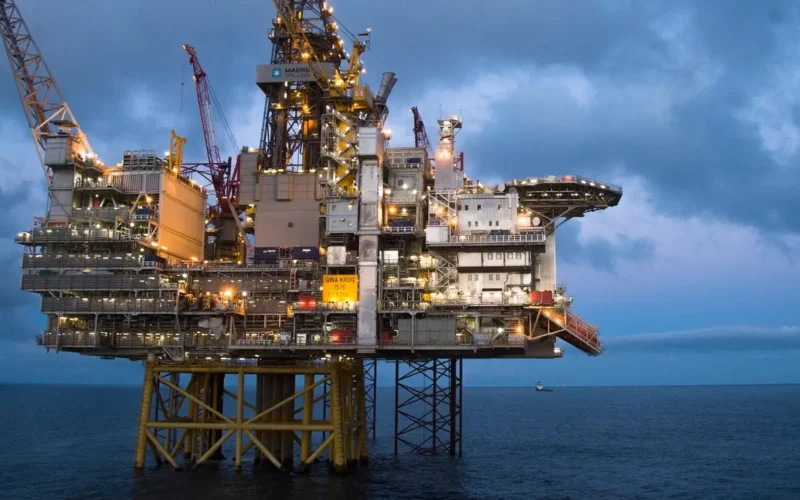
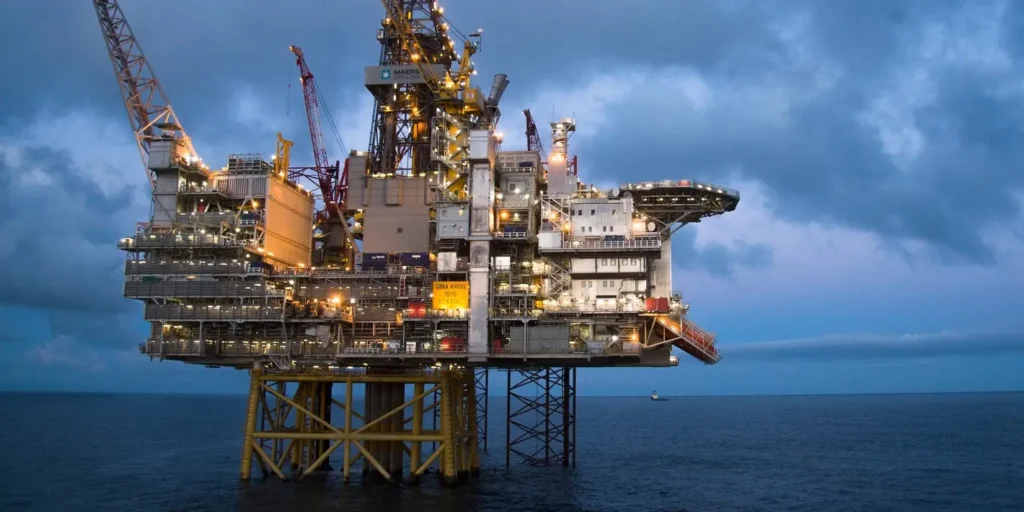
Equinor ASA (NYSE: EQNR) and partner ORLEN Upstream Norway AS have started production at the Eirin field in the North Sea, with first gas now flowing to European buyers via the Gina Krog and Sleipner A platforms. The development carries expected recoverable resources of about 27.6 million barrels of oil equivalent, predominantly gas, and was brought from project sanction to first production in roughly three years at total estimated investment of NOK 4.5 billion. Eirin extends the economic life of the Gina Krog platform from 2029 to 2036, adding seven years of production runway to a key Norwegian Continental Shelf asset. The start-up arrives as Equinor shares trade around USD 41 on the New York Stock Exchange, near the upper end of a 52-week range of roughly USD 22 to USD 43, and one day before the company’s first-quarter 2026 results are scheduled for release. For a field originally proven in 1978 and shelved as uneconomic for four and a half decades, the timing is the entire story.
Why is a 1978 discovery suddenly central to Europe’s 2026 gas security strategy?
Eirin sat dormant on Equinor’s books for forty-five years because the economics did not support a standalone development. What changed was not the geology but the geopolitics. After Russia’s full-scale invasion of Ukraine reshaped European pipeline flows, Norwegian gas moved from being one of several supply options to becoming the single largest pipeline source feeding the continent, currently delivering around 100 billion cubic metres per year. Equinor and its partners reassessed the discovery in 2023 against that altered backdrop, sanctioned the project, and have now delivered first gas inside three years. The reassessment frame is important. This is not exploration success. It is portfolio reactivation, and it signals how aggressively operators on the Norwegian shelf are now mining their own legacy data for fast, low-risk production additions that can be tied back to existing host platforms.
The European demand context sharpens the strategic logic further. Dutch TTF front-month gas was trading at roughly 47 EUR per megawatt hour in early May 2026, down from peaks above 70 EUR per megawatt hour in March but still around 34 percent higher than a year earlier. The Strait of Hormuz has been effectively closed since late February as a result of the ongoing Iran conflict, removing about a fifth of global LNG supply from the market and forcing European buyers to compete more aggressively for cargoes ahead of the storage refill season. In that environment, every additional unit of Norwegian pipeline gas reduces marginal LNG demand, eases the storage-injection bill for European utilities, and partially insulates Italian and German power markets from gas-driven electricity price spikes that have repeatedly pushed day-ahead power above 120 EUR per megawatt hour during the current crisis. Eirin alone is too small to move the macro balance. The template it represents is not.
What does the Eirin development model tell us about the future of the Norwegian Continental Shelf?
The interesting number in the Equinor announcement is not 27.6 million barrels of oil equivalent. It is 4.5 months and three years. Equinor matured the project from initiation to investment decision in four and a half months, and from project establishment to first gas in three years. For comparison, large greenfield offshore projects routinely run seven to ten years from discovery to first production. The Eirin model strips that timeline by leveraging three structural advantages: a subsea template tied back to an existing host platform, reuse of mature technology rather than novel engineering, and standardised solutions that compress the front-end engineering cycle. The licence partnership of Equinor at 58.7 percent and ORLEN Upstream Norway at 41.3 percent then ran the project through a decision-making process designed to avoid the committee-driven delays that have historically inflated North Sea capital costs.
This matters because the Norwegian Continental Shelf faces a structural production cliff over the next decade as legacy fields enter steep decline. The Norwegian Petroleum Directorate’s own production curves require operators to bring forward smaller, marginal discoveries to defend output. Eirin demonstrates that the subsea tie-back model can do this profitably even at modest reserve sizes, provided host-platform infrastructure already exists and has spare processing capacity. Gina Krog now becomes a more valuable asset because of Eirin, not just for the seven additional years of life but for the optionality the platform provides as a future host for further satellite tie-ins. The same logic extends to other late-life Norwegian hubs including Snorre, Statfjord, and the broader Sleipner area. Linda Kåda Høiland’s appointment as vice president for Statfjord in Equinor’s Exploration and Production Norway division aligns directly with this thesis. Late-life and marginal-field economics are now a strategic priority area, not an afterthought.
The execution risk is also worth naming. Subsea tie-back projects depend entirely on the integrity and availability of the host platform. Any unplanned outage at Gina Krog or downstream at Sleipner A propagates immediately into Eirin’s revenue stream. The standardised solutions that compressed delivery time can also create concentration risk if multiple satellite developments share common components and a single supplier failure cascades. None of these risks are unique to Eirin, but they shape the reality that fast, capital-light development comes with operational interdependencies that did not exist in the era of standalone platforms.
How does Eirin fit into Equinor’s capital allocation thesis ahead of first-quarter results?
Equinor reports first-quarter 2026 results on Tuesday May 6, and the Eirin start-up effectively front-runs the production narrative the company will want to anchor in that release. The strategic story Equinor has been telling investors over the last eighteen months is one of capital discipline, with the company reducing its 2030 renewable installed capacity target from 12 to 16 gigawatts down to 10 to 12 gigawatts, and divesting or trimming positions in Scatec ASA and adjacent renewable assets. The pivot is not away from energy transition but toward higher-return oil and gas barrels in the near term, with renewable build-out paced more conservatively to protect cash distributions. Eirin sits squarely inside this thesis. It is a relatively small absolute investment that extends the cash-generation life of an existing platform, requires no new exploration risk, and benefits from European gas prices that remain elevated by historical standards.
The market reaction to the recent capital allocation shift has been broadly constructive but not uniformly bullish. Equinor’s NYSE-listed shares are up significantly over the past year and trading near 52-week highs, but consensus analyst price targets cluster around USD 37 with a Hold rating, implying that the recent rally has already priced in much of the Norwegian gas premium narrative. Some analyst commentary has flagged concerns about earnings sensitivity if Brent moves toward USD 50 per barrel, the Norwegian tax structure compressing free cash flow, and dividend coverage in a sustained lower-price scenario. Eirin does not resolve these concerns, but it does add a tangible operational data point that Equinor can convert marginal discoveries into revenue inside three years at scale-replicable economics. For a company whose investment case rests heavily on demonstrating capital efficiency, that is a useful evidence point heading into earnings.
The CO2 intensity figure of around 3 kilograms per barrel of oil equivalent produced, achieved because Gina Krog was electrified in 2023, also matters for the European customer base. Several large European utilities and industrial gas buyers now apply scope-three carbon screens to their long-term supply contracts, and Norwegian gas with sub-5 kilogram CO2 per barrel intensity is among the lowest-emission hydrocarbon supply available globally. This is a quiet competitive moat that becomes more valuable as European carbon pricing under the EU Emissions Trading System and the Carbon Border Adjustment Mechanism continues to bite into less efficient supply sources.
What does Eirin signal about the broader North Sea investment cycle and competitive landscape?
The Eirin start-up arrives at a moment when North Sea capital allocation decisions are being made under conflicting pressures. On one side, European demand for low-emission, geographically secure pipeline gas is structurally elevated and will remain so through at least the late 2020s, with Kpler and ABN AMRO forecasts both pointing to TTF averaging in the high single-digit to low double-digit dollars per million British thermal units range through 2026 and beyond. On the other side, oil price expectations have softened, with several investment houses forecasting Brent at USD 50 to 55 per barrel in 2026, and global oversupply scenarios pushing oil-linked valuations lower. Operators with gas-heavy Norwegian portfolios benefit from this divergence in ways that pure oil producers do not.
For ORLEN Upstream Norway, the Polish state-controlled energy group’s local upstream subsidiary, Eirin is a meaningful production addition that strengthens its position as a European gas supplier with Norwegian-sourced volumes. Poland has been one of the most aggressive European buyers of non-Russian gas since 2022, and ORLEN’s continued investment in Norwegian production capacity is a vertical-integration play that reduces its exposure to spot LNG markets. The ORLEN stake at 41.3 percent of Eirin is consistent with a wider strategic pattern in which Central and Eastern European utilities are taking direct equity positions in Norwegian gas production rather than relying solely on long-term offtake contracts.
The competitive read-through to peer operators is also clear. Aker BP, Vår Energi, and Shell on the Norwegian shelf are all running similar marginal-field reactivation programmes, and Eirin sets a public benchmark on delivery speed that will be hard to ignore in investor presentations. Operators who cannot match three-year cycle times on subsea tie-backs will face questions about engineering capability, supply-chain management, and decision-making efficiency. The bar has effectively been reset.
How should investors and policymakers read the Eirin start-up in the context of Europe’s gas trajectory?
Eirin is not, on its own, an answer to Europe’s gas security question. The 27.6 million barrels of oil equivalent represents a small fraction of annual European gas demand, and the field will deplete over its production life like any other. The signal value lies elsewhere. Europe’s strategy for the rest of this decade increasingly depends on three pillars: maximising Norwegian pipeline production, attracting LNG cargoes in competition with Asian buyers, and building enough storage and renewable capacity to handle the demand-side gap. The first of those pillars depends entirely on whether Norwegian operators can keep adding barrels faster than legacy fields decline. Eirin shows that the playbook for doing so exists and works.
The policy implication for European energy ministries is that supply security is being delivered, in part, through quietly sanctioned marginal-field projects on the Norwegian shelf rather than through dramatic new infrastructure announcements. The corollary is that any disruption to Norwegian production, whether through unplanned outages, labour disputes such as the recent breakdown of wage talks between Norwegian oil firms and unions, or sabotage of subsea infrastructure, would have outsized impact on European energy balances. Norway’s role has shifted from important supplier to systemically critical supplier, and the risk management frame around that role has not yet caught up to the new reality.
For Equinor shareholders heading into first-quarter results, Eirin reinforces the narrative of disciplined capital allocation delivering tangible production additions on compressed timelines. It does not change the fundamental debate about Equinor’s renewables strategy, dividend sustainability in a lower oil price environment, or the gradual decline of Norwegian total production volumes over the next decade. But it does provide a useful data point that the company’s near-term execution capability remains strong, which is what the market wants to hear when commodity price tailwinds may be fading.
Key takeaways on what Eirin start-up means for Equinor, ORLEN, and European gas markets
- Eirin’s three-year cycle from project sanction to first gas establishes a new benchmark for marginal-field development on the Norwegian Continental Shelf and pressures peer operators to match delivery speed.
- The field extends Gina Krog’s economic life from 2029 to 2036, materially altering platform-level economics and creating optionality for further satellite tie-ins in the Sleipner area.
- Equinor’s NYSE-listed shares trading near 52-week highs around USD 41 reflect a rerating tied to Norwegian gas premium narratives, but consensus price targets near USD 37 suggest much of that premium is already priced in.
- European gas markets remain structurally sensitive to Norwegian supply, with TTF prices around 47 EUR per megawatt hour still elevated by 34 percent year-on-year and the Strait of Hormuz blockade tightening LNG availability.
- Equinor’s CO2 intensity of around 3 kilograms per barrel of oil equivalent at Eirin, enabled by Gina Krog electrification, strengthens its position with European buyers applying scope-three carbon screens to long-term contracts.
- ORLEN Upstream Norway’s 41.3 percent stake reflects a broader Central and Eastern European utility pattern of taking direct equity in Norwegian production rather than relying solely on LNG offtake contracts.
- Marginal-field reactivation, not new exploration, is now the dominant production-addition mechanism on the Norwegian shelf, with implications for service contractors, subsea technology suppliers, and decommissioning timelines.
- Norway’s role in European energy security has shifted from important to systemically critical, raising the strategic stakes around any disruption to Norwegian production whether from outages, labour action, or geopolitical risk.
- Equinor’s Q1 2026 earnings release on May 6 will frame Eirin within a broader capital discipline narrative, with investor focus likely on free cash flow generation, dividend coverage, and the trajectory of the renewables divestment programme.
- The execution model behind Eirin, standardised subsea tie-backs to existing hosts with mature technology reuse, is replicable across multiple late-life Norwegian hubs and represents a structural advantage Equinor can press through the rest of the decade.
Share this:
Discover more from Business-News-Today.com
Subscribe to get the latest posts sent to your email.