




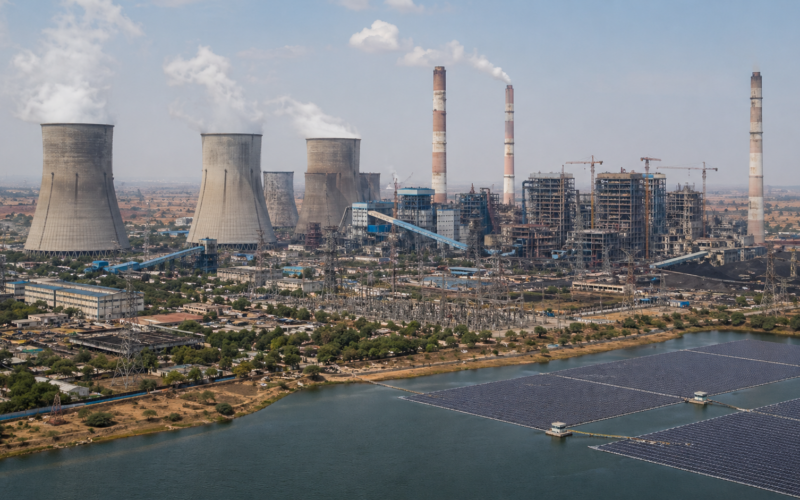
NTPC Ramagundam Super Thermal Power Station, widely referenced by its operating shorthand RSTPS, sits at Jyothi Nagar in the Peddapalli district of Telangana and remains the single largest power station in southern India. The plant is a pit-head coal-fired complex co-located with the Singareni coalfields, and it was conceived in the late 1970s as the southern anchor of NTPC’s national thermal build-out. Its strategic relevance has not faded with age. Even as renewables capacity expands across the Deccan, RSTPS continues to underwrite baseload supply for Telangana, Andhra Pradesh, Tamil Nadu, Karnataka, Kerala, Goa and Puducherry, and it has now been chosen as the host site for one of NTPC’s largest near-term supercritical expansions. The combination of an aging thermal core, a fully commissioned floating solar overlay and a fresh 2,400 MW supercritical phase under construction makes Ramagundam one of the most analytically interesting power assets on the National Stock Exchange and BSE for investors tracking NTPC Limited (NSE: NTPC, BSE: 532555) and its principal contractor Bharat Heavy Electricals Limited (NSE: BHEL, BSE: 500103).
How big is NTPC Ramagundam and why does it matter to South India
NTPC Ramagundam is a coal-fired super thermal power station with a current installed thermal capacity of 2,600 MW spread across three stages and seven units, plus a 100 MW floating solar photovoltaic overlay that takes the integrated installed capacity at the site to 2,710 MW. It is the first ISO 14001 certified Super Thermal Power Station in India, and it has been positioned by NTPC Limited as a benchmark performance station within its internal fleet. Strategically, the project sits at the intersection of three structural pressures shaping Indian power. First, it provides dispatchable, pit-head coal-fired power into a southern grid that remains short on firm capacity despite rapid solar additions. Second, it has been chosen as the location for the Telangana Super Thermal Power Project, NTPC Limited’s flagship pit-head ultra-supercritical and supercritical build, which is being executed as a phased 4,000 MW expansion. Third, the floating solar photovoltaic plant on the balancing reservoir has turned the same site into one of NTPC Limited’s most visible decarbonisation showcases. The result is a single industrial footprint that simultaneously supports baseload coal generation, large-scale renewable integration and a multi-decade thermal expansion pipeline.

Who owns and operates RSTPS and which states draw power from it
The project is fully owned and operated by NTPC Limited, India’s largest integrated power utility and a Maharatna central public sector enterprise. There is no joint venture partner at the asset level, and ownership has been stable since commissioning. The 100 MW Ramagundam Floating Solar Power Plant, although commercially aggregated into NTPC Limited’s renewables portfolio and increasingly tracked under NTPC Renewable Energy Limited, was constructed at the same site on the plant’s balancing reservoir and is also a wholly owned NTPC Limited asset. The principal external counterparties are therefore not equity partners but contractors and fuel suppliers. Singareni Collieries Company Limited supplies thermal-grade coal to the station, with a long-term plan under which the coal miner ensures supplies of around five million tonnes a year, primarily through the Adriyala mine in the Karimnagar belt. Power offtake is structured through long-term power purchase agreements with southern state utilities, with allocations historically led by Andhra Pradesh and Telangana followed by Tamil Nadu, Karnataka, Kerala, Goa and Puducherry. On the expansion side, the operatorship of Telangana Super Thermal Power Project also remains with NTPC Limited, but the execution risk has been transferred to Bharat Heavy Electricals Limited under a turnkey main plant package, which materially reshapes the contractor exposure profile of the site.
What is the capacity of NTPC Ramagundam and how has it grown since the 1980s
The capacity story at Ramagundam has unfolded in distinct waves. Stage I, commissioned through the 1980s, comprises three 200 MW units and was originally rated at 600 MW. Stage II added three 500 MW units, and Stage III added a single 500 MW unit, taking the original thermal complex to 2,600 MW across seven units. The Stage I units were equipped with turbines manufactured by Ansaldo Energia, while the Stage II 500 MW units were supplied by Bharat Heavy Electricals Limited, with Stage III being notable as the first computer-operated unit of its kind in South India. On top of this, the 100 MW Ramagundam Floating Solar Power Plant was progressively commissioned through 2022, and the 100 MW plant built on the balancing reservoir of NTPC Ramagundam reached full operational capacity on 1 July 2022, taking integrated capacity to 2,710 MW.
On the operating side, the station has consistently been positioned among the better performers in the NTPC Limited fleet. Public disclosures and internal benchmarking documents indicate generation of around 16,059 million units in FY 2022-23 against a target that was exceeded, alongside steady improvements in plant load factor and gross heat rate compared with peer stations such as Korba, Rihand, Singrauli and Simhadri. The next leg of capacity growth is no longer at the existing 2,600 MW thermal plant but at the adjacent Telangana Super Thermal Power Project. Phase I of Telangana Super Thermal Power Project is a 1,600 MW (2 x 800 MW) ultra-supercritical project, with Unit 1 already dedicated to the nation. Phase I is being established at an approved cost of around Rs 10,998 crore on land within the premises of NTPC Limited’s existing Ramagundam station in Peddapalli district and will supply 85 percent of its power to the state of Telangana. Phase II takes the project from 1,600 MW to 4,000 MW by adding 3 x 800 MW supercritical units, which on full commissioning would push the integrated NTPC Limited footprint at Ramagundam to roughly 6,710 MW including the floating solar plant.
How is coal supplied and how is power evacuated from RSTPS
NTPC Ramagundam is fundamentally a pit-head asset, which is the central reason its economics have remained competitive over four decades. Coal is sourced at scale from Singareni Collieries Company Limited nearby and is transported using the merry-go-round system, where a train travels on one rail route, delivers coal and returns on another. A second route brings open wagons via Ramagundam railway station to a wagon tippler within the plant. The station also draws cooling and process water from the Godavari basin via a balancing reservoir, the same reservoir that now hosts the floating solar photovoltaic array.
On the power evacuation side, RSTPS feeds a 400 kV switchyard that connects into the southern regional grid, with multiple high-voltage transmission corridors radiating out toward Khammam, Chandrapur and other load centres. Auto transformers interconnect the 400 kV system of NTPC Limited and the 220 and 132 kV system of the state transmission utility, and tie transformers feed station auxiliaries including cooling water and raw water pumps, coal handling, water treatment, ash and fuel handling, cooling towers and lighting. Power is allocated across the southern states under long-term arrangements, with public technical literature historically showing approximate allocations of 610 MW to Andhra Pradesh and Telangana, 470 MW to Tamil Nadu, 345 MW to Karnataka, 245 MW to Kerala, 100 MW to Goa and 50 MW to Puducherry, although shares have been periodically rebalanced through Power System Operation Corporation processes. The presence of a high-voltage direct current back-to-back link toward Chandrapur is particularly important, since it allows controlled power exchange between the southern and western regional grids and gives RSTPS a role beyond the southern footprint during system stress.
What are the key milestones in the Ramagundam development timeline
The development arc of Ramagundam stretches from the late 1970s to the 2030s. Stage I construction began under NTPC Limited’s first-generation thermal programme, with the 3 x 200 MW units commissioned through the 1980s. Stage II added three 500 MW units, and Stage III, also a 500 MW unit, established the site as a 2,600 MW super thermal complex. The floating solar overlay marked a shift in the site’s character. NTPC Limited commissioned an additional 42.5 MW of capacity at the Ramagundam floating solar project on 24 March 2022, after earlier commissioning 17.5 MW (Part I) and 20 MW (Part II), taking total commercially operational capacity to 80 MW, with the final 20 MW segment commissioned with effect from 1 July 2022 to complete the 100 MW plant.
The supercritical expansion has its own long history. In 2010 NTPC Limited received a terms of reference toward Ramagundam Stage IV, consisting of two units of 500 MW each, and in January 2014 NTPC Limited said it was planning expansion of the Ramagundam project with potential for two projects of 1,320 MW subject to coal linkages, before stating in July 2014 that it planned to commence work on the first unit of a proposed 4,000 MW (5 x 800) power plant at Ramagundam. The project was eventually crystallised as the Telangana Super Thermal Power Project, with Phase I being a 2 x 800 MW ultra-supercritical build and Phase II a 3 x 800 MW supercritical addition. Development of the Telangana expansion was revived in February 2024 when the project was granted fresh Terms of Reference by the Expert Appraisal Committee, formally on 10 April 2024, after which NTPC Limited issued a tender in August 2024, Bharat Heavy Electricals Limited secured the Main Plant Package contract in November 2024, and the project received fresh Environmental Clearance in September 2025.
Which companies won contracts for Telangana STPP and the floating solar plant
The contract history of Ramagundam runs along three parallel tracks: the original thermal plant, the floating solar plant and the Telangana Super Thermal Power Project expansion. On the original thermal complex, Stage I turbines came from Ansaldo Energia, while Stage II and Stage III main plant equipment was supplied by Bharat Heavy Electricals Limited, which has been the dominant equipment supplier across the NTPC Limited fleet. Coal supply is locked in through Singareni Collieries Company Limited via the Adriyala block and other linkages.
On the renewables side, the 100 MW floating solar plant was constructed by Bharat Heavy Electricals Limited under an EPC contract. The 100 MW floating solar project at Ramagundam was constructed at a financial implication of Rs 423 crore through Bharat Heavy Electricals Limited as the EPC contractor, spreads over 500 acres of reservoir, is divided into 40 blocks of 2.5 MW each, and uses 11,200 solar modules placed on HDPE floaters anchored with HMPE rope tied to dead weights placed in the balancing reservoir bed. Module supply has historically been associated with vendors such as Prabhdayal and Adtech as listed in NTPC Renewable Energy Limited’s project disclosures.
The most economically significant contract award at the site, however, is the Telangana Super Thermal Power Project Phase II main plant package. Bharat Heavy Electricals Limited secured a contract from NTPC Limited to establish the main plant package of three units of the 800 MW Telangana Stage-II supercritical thermal power plant project, with scope extending to design, engineering, manufacturing, commissioning and civil construction, and the three units to be set up at a cost of Rs 29,344 crore. The Notification of Award was issued by NTPC Limited on 29 March 2026 for the main plant package of the 3 x 800 MW supercritical thermal power project located in Peddapalli district, Telangana, valued at over Rs 13,500 crore excluding GST, with Bharat Heavy Electricals Limited handling design, engineering, manufacturing, supply, erection, commissioning and testing including boilers, turbines, generators and associated civil and structural works. Bharat Heavy Electricals Limited is required to complete the facilities for the main plant package within 62 months from the date of the Notification of Award. The contract value places Telangana Super Thermal Power Project Phase II among the largest single power equipment orders in Bharat Heavy Electricals Limited’s recent order book and reinforces the company’s structural exposure to NTPC Limited’s thermal pipeline.
What environmental and regulatory hurdles does the Ramagundam expansion face
The regulatory environment around Ramagundam has tightened significantly over the past decade. The site operates under environmental clearances from the Ministry of Environment, Forest and Climate Change, with conditions covering particulate emissions, sulphur dioxide and nitrogen oxide controls, ash handling, water consumption and land-use issues at the auxiliary footprint. The original Stage I units have been subject to Central Electricity Authority and pollution control board scrutiny on emission compliance, given their vintage. The Telangana Super Thermal Power Project Phase II expansion has faced a more contested regulatory path. A public hearing for the Telangana Super Thermal Power Project Phase II was held in January 2025 in Jyothi Nagar amid significant police presence and additional restrictions en route to the hearing location, which reportedly limited attendance, with a Ramagundam legislator claiming that NTPC Limited was neglecting nearby villages affected by the power station project. The fresh Environmental Clearance was eventually granted in September 2025.
There are also long-running social and land issues. Residents from Khajipalli, Mallialpalli, Kundanpalli, Shalapalli, Elkalapali, Medipalli, Laxmipuram, Kannala and Brahmanapalli have repeatedly demanded employment, water, road and health amenities, citing land acquisition decades ago. Geopolitically, the project is insulated from international supply shocks because both coal and equipment are domestic, although NTPC Limited’s broader fuel security depends on coordinated movement between Coal India, Singareni Collieries Company Limited and Indian Railways. On the climate side, the floating solar plant has been positioned as an emissions offset narrative. The 100 MW floating solar project would help avoid 4.36 million tonnes of CO2 equivalent during the life of the project and would save 2,000 million litres of water per annum, sufficient to meet yearly water requirements of approximately 10,000 households.
How does Ramagundam shape NTPC earnings and India’s power capacity strategy
For NTPC Limited, Ramagundam is both a legacy cash-generating asset and a forward growth platform. The 2,600 MW thermal plant continues to contribute to regulated equity returns through the standard cost-plus tariff regime administered by the Central Electricity Regulatory Commission. The Telangana Super Thermal Power Project expansion, once commissioned, will materially increase NTPC Limited’s installed capacity in the southern region and lock in incremental regulated equity at higher capital cost per megawatt, which is structurally accretive to long-term earnings visibility. For Bharat Heavy Electricals Limited, the Telangana Super Thermal Power Project Phase II main plant package is one of the most visible recent contracts in the company’s recovery narrative and provides multi-year revenue visibility through a 62-month execution window.
At the national level, the project supports the Government of India’s emphasis on pit-head supercritical and ultra-supercritical thermal capacity, which is intended to provide firm power as renewables scale toward the 500 GW non-fossil target by 2030. NTPC Limited has revised its renewable energy targets to 60 GW from 30 GW by 2032, and is setting up ground-mounted solar PV projects, floating solar PV, wind and hybrid projects to achieve this target, with Ramagundam serving as a flagship demonstration of the floating solar vertical. In global terms, RSTPS does not directly export power, but the Telangana Super Thermal Power Project is large enough that its commissioning timeline materially affects southern Indian thermal capacity additions through the late 2020s and early 2030s, and therefore feeds into international assessments of India’s coal trajectory and decarbonisation pace.
NTPC Ramagundam production update 2026 and BHEL Rs 13,500 crore order
The most consequential 2026 development at Ramagundam is contract execution rather than new generation. Bharat Heavy Electricals Limited had emerged as the successful bidder for the project in October 2024, following which a Limited Notice to Proceed was issued in November 2024 to initiate basic engineering activities, and the company is required to complete the facilities for the main plant package within 62 months from the date of the Notification of Award. The Notification of Award was issued by NTPC Limited on 29 March 2026 for the main plant package of the 3 x 800 MW supercritical thermal power project located in Peddapalli district, Telangana, valued at over Rs 13,500 crore excluding GST, with the project awarded through an international competitive bidding process. This sequence converts Telangana Super Thermal Power Project Phase II from a planning-stage expansion into an active multi-year construction programme on the Ramagundam footprint.
Phase I of Telangana Super Thermal Power Project, the 2 x 800 MW ultra-supercritical build, has already entered the operational phase with the dedication of the first 800 MW unit to the nation by the Prime Minister, and Unit 2 is in the commissioning trajectory. On the floating solar plant, all 100 MW remains commercially operational. The Stage I 200 MW units of the original thermal plant are increasingly the most exposed segment of the asset given their vintage, and any future retirement, refurbishment or repurposing decision will likely be a key incremental disclosure for investors tracking NTPC Limited.
What is the long-term outlook for RSTPS through 2040 and beyond
The long-term outlook for Ramagundam is unusually layered for an Indian power station. The original 2,600 MW thermal complex faces classic late-life questions around heat rate degradation, retrofit economics for emission control equipment and eventual retirement of the oldest 200 MW units. The Telangana Super Thermal Power Project at the same site, once Phase I and Phase II are fully built out at 4,000 MW, becomes the dominant generating asset within the integrated footprint and effectively replaces and exceeds the original Ramagundam capacity in efficiency-adjusted terms. The floating solar plant will continue to operate alongside, contributing zero-fuel generation and water savings while improving the environmental optics of the site.
What could materially change the trajectory is a combination of three variables: the pace of supercritical commissioning at Telangana Super Thermal Power Project, the timing and treatment of any retirement decision on Stage I units, and the trajectory of southern Indian power demand against renewable additions. If demand growth tracks the projected 7 percent annual power demand growth that NTPC Limited has used as a planning assumption, Ramagundam in its expanded form remains a structurally important southern baseload asset well into the 2040s. If retirement of the oldest units is accelerated and supercritical commissioning slips, the site could see a temporary capacity dip even as Phase II construction continues. For investors tracking NTPC Limited and Bharat Heavy Electricals Limited, Ramagundam is therefore not just a single power station but a multi-decade execution, decarbonisation and capital allocation story unfolding on a single piece of land in Peddapalli district.
Key takeaways on NTPC Ramagundam (RSTPS) capacity, contracts, and 2026 outlook
- NTPC Ramagundam has a current installed capacity of 2,710 MW, comprising 2,600 MW of coal-fired thermal across three stages and seven units, plus a 100 MW floating solar plant on the balancing reservoir.
- The station is operated by NTPC Limited (NSE: NTPC, BSE: 532555) and supplies power to Telangana, Andhra Pradesh, Tamil Nadu, Karnataka, Kerala, Goa and Puducherry under long-term offtake.
- Coal is sourced from Singareni Collieries Company Limited under a long-term arrangement of around five million tonnes a year, primarily through the Adriyala block in the Karimnagar belt.
- Telangana Super Thermal Power Project Phase I (2 x 800 MW ultra-supercritical) is operational at the same site, with the first 800 MW unit already dedicated to the nation.
- Telangana STPP Phase II (3 x 800 MW supercritical) was awarded to Bharat Heavy Electricals Limited (NSE: BHEL, BSE: 500103) on 29 March 2026 at a contract value of over Rs 13,500 crore excluding GST, with a 62-month completion timeline.
- On full build-out, the integrated NTPC footprint at Ramagundam will reach approximately 6,710 MW including the floating solar plant, making it one of the largest single-site power complexes in India.
- The 100 MW Ramagundam floating solar plant was built by BHEL at a cost of Rs 423 crore, spans 500 acres of reservoir, and is expected to avoid 4.36 million tonnes of CO2 equivalent over its life.
Discover more from Business-News-Today.com
Subscribe to get the latest posts sent to your email.

