




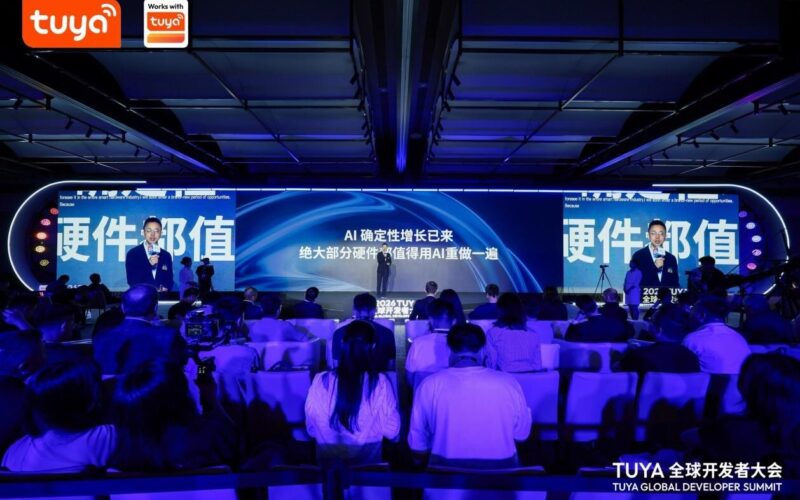
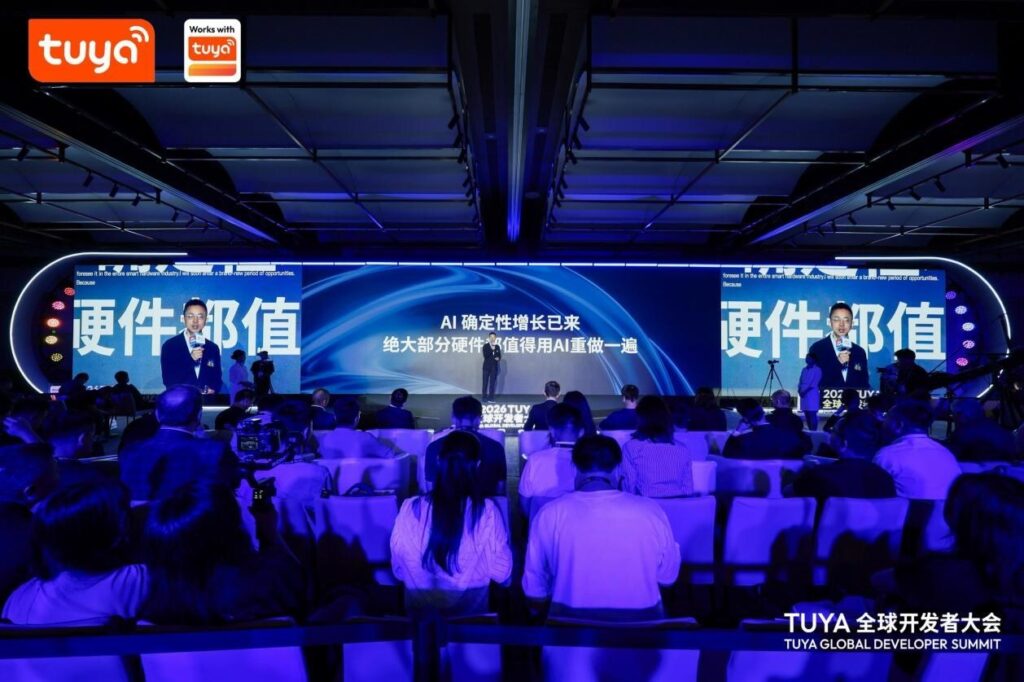
Tuya Smart (NYSE: TUYA, HKEX: 2391), a Hangzhou-based AI cloud platform provider with trailing twelve-month revenue of $321.8 million, used its 2026 Global Developer Summit to unveil a substantially upgraded version of its Hey Tuya voice assistant alongside a portfolio of proprietary AI infrastructure tools designed for hardware deployment. The company also announced a sharpened strategic focus on three commercial ecosystems: AI Home, AI Robot, and AI Energy. Taken together, the announcements represent Tuya Smart’s most comprehensive public articulation of its pivot away from a pure IoT middleware identity toward a full-stack AI platform competing for developer mindshare in the post-app-store economy. For a company trading at roughly $2.49 per share against a 52-week range of $1.87 to $2.95, the summit carries visible commercial urgency.
How does the upgraded Hey Tuya change the competitive calculus for AI voice assistant platforms in smart homes?
The prior iteration of Hey Tuya operated primarily as a device control layer, competent within its own ecosystem but limited in its ability to handle tasks that crossed into productivity or information retrieval. The new version changes that geometry in a meaningful way. Hey Tuya now integrates natively with Google Mail, Google Calendar, and Google Docs, which moves the assistant from a reactive device controller into something closer to an ambient operating system for daily routines. A user can issue a single spoken command to send an email, reschedule a meeting, or retrieve a document, without switching contexts.
That integration matters strategically because it repositions Hey Tuya on the same competitive ground currently occupied by Amazon Alexa’s routines engine and Google Assistant’s deeper Android integrations. Neither of those platforms is standing still, but Tuya Smart has a structural advantage in that its platform underpins a developer ecosystem spanning thousands of hardware manufacturers and independent software vendors who have already embedded Tuya infrastructure into their product lines. Making Hey Tuya more useful at the application layer creates a retention incentive that pure cloud competitors cannot replicate as efficiently. The question is whether the Google productivity integrations will extend to other office suites, notably Microsoft 365, which would meaningfully expand Hey Tuya’s relevance in commercial building management and enterprise IoT contexts.
The expansion of hardware compatibility to include Matter and Home Assistant represents a deliberate opening of the ecosystem rather than a walled-garden play. Matter, the cross-industry interoperability standard, has gained enough adoption that platform resistance to it now carries real commercial cost. By embracing both Matter and Home Assistant simultaneously, Tuya Smart signals to the developer community that it is prioritising reach over control, a posture that suits a platform monetising primarily through cloud services rather than hardware margins.
What is Vibe Coding and how does it lower the barrier to AI plus IoT application development?
Among the more strategically consequential announcements at the summit was the introduction of Vibe Coding, a natural language development tool that allows both professional developers and non-technical creators to build integrated AI, IoT, and web or mobile applications through conversational instruction rather than conventional programming. The tool enables creation of device control dashboards, personalised automation workflows, and lightweight lifestyle applications without requiring the developer to write underlying code.
The commercial logic is straightforward. Tuya Smart’s existing developer community numbers in the thousands, but the total addressable developer base for AI plus IoT applications is far larger if the barrier to entry drops from software engineering proficiency to conversational fluency. Vibe Coding is not a novel concept in isolation, but its application to the IoT domain, where hardware integration complexity has historically deterred smaller developers, makes it a credible differentiation lever. If the tool works reliably in production, it could meaningfully accelerate the volume of applications built on Tuya infrastructure, which in turn drives cloud consumption and recurring service revenue.
The risk is execution depth. Natural language interfaces for code generation perform inconsistently when business logic becomes complex or when hardware interoperability requirements create edge cases that the underlying model has not been adequately trained on. Tuya Smart will need to demonstrate that Vibe Coding produces production-quality applications rather than functional prototypes that require significant manual remediation before deployment.
How does Tuya Smart’s proprietary AI hardware stack compare to what competitors are offering developers?
Beyond the consumer-facing Hey Tuya upgrade, Tuya Smart presented a self-developed AI infrastructure suite aimed specifically at hardware deployment scenarios. The centrepiece is the Personal Voice Activity Detection model, referred to as PVAD, which the company says can identify and isolate the intended speaker in complex acoustic environments without requiring prior voice enrollment. For hardware devices deployed in shared or noisy spaces, reliable speaker identification is a non-trivial problem that existing wake-word solutions handle poorly. A self-trained PVAD model that eliminates false activations would have direct product implications for smart speakers, service robots, and industrial control terminals.
The company also announced upgrades to Physical AI Foundation V2.8, Wukong AI 3.0, the Tuya Real-Time Communication network, Physical Action Model, and OmniMem V2.0, a long-term memory system for AI agents. Individually, each of these represents incremental development. Collectively, they constitute a hardware-oriented AI stack that Tuya Smart is positioning as a turnkey toolkit for developers who want to build AI-native physical products without assembling the infrastructure from scratch.
The competitive frame here is less about consumer electronics giants and more about the developer platform layer occupied by players such as MediaTek’s cloud AI services arm, Qualcomm’s AI Hub for IoT, and Amazon Web Services IoT Greengrass. Tuya Smart’s differentiation claim is that its stack integrates device hardware support, connectivity protocols, AI inference, and application services in a unified environment, whereas competing offerings typically require developers to source and assemble multiple components. Whether that integration advantage translates into developer stickiness depends on how effectively Tuya Smart supports the stack through documentation, developer relations, and commercial-grade reliability guarantees.
Why is the AI Home, AI Robot, and AI Energy framework strategically significant for Tuya Smart’s revenue model?
The three-ecosystem framing announced by Tuya Smart co-chairman and president Leo Chen is not merely a product taxonomy. It is an attempt to communicate a credible monetisation roadmap to investors and enterprise partners who have grown increasingly sceptical about whether AI infrastructure platforms can translate developer activity into durable revenue growth. Tuya Smart’s trailing twelve-month revenue of $321.8 million reflects solid platform scale, but the 7.8% year-on-year growth rate and the stock’s position below its 52-week high of $2.95 suggest the market is still waiting for evidence that the AI transition accelerates the top line rather than merely rebranding it.
The AI Home vertical is the most mature of the three, given that Tuya Smart’s existing device ecosystem is concentrated in residential smart home products. The strategic move here is expanding from reactive automation, turning lights on when motion is detected, toward proactive whole-home intelligence that anticipates user needs based on habit patterns, environmental data, and calendar context. The commercial upgrade path from basic automation to AI-driven ambient intelligence creates a natural SaaS upsell opportunity, which partially explains the 37% surge in recurring services revenue reported for fiscal 2025.
AI Robot is the most speculative of the three verticals in terms of near-term revenue contribution. The five categories identified, companionship, cleaning, wellness, protection, and embodied robotics, span an enormous range of technical complexity and market maturity. Cleaning robots are already a commoditised market with thin margins. Embodied robotics, meaning general-purpose physical agents, remains largely pre-commercial. Tuya Smart’s realistic contribution to this vertical is likely to be at the AI operating system and connectivity layer rather than as a hardware manufacturer, which means its addressable opportunity is limited to platform licensing and cloud services consumed by robot manufacturers building on its infrastructure.
AI Energy is arguably the vertical with the clearest structural tailwind. Energy management across residential and commercial buildings is under significant regulatory and cost pressure globally, and AI-driven optimisation of consumption, storage, and grid interaction is a practical near-term application rather than a distant aspiration. Tuya Smart’s existing connectivity infrastructure in commercial buildings and industrial environments gives it a meaningful starting point for deploying AI energy management solutions without requiring a fresh hardware rollout.
What does Tuya Smart’s market position and stock trajectory signal about investor conviction ahead of the Q1 2026 earnings report?
TUYA shares were trading around $2.49 as of the week preceding the summit, up approximately 6% over the prior two weeks but still 15% below the 52-week high of $2.95. The 52-week low of $1.87 provides perspective on how volatile sentiment has been around the company’s AI transition narrative. The analyst consensus price target of approximately $3.37 to $3.49, with at least one broker maintaining a buy rating, implies meaningful upside from current levels if the strategic execution matches the summit’s ambition.
The upcoming Q1 2026 earnings report, expected in late May, will be the first detailed financial read of the year and will likely determine whether the summit announcements translate into price momentum or fade as product announcements without near-term financial consequence. Investors will be focused specifically on whether recurring services revenue sustains the 37% growth rate that drove the FY2025 profitability story, and whether new developer registrations on the Tuya platform are accelerating in response to the AI hardware toolkit and Vibe Coding launch.
Tuya Smart holds total cash of approximately $952 million against minimal debt, which provides substantial balance sheet protection and the capacity to fund continued R&D investment without equity dilution. That financial cushion is an underappreciated aspect of the investment case for a platform company operating in a capital-intensive technology transition.
Key takeaways on what the 2026 TUYA Global Developer Summit means for Tuya Smart, its competitors, and the AI IoT industry
- Hey Tuya’s integration with Google productivity services repositions the assistant from a device control layer toward an ambient AI operating system, sharpening the competitive challenge to Alexa and Google Assistant in smart home environments.
- Matter and Home Assistant compatibility signals an ecosystem openness strategy that prioritises developer reach over platform lock-in, consistent with a cloud monetisation model rather than a hardware margin play.
- Vibe Coding’s natural language application builder targets a developer base well beyond traditional programmers, but its commercial value depends entirely on production reliability at hardware integration depth.
- The PVAD speaker identification model addresses a genuine technical gap in AI hardware deployments, particularly for shared-use and commercial devices where false activations carry real operational cost.
- The three-ecosystem strategy of AI Home, AI Robot, and AI Energy provides an investable narrative framework, but AI Robot’s near-term revenue contribution is speculative and AI Energy’s execution requires direct competition with established building management and energy software incumbents.
- Recurring services revenue surging 37% in FY2025 is the single most important financial signal in the Tuya Smart investment thesis; the Q1 2026 earnings report will either confirm acceleration or expose a deceleration risk that current valuations have not priced in.
- TUYA’s $952 million cash position provides meaningful runway for R&D and developer ecosystem investment without the equity dilution risk that pressures higher-burn AI infrastructure peers.
- The stock’s trading range of $1.87 to $2.95 over the past 52 weeks reflects ongoing uncertainty about whether AI transition rhetoric is converting into durable revenue growth, a question the 2026 summit does not conclusively answer.
- Competitive pressure from Qualcomm, MediaTek, and AWS at the IoT infrastructure layer means Tuya Smart’s full-stack integration claim must be backed by developer adoption data, not just feature announcements.
- For institutional investors, the summit establishes a clear set of near-term catalysts: Vibe Coding developer uptake, recurring services revenue trajectory in Q1, and early commercial traction in the AI Energy vertical.
Share this:
Discover more from Business-News-Today.com
Subscribe to get the latest posts sent to your email.