


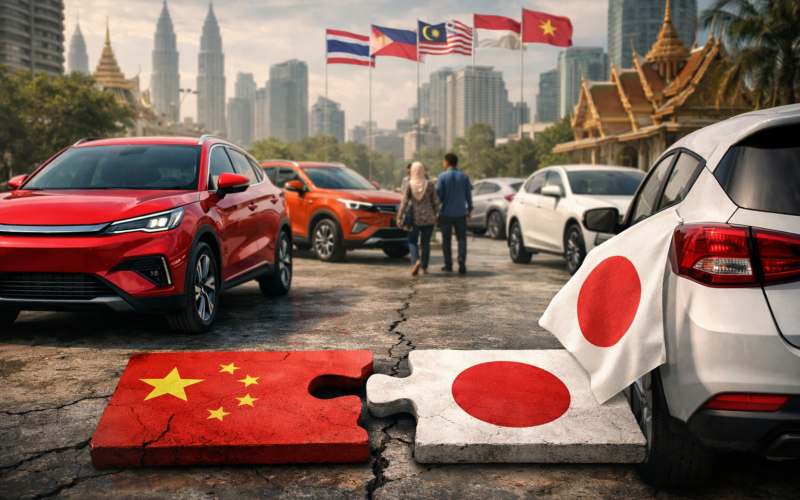
Chinese automakers are systematically dismantling Japanese dominance across the ASEAN light vehicle market, capturing share in nearly every major economy in the region even as total industry volumes contract. BYD Co. Ltd., Chery Automobile Co. Ltd., and SAIC Motor Corp. Ltd., operating through brands including MG, Wuling, Omoda, and Jetour, grew their combined sales across Southeast Asia’s four largest markets by more than 58% in the first quarter of 2025 compared to the same period a year earlier, reaching over 67,500 units in a single quarter as total regional volumes barely moved. The strategic pivot is no accident: as middle-class demand stalls in Thailand and Indonesia, credit conditions tighten, and fuel prices spike from the Middle East conflict, Chinese manufacturers with locally priced electric and hybrid vehicles are capturing a disproportionate share of what remains. The ASEAN light vehicle market, once among the most reliably Japan-dominated automotive regions on earth, is in the middle of a competitive realignment that the current macro downturn is accelerating rather than pausing.
How have Chinese automakers grown their ASEAN market share while total industry volumes decline?
The arithmetic of a shrinking market rewards those who grow faster than the average, and that is precisely what Chinese brands have done across ASEAN since 2023. In Thailand, which accounts for roughly 20% of the Southeast Asian auto market, a Bloomberg analysis of vehicle sales and registration data found that the combined share held by nine Japanese automakers fell to 69.8% for the first ten months of 2025, a decline of 6.6 percentage points from the same period in 2024. These manufacturers had maintained a share in the high 80% to 90% range throughout the 2010s. That figure dropped to 77.8% in 2023, and the trajectory suggests it could fall below 70% for the full year 2025. In Indonesia, which represents close to 30% of the regional market, the same Bloomberg analysis showed the Japanese share fell below 90% in 2024 and dropped further to 82.9% for the first ten months of 2025.
The pace of displacement is fastest in markets where electric vehicle policy has most aggressively shifted buyer incentives. Thailand secured over three billion dollars in Chinese OEM investment commitments anchored by Great Wall Motor Co. Ltd. and Chery. As of Q1 2025, Chinese brands accounted for over 10% of regional sales across the four main ASEAN markets, up from just over 6% in the same period a year earlier. In the context of a market that has contracted meaningfully in its two largest economies, that shift in share represents a substantial real-terms gain in unit volume entirely at the expense of incumbent Japanese brands.
Chery has been particularly aggressive in Malaysia, where it sold 6,826 units in Q1 2025 alone, a near 50% jump year on year and more than half of its entire regional sales recorded in a single country. BYD Co. Ltd. more than doubled its regional Q1 2025 volumes to over 24,500 units, driven heavily by its rapid build-out in Indonesia. SAIC Motor Corp. Ltd., through its MG and Wuling brands, remains the most established Chinese presence in the region, with roots going back to its Indonesian manufacturing joint venture in 2016. Across the top three Chinese automotive groups, BYD Co. Ltd., Chery, and SAIC Motor Corp. Ltd. accounted for over 70% of all Chinese vehicle sales across the four surveyed ASEAN markets in Q1 2025.
Why is BYD’s Subang factory the most consequential single development in ASEAN automotive in 2026?
The commissioning of BYD Co. Ltd.’s manufacturing plant in Subang, West Java, is not simply a production milestone. It is a structural turning point in the competitive architecture of the region’s largest automotive market. The facility, built at an investment confirmed by Indonesia’s Coordinating Minister for Economic Affairs at approximately 1.3 billion dollars, sits across 126 hectares in the Subang Smartpolitan industrial estate and carries an annual production capacity of 150,000 electric vehicles. BYD Co. Ltd.’s president director for Indonesia, Eagle Zhao, confirmed the plant was on track and targeted first-quarter 2026 production commencement.
The strategic implications extend well beyond capacity numbers. BYD Co. Ltd. entered the Indonesian passenger car market in January 2024, launching the Seal, Dolphin, and Atto 3. In October 2025, Association of Indonesian Automotive Industries (GAIKINDO) wholesale data recorded a historic event: the BYD Atto 1 became the best-selling single model in the country for the month, posting 9,396 units and displacing the Toyota Kijang Innova, which had led the charts for years. The Atto 1 held that position again in November 2025 with 8,333 units, confirming the result was not a statistical anomaly. For the full year 2025, GAIKINDO data shows BYD Co. Ltd. delivered 46,711 units wholesale, with the Atto 1 accounting for 22,582 of those, making BYD Co. Ltd. the sixth best-selling manufacturer in Indonesia, a market it entered less than two years earlier.
The Subang plant transforms BYD Co. Ltd. from an imported brand reliant on temporary duty exemptions into a locally manufacturing competitor with structurally lower cost exposure, deeper government alignment, and the kind of supply chain localisation that Japanese brands spent decades building. The Indonesian government’s policy of granting import duty exemptions to Chinese brands committed to building local plants effectively subsidised the market entry that now threatens the incumbents who helped construct the country’s automotive infrastructure over half a century.
The downstream consequences extend beyond BYD Co. Ltd. itself. Thailand’s Ministry of Industry data showed that 420 Chinese auto parts and component suppliers had registered operations in Thailand in Q1 2025, triple the count from 2020 and representing 22% of all foreign-invested enterprises in the country, up from 7% five years earlier. A parallel supplier migration into Indonesia will follow the Subang plant, progressively building a Chinese-origin component ecosystem that further reduces landed costs for Chinese brands while raising localisation barriers for later entrants.
What does the Japanese automakers’ ASEAN retreat signal for the broader competitive outlook?
The Bloomberg analysis covering 2019 to 2024 found that Japanese automakers suffered their steepest market share losses across China, Singapore, Thailand, Malaysia, and Indonesia over that period. Sales of Japanese-branded vehicles declined approximately 5% in Malaysia, 6% in Indonesia, 12% in Thailand, and around 18% in Singapore across the five-year window. Across ASEAN as a whole, Japanese OEM passenger car sales fell roughly 12% in 2024. The underlying cause is structural: Japanese automakers entered the electric vehicle transition cycle later, moved more slowly on software-defined vehicle platforms, and are only now beginning to retrofit their regional manufacturing footprints for electrification.
The industrial response has been costly and uneven. Honda Motor Co. Ltd. announced the closure of one of its two Thai manufacturing plants in 2025, while Suzuki Motor Corp. closed its only Thai vehicle factory. Toyota Motor Corp., still the most resilient Japanese brand in the region by virtue of its pickup truck dominance and deeply embedded production base, unveiled a hybrid-equipped Hilux variant at the Thailand International Motor Expo in late 2025, a defensive move designed as much to protect supply chain relationships with over 2,700 Japanese parts manufacturers operating across Southeast Asia as to win new customers. The combined investment pledge from Toyota Motor Corp., Honda Motor Co. Ltd., Isuzu Motor Ltd., and Mitsubishi Motors Corp. to convert Thai factories for electric vehicle production totals 4.3 billion dollars over five years. That is substantial capital, but it represents a belated and compressed transition compared to Chinese brands that arrived in ASEAN as electric-native manufacturers from day one.
Geely Holding Group’s position in this realignment warrants particular attention, and is frequently underweighted in competitive assessments. Through its 49.9% stake in Malaysia’s Proton Holdings Sdn Bhd, acquired in 2017, Geely Holding Group has an embedded national brand operating as a deeply localised proxy in the region’s most brand-loyal domestic market. Proton Holdings Sdn Bhd turned profitable under Geely Holding Group’s management by 2019 after years of losses, and in March 2026 it was the only major automotive brand to post year-on-year sales growth in Malaysia, supported by the freshly launched eMas 5 battery electric vehicle and eMas 7 plug-in hybrid electric vehicle. Analysts who count Proton Holdings Sdn Bhd within the Chinese OEM ecosystem, given its comprehensive technology and platform dependence on Geely Holding Group, materially revise upward the Chinese penetration calculus across the region.
How does the Middle East energy shock create an unintended accelerant for EV adoption in Southeast Asia?
The geopolitical dimension adds urgency to what was already a structural shift. Maybank Investment Bank research identifies the Philippines as the most fuel-import-exposed ASEAN economy, with roughly 90 to 95% of its crude oil sourced from Persian Gulf countries. Vietnam sources approximately 88% of its crude from the same region, Malaysia around 69%, and Thailand approximately 59%. The conflict-driven disruption of Middle East supply routes has pushed fuel prices higher across the bloc, triggered a Philippine government declaration of a national energy emergency, prompted a temporary reversion to Euro II petroleum standards in Manila, and led both the Philippine and Malaysian governments to introduce public sector work-from-home policies explicitly designed to reduce fuel consumption.
For internal combustion engine vehicle demand, this is unambiguously negative. For the electric vehicle segment, and specifically for the Chinese brands that dominate it in ASEAN, the dynamics are more nuanced. Fuel price shocks historically improve the total cost of ownership argument for battery electric vehicles. In markets where electricity prices are regulated or subsidised, the relative savings from switching to an EV widen precisely when pump prices spike. Chinese brands offer the broadest and most competitively priced EV and plug-in hybrid range across ASEAN. The regional EV market share reached approximately 15% in 2024, up from 9% in 2023, according to industry data tracked by Infineum and PwC’s ASEAN automotive research programme. Further acceleration in 2026 driven by fuel-price-induced conversion would disproportionately benefit the brands that have built the most aggressive distribution and model-launch pipelines, which at this stage of the market are overwhelmingly Chinese.
PwC’s ASEAN automotive capacity analysis projects that Chinese OEMs will add approximately 1.55 million units of regional production capacity by 2030, with Chery alone planning 180,000 units of new output across Malaysia and Thailand, Great Wall Motor Co. Ltd. planning 120,000 units across the same two markets, and Geely Holding Group targeting 95,000 units across Vietnam and Indonesia. Set against a current total ASEAN light vehicle market of roughly 3.1 to 3.2 million units annually, the scale of planned Chinese manufacturing footprint in the region is not incremental. It is transformational.
Key takeaways: What Chinese OEM expansion in ASEAN means for incumbents, investors, and the industry
- Chinese-branded light vehicle sales across Southeast Asia’s four main markets rose more than 58% year on year in Q1 2025, crossing 10% regional market share for the first time, up from just over 6% a year earlier.
- GAIKINDO wholesale data confirmed the BYD Atto 1 as Indonesia’s best-selling vehicle model in both October and November 2025, the first time a non-Japanese model had led the country’s sales charts in its modern automotive history.
- BYD Co. Ltd.’s Subang plant in West Java brings 150,000 units of annual electric vehicle production capacity online in the region’s largest market in 2026, converting the brand from importer to local manufacturer with structural cost advantages over Japanese rivals.
- A Bloomberg analysis of sales and registration data found Japanese automakers suffered their steepest market share declines across China, Singapore, Thailand, Malaysia, and Indonesia between 2019 and 2024, with Thailand losses of around 12% and Singapore losses approaching 18%.
- Thailand’s Ministry of Industry data recorded 420 Chinese auto parts suppliers registered in the country in Q1 2025, triple the 2020 figure, signalling that the component ecosystem supporting Chinese brands is being rapidly localised across the region.
- Maybank Investment Bank research puts the Philippines’ crude oil import dependency on Persian Gulf sources at 90 to 95%, making it the most exposed ASEAN economy to the current Middle East fuel shock, with direct negative consequences for ICE vehicle demand and a relative lift for EVs.
- Geely Holding Group’s 49.9% stake in Proton Holdings Sdn Bhd gives it an embedded, government-aligned national brand in Malaysia that was the only major automotive name to grow sales in March 2026, driven by the eMas BEV and PHEV launches.
- PwC’s ASEAN automotive capacity projections show Chinese OEMs are planning approximately 1.55 million units of new regional production capacity by 2030, a figure that approaches half of the current total ASEAN annual light vehicle market.
- Honda Motor Co. Ltd. and Suzuki Motor Corp. have already reduced their Thai factory footprints, confirming that the rationalisation of Japanese manufacturing presence in ASEAN is a financial reality underway, not a strategic hypothetical.
- The next 24 months will determine whether Japanese brands can stabilise their share through hybrid product strength and supply chain depth, or whether the Chinese industrial foothold in ASEAN becomes structurally irreversible.
Discover more from Business-News-Today.com
Subscribe to get the latest posts sent to your email.