



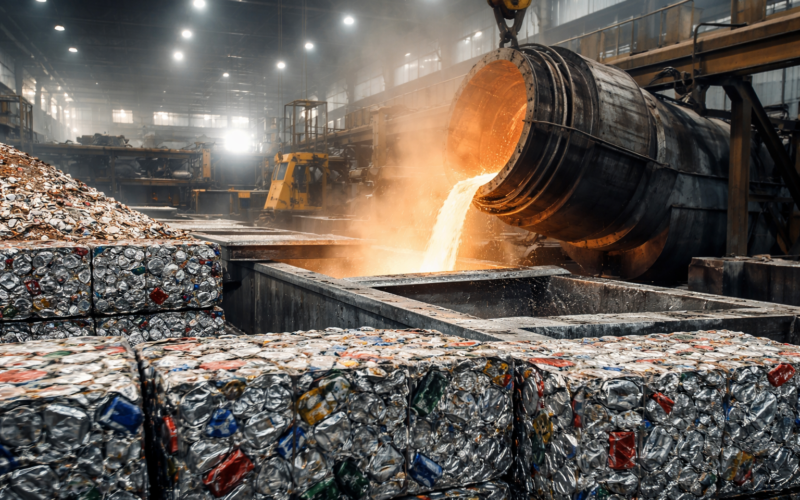
Glencore plc (LSE: GLEN) said on April 10 that it had acquired a 45% stake in an aluminum recycling and remelting plant near Charleston, South Carolina, converting what had already been a financing and marketing relationship into a direct ownership position. Alumicore will retain the remaining 55% and operate the facility, while Glencore gains deeper exposure to the United States aluminum value chain at a time when supply security has become a strategic issue rather than a procurement footnote. The deal also fits Glencore plc’s broader metals positioning in the United States, where it already holds a 30% stake in Century Aluminum Company (NASDAQ: CENX), the country’s largest producer of primary aluminum. For a transaction with no disclosed price tag, the industrial message is still loud: Glencore plc wants a firmer seat at the table as recycled metal, domestic processing, and supply resilience move to the center of aluminum strategy.
Why is Glencore plc buying into a South Carolina aluminum recycling plant right now?
The timing matters because aluminum is no longer being priced only as an industrial metal. It is increasingly being priced as a strategic material exposed to logistics shocks, geopolitical risk, and industrial policy. Reuters reported that Glencore plc’s move comes as Middle East conflict has created supply bottlenecks and pushed aluminum prices higher, while separate Reuters coverage in March and April showed the closure of the Strait of Hormuz and damage to Gulf smelters had helped drive benchmark aluminum to four-year highs and exposed how dependent Western markets remain on vulnerable trade routes and Gulf production. In that context, an equity position in a United States remelting asset looks less like opportunistic portfolio tidying and more like a deliberate hedge against a more fragmented global metals system.
That is what makes the South Carolina plant strategically interesting. Recycling and remelting capacity does not replace primary smelting, but it can shorten supply chains, reduce dependence on imported metal units, and improve access to domestically processed feedstock for customers who care about resilience almost as much as price. Glencore plc effectively appears to be stacking positions across the United States aluminum chain: primary exposure through Century Aluminum Company, and secondary exposure through the Alumicore-operated recycling and remelting footprint. That is not a complete vertical chain, but it is closer to one than Glencore had before.
How does this South Carolina deal strengthen Glencore plc’s United States metals strategy?
The most revealing detail is that Glencore plc had already provided funding to the facility in exchange for marketing rights before taking equity. Companies often start with financing or offtake-style arrangements when they want access without assuming operating responsibility. Moving from that structure into ownership suggests Glencore plc saw enough strategic merit in the asset to shift from transactional participation to capital commitment. It also suggests the company believes value will accrue not only from marketing flows, but from being part of the asset’s longer-term development and output base.
This matters because Glencore plc’s edge has historically been built on trading, logistics, and physical market intelligence across commodity chains. A minority stake in a recycling and remelting plant aligns neatly with that model. The company gets closer to metal flows, closer to customers, and closer to the arbitrage between scrap, recycled units, and primary aluminum markets. It also does so without taking full operating control, since Alumicore will run the plant. That lowers execution burden while still giving Glencore plc meaningful strategic optionality. In plain English, it gets exposure without having to own the whole headache.
What does the Alumicore partnership say about execution risk and capital discipline?
The structure of the deal is almost as important as the asset itself. Alumicore is not just the majority owner. It is also the operator, and Glencore plc explicitly highlighted Alumicore’s operating experience in Pennsylvania and its development work on another advanced facility in Pittsburgh. Together, the South Carolina site and Alumicore’s Pennsylvania assets are expected to have the capacity to recycle more than 120,000 tonnes of aluminum per year. That matters because Glencore plc is not trying to become a specialized plant operator overnight. It is backing an operator that already knows the process and keeping the industrial logic focused on partnership rather than reinvention.
From a capital allocation standpoint, that is a disciplined move. A 45% stake gives Glencore plc material participation without obliging it to consolidate all operational risk onto its own balance sheet. For investors, that may be the appealing part of the story. This is not a splashy megadeal. It is a targeted industrial investment that fits the company’s marketing-heavy DNA while adding optionality in a market where physical availability can suddenly matter more than theoretical supply. In commodity markets, boring can be beautiful, especially when it is boring in exactly the right place.
Why could recycled aluminum become more important than primary metal in United States strategy?
There are at least three reasons. First, recycled aluminum capacity can be developed and scaled with a different economics profile than building brand new primary smelting capacity, which is massively energy-intensive and politically difficult in many jurisdictions. Second, customers in automotive, packaging, construction, and industrial applications increasingly care about the carbon profile and domestic provenance of supply, even when they are not saying so with the enthusiasm of a conference keynote. Third, when global trade routes are disrupted, local processing capacity becomes strategically valuable in a way that spreadsheets tend to underestimate until the disruption arrives.
Glencore plc’s investment therefore looks like a practical acknowledgment that secondary aluminum is no longer a side story. It is becoming part of the core industrial response to supply insecurity. The South Carolina plant is near Charleston, giving it geographical relevance for inbound scrap, outbound customers, and broader southeastern United States industrial demand. That does not automatically make it a transformative asset on its own, but it does place Glencore plc closer to a regional processing corridor that could become more valuable if supply dislocations persist or if policy incentives continue to favor domestic industrial capacity.
What does the market reaction say about Glencore plc and Century Aluminum Company today?
Glencore plc shares do not look like a stock suffering an existential identity crisis. Hargreaves Lansdown showed the shares closing around 562p on April 10, while Yahoo Finance showed a 52-week range of 237.88p to 577.26p. FTSE Russell data published the same day showed Glencore plc up 0.6% over one week and 5.9% over four weeks, with the shares trading very near their 52-week high. In other words, the market is already giving Glencore plc credit for a stronger commodity backdrop and for its broader portfolio leverage to metals and trading conditions. This South Carolina investment is unlikely to be large enough on its own to move the stock materially, but it does reinforce the idea that management is deploying capital into industrial choke points with improving strategic value.
Century Aluminum Company’s stock context is even more dramatic. Yahoo Finance and other market data sources showed Century Aluminum Company trading near record levels for the year, with a 52-week range around $14.77 to $68.69, while recent daily data showed the stock climbing sharply across late March and early April. That matters because Glencore plc’s 30% holding in Century Aluminum Company means its United States aluminum exposure is already tied to a market that investors are repricing aggressively in response to supply shocks and policy tailwinds. The South Carolina recycling plant does not directly belong to Century Aluminum Company, but it strengthens the broader ecosystem in which Glencore plc is building its United States aluminum thesis.
Could this minority stake reshape competition in the United States aluminum supply chain?
Not by itself. The plant will not suddenly redraw the entire competitive map. But that is not the right test. The better question is whether this deal improves Glencore plc’s position relative to peers that are still treating recycling, scrap processing, and domestic remelting as adjacent opportunities rather than core supply-chain assets. On that measure, the answer is probably yes.
The aluminum industry is entering a period in which competitive advantage will come from a mix of feedstock access, processing flexibility, geography, and customer credibility. Companies that can combine primary exposure, recycled content capability, and domestic supply security will have more ways to respond to premium swings, trade distortions, and customer procurement shifts. Glencore plc is not building the full answer here, but it is assembling pieces of one. The risk for competitors is not that this single plant overwhelms them. The risk is that Glencore plc is moving earlier than others to secure scarce industrial positions that look modest today and far more valuable after the next supply shock.
What could go wrong if Glencore plc’s South Carolina aluminum recycling strategy underdelivers?
The obvious risk is that the current aluminum supply panic cools faster than expected. If Middle East disruptions ease and price premiums normalize, some of the urgency behind domestic secondary capacity could fade. Assets bought or funded under crisis logic can look less compelling when markets calm down and freight lanes reopen. Another risk is more operational: recycling and remelting businesses depend on scrap quality, sortation efficiency, and margin discipline, not just on big-picture commodity narratives. Even with Alumicore as operator, execution still matters.
There is also the question of scale. More than 120,000 tonnes per year across the South Carolina and Pennsylvania footprint is meaningful, but not enough to transform United States supply dynamics on its own. To become strategically decisive, Glencore plc may need this investment to be part of a broader chain of moves in recycling, processing, logistics, or customer contracting. That does not make the current stake unimportant. It just means investors should read it as a directional signal rather than a complete end-state. In M&A language, this is less “mission accomplished” and more “we have chosen our lane.”
What does Glencore plc’s latest aluminum move signal about where industrial capital is heading next?
The larger signal is that industrial capital is migrating toward resilience assets. These are not always glamorous mines, giant smelters, or headline acquisitions. Sometimes they are minority stakes in regional processing plants that sit in the right geography, with the right operator, and the right exposure to a market under stress. Glencore plc’s South Carolina move fits that mold neatly. It is a bet on domestic capability, on recycled metal as a strategic input, and on a United States aluminum system that may reward local flexibility more than before.
For executives and investors, the useful takeaway is that the aluminum story is shifting from pure output volume to supply-chain architecture. Who owns the material is still important. Who can process it, remelt it, move it, and deliver it under stress is becoming just as important. Glencore plc appears to understand that. The company has not placed its biggest bet here, but it may have placed one of its smarter ones.
What are the key takeaways on what this Glencore plc investment means for the company, rivals, and the United States aluminum industry?
- Glencore plc is moving from financing and marketing rights to direct equity ownership, which signals stronger conviction in the asset’s strategic value.
- The South Carolina stake deepens Glencore plc’s exposure to the United States aluminum chain alongside its existing 30% holding in Century Aluminum Company.
- Recycling and remelting capacity is becoming a resilience asset as geopolitical disruption exposes the fragility of long global aluminum supply routes.
- The minority structure looks capital-disciplined because Alumicore keeps operating control while Glencore plc still gains industrial and commercial exposure.
- The transaction reinforces a broader shift in metals investing toward regional processing infrastructure rather than only upstream production assets.
- Glencore plc is positioning around both primary and secondary aluminum, which could matter more if customers increasingly prioritize domestic and lower-carbon supply.
- The current scale is meaningful but not transformative, so investors should view the deal as a strategic building block rather than a final-state solution.
- If aluminum prices normalize quickly, the urgency behind domestic recycling assets may cool, which is the clearest near-term strategic risk.
- Competitors that remain underexposed to recycled metal processing may find themselves scrambling for similar assets if disruptions persist.
- For the wider industry, the deal is another reminder that future advantage may depend less on headline capacity and more on supply-chain architecture.
Discover more from Business-News-Today.com
Subscribe to get the latest posts sent to your email.