

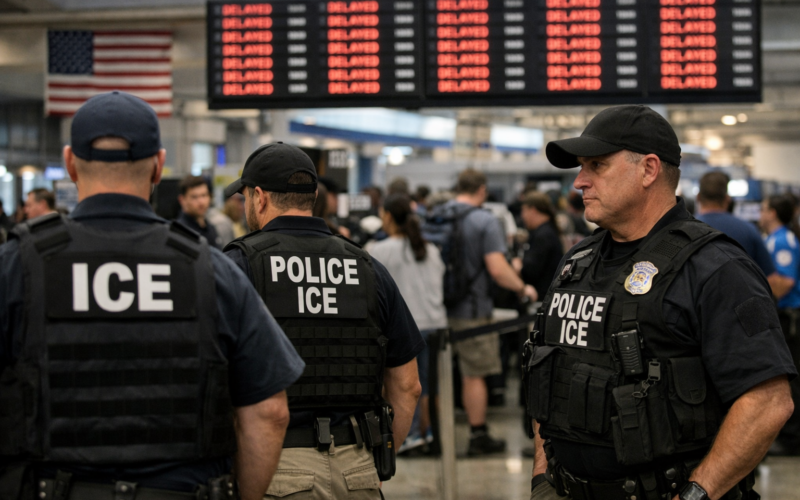
President Donald Trump threatened on Saturday, 21 March 2026, to deploy agents from the United States Immigration and Customs Enforcement agency to American airports beginning Monday, 23 March 2026, unless congressional Democrats agreed to a Republican-backed funding package to reopen the Department of Homeland Security. The threat came as a partial government shutdown of the Department of Homeland Security (DHS) entered its sixth week, leaving tens of thousands of Transportation Security Administration officers without pay and causing widespread delays at airports across the United States during the spring break travel period.
In a post on his Truth Social platform, President Trump wrote that he would move Immigration and Customs Enforcement agents to airports to carry out security functions, including immigration enforcement, if Democrats did not immediately agree to a deal. In a follow-up post, the president confirmed the deployment would begin on Monday, 23 March 2026, directing the agency to prepare to move. The White House did not clarify what specific functions the Immigration and Customs Enforcement agents would perform once deployed.
Immigration and Customs Enforcement agents are not trained in airport security screening. Transportation Security Administration officers complete a monthslong certification process before conducting passenger and baggage screening. George Borek, a Transportation Security Administration officer and union steward at Hartsfield-Jackson Atlanta International Airport, said that individuals without that specific training would not be able to replicate the screening function and that introducing untrained personnel could create additional problems at checkpoints.
How did the partial Department of Homeland Security government shutdown begin, and why has it lasted six weeks?
The Department of Homeland Security lost funding on 14 February 2026 after Senate Democrats declined to advance a House-passed appropriations bill that included full funding for Immigration and Customs Enforcement and Customs and Border Protection without accompanying operational reforms. The immediate catalyst for Democratic opposition was the fatal shooting of two individuals, identified as Renee Good and Alex Pretti, by federal immigration enforcement agents in Minneapolis, Minnesota, during a surge in enforcement activity earlier in 2026. Democrats determined that they would not support any funding bill that provided money to Immigration and Customs Enforcement and Customs and Border Protection without significant changes to how those agencies carry out enforcement operations.
By Friday, 20 March 2026, Senate Democrats had blocked the Department of Homeland Security funding bill for the fifth time. The vote to advance the measure was 47 to 37, falling short of the 60-vote threshold required to overcome a Senate filibuster. Senator John Fetterman of Pennsylvania was the only Democrat to vote alongside Republicans in support of the measure. The Senate remained in session over the weekend to continue negotiations, though no vote on the funding package was scheduled.
Republican leaders in both chambers have consistently argued that the Department of Homeland Security must be funded as a whole and have rejected Democratic efforts to separate Transportation Security Administration, Federal Emergency Management Agency, and Coast Guard funding from the broader Department of Homeland Security appropriations bill. Senate Majority Leader John Thune of South Dakota said that multiple opportunities had already been presented to fund the Transportation Security Administration and that Democrats had blocked each one. Speaker of the House Mike Johnson described Democrats as holding the department hostage to protect what he characterised as criminal undocumented immigrants.

What specific reforms are Senate Democrats demanding from Immigration and Customs Enforcement and Customs and Border Protection as conditions for funding?
Senate Democrats have put forward several operational demands as conditions for supporting a Department of Homeland Security funding bill. These demands include requiring Immigration and Customs Enforcement and Customs and Border Protection agents to obtain judicial warrants before entering private property, rather than the administrative warrants the agencies currently use. Democrats have also sought a ban on agents wearing masks during enforcement operations, mandatory display of official identifying information on uniforms, and universal codes of conduct for federal immigration enforcement officers.
The Trump administration made some concessions earlier in March 2026, agreeing to expand the use of body-worn cameras, with an exception for undercover operations, and to limit civil immigration enforcement activities at designated sensitive locations including hospitals, schools, and places of worship. Republicans stated that those concessions represented significant movement by the White House. Democrats characterised the offers as inadequate. The administration also removed Department of Homeland Security Secretary Kristi Noem and placed White House border czar Tom Homan in direct operational command in Minneapolis following the fatal shootings.
Senate Minority Leader Chuck Schumer of New York proposed on Saturday a standalone measure to fund the Transportation Security Administration while negotiations on broader Department of Homeland Security funding continued. Republicans blocked that measure on the Senate floor. Senator Thune said the standalone proposal would not effectively reopen the agency. On Saturday afternoon, Senator Schumer described conversations as productive but called on Republicans to fund the Transportation Security Administration immediately and continue negotiating on the remaining points of disagreement.
What has the Department of Homeland Security shutdown meant for Transportation Security Administration staffing and US airport operations during spring break travel?
The Department of Homeland Security shutdown has created significant operational strain across the United States air travel network. Transportation Security Administration officers are classified as essential employees and are required to report to work during funding lapses, but they do so without pay. More than 60,000 Transportation Security Administration officers and other department personnel did not receive a first full paycheck as a result of the shutdown, and a second pay period was approaching on 27 March 2026. TSA officer George Borek described the financial and emotional strain on colleagues as severe, with some officers relying on food banks and community assistance programmes.
Rising absenteeism and increasing resignation rates among unpaid Transportation Security Administration officers have contributed to extended wait times at security checkpoints across major airports during one of the busiest travel periods of the year. Airports most severely affected included George Bush Intercontinental Airport and William P. Hobby Airport in Houston, Texas; Hartsfield-Jackson Atlanta International Airport in Atlanta, Georgia; Louis Armstrong New Orleans International Airport in New Orleans, Louisiana; and Philadelphia International Airport in Philadelphia, Pennsylvania. Security wait times at some of these locations exceeded three hours. Airports issued advisories urging passengers to arrive well ahead of scheduled departure times.
Transportation Secretary Sean Duffy warned on Friday, 20 March 2026, that conditions at airports would deteriorate further without a funding resolution. Atlanta Mayor Andre Dickens announced on Saturday that Transportation Security Administration screeners at Hartsfield-Jackson Atlanta International Airport would receive two free meal vouchers per shift, complimentary parking, and free access to public transportation as emergency support measures while the shutdown continued.
How have Republican and Democratic senators responded to Trump’s threat to deploy ICE agents to airports as a security measure?
Congressional reaction to the president’s threat was mixed across party lines and largely sceptical of the practical utility of deploying Immigration and Customs Enforcement agents in an airport security role. Republican Senator John Kennedy of Louisiana acknowledged that Immigration and Customs Enforcement agents could potentially assist with crowd control to free up trained Transportation Security Administration officers for actual screening duties, but said it would not be a definitive solution to the staffing crisis. Senate Majority Leader Thune said he hoped a deal could be reached so that deploying Immigration and Customs Enforcement agents to airports would not become necessary.
Democratic Senator Mark Warner of Virginia rejected the president’s statement, saying the threat demonstrated the need to fund the Transportation Security Administration directly. Senator Schumer, in remarks on the Senate floor on Saturday, called the situation unacceptable and accused Republicans of holding workers and travellers hostage to political considerations. Senator Elizabeth Warren of Massachusetts told reporters that Democrats were seeking standard accountability measures for federal immigration agents comparable to those applied to other law enforcement agencies.
Republican Senator Ted Cruz of Texas proposed an alternative approach on Saturday, suggesting that funding for Immigration and Customs Enforcement and Customs and Border Protection be separated from the broader Department of Homeland Security appropriations bill and passed later through the budget reconciliation process, which requires only a simple majority rather than 60 Senate votes. The proposal was floated as one possible mechanism to break the impasse, though it had not been formally advanced as legislation by Saturday evening.
What is the legal status of Elon Musk’s offer to personally cover Transportation Security Administration worker salaries during the shutdown?
Separately from the congressional debate, Elon Musk, chief executive officer of Tesla and owner of the social media platform X, published a post on Saturday morning offering to personally cover the salaries of Transportation Security Administration personnel during the funding impasse. The offer was framed as a response to the disruption the shutdown was causing to American travellers and airport workers. Senator Fetterman publicly praised the offer, describing it as generous and reiterating his position as the only Democratic senator to have voted alongside Republicans on every Department of Homeland Security funding measure.
Legal analysts noted significant uncertainty about whether the arrangement would be permissible under federal law. Federal statute generally prohibits government employees from receiving outside compensation tied to their official duties. The Antideficiency Act bars federal agencies from spending funds that have not been appropriated by Congress, a restriction that has previously been cited in relation to similar private pay proposals during government shutdowns. Neither the Department of Homeland Security nor the Trump administration had officially responded to or confirmed any mechanism for implementing the offer by Saturday afternoon.
What is the broader institutional and security impact of the Department of Homeland Security shutdown beyond Transportation Security Administration airport staffing?
The Department of Homeland Security shutdown has affected a range of agencies and functions beyond Transportation Security Administration airport security. The Federal Emergency Management Agency has been unable to process certain state and local homeland security and terrorism-prevention grants, and has cancelled training programmes at national response centres. The Cybersecurity and Infrastructure Security Agency has been operating at reduced capacity during a period officials have described as presenting elevated risks from foreign adversaries. Coast Guard civilian personnel have worked without pay, affecting missions related to port security, search and rescue operations, and drug interdiction.
Congress is scheduled to enter a two-week Easter recess near the end of March 2026. Senate Majority Leader Thune threatened on Thursday, 19 March 2026, to cancel or curtail the recess if a Department of Homeland Security funding agreement had not been reached before lawmakers were scheduled to leave Washington. A bipartisan group of appropriators met with White House border czar Tom Homan on Friday, 20 March 2026, in sessions described by members of both parties as productive. Thune acknowledged on Friday that there was deal space in the negotiations and that the Trump administration had added to its offer and submitted legislative text, though specific details of the revised offer were not publicly disclosed by either party as of Saturday, 21 March 2026.
The shutdown passed its 35th day on Friday, 20 March 2026, and was set to enter its sixth week without a resolution over the weekend. The combination of escalating airport disruptions, the approach of a second missed paycheck for Transportation Security Administration workers, the threat of cancelled Easter recess, and the proximity of bipartisan talks with the White House appeared to be creating new urgency around the negotiations, though both parties maintained that significant gaps remained on the core question of how to reform and fund Immigration and Customs Enforcement and Customs and Border Protection.
Key takeaways on what the Department of Homeland Security shutdown and Trump’s ICE airport threat mean for US domestic policy and air travel security
- President Trump threatened on 21 March 2026 to deploy Immigration and Customs Enforcement agents to United States airports starting Monday, 23 March 2026, if congressional Democrats did not agree to a Republican-backed Department of Homeland Security funding package; Immigration and Customs Enforcement agents have no Transportation Security Administration screening training, and it remained unclear what security functions they would perform.
- The Department of Homeland Security partial government shutdown entered its sixth week after Senate Democrats blocked the funding bill for the fifth time on 20 March 2026; the vote failed 47 to 37, short of the 60-vote threshold required to overcome a Senate filibuster, with Senator John Fetterman of Pennsylvania the sole Democrat voting with Republicans.
- Democrats are conditioning support for Department of Homeland Security funding on reforms to Immigration and Customs Enforcement and Customs and Border Protection, including judicial warrants for home entry, a ban on agents wearing masks, and mandatory display of identifying information, following the fatal shooting of two individuals by federal immigration agents in Minneapolis, Minnesota.
- Transportation Security Administration staffing shortages caused by non-payment of over 60,000 officers produced security wait times exceeding three hours at major airports including those in Houston, Atlanta, New Orleans, and Philadelphia during the spring break travel period; a second missed paycheck was approaching on 27 March 2026.
- Bipartisan negotiations with White House border czar Tom Homan were described as productive by members of both parties following meetings on 19 and 20 March 2026; Senate Majority Leader Thune confirmed the administration had submitted an updated offer with legislative text, though details were not publicly disclosed, and the Easter congressional recess was threatened with cancellation if no deal was reached.
Discover more from Business-News-Today.com
Subscribe to get the latest posts sent to your email.