



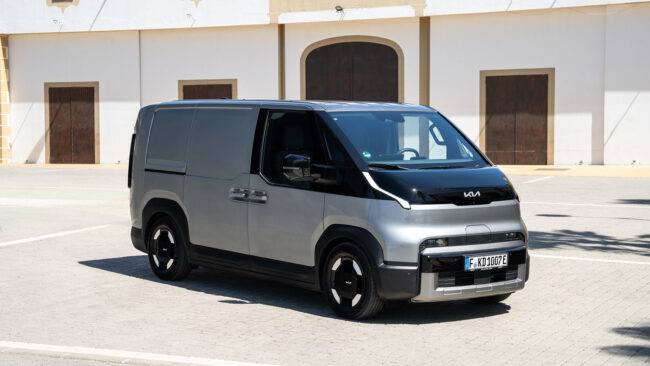
Kia Corporation has seized a pivotal lead in Europe’s commercial vehicle market with its all-electric PV5 Cargo, earning a maximum five-star rating in the 2025 Euro NCAP Commercial Van Safety assessment and clinching the coveted 2026 International Van of the Year (IVOTY) title. This double victory not only marks a watershed moment for Kia in the electric light commercial vehicle (eLCV) space but also sets a fresh benchmark for what global logistics, delivery operators, and fleet managers can expect from their next-generation workhorses.
Analysts tracking the shift toward electrification in the logistics sector have noted that the PV5 Cargo’s breakthrough—achieved through a combination of advanced safety tech, modular design, and practical real-world engineering—gives Kia a strong position as European businesses accelerate their transition to zero-emission fleets. With this latest accolade, Kia extends the momentum built by earlier hits like the EV6 and EV9, and looks poised to shake up a market traditionally dominated by legacy European automakers.
How did Kia PV5 Cargo secure the Euro NCAP five-star rating and why does it matter to fleet buyers?
The Euro NCAP’s maximum five-star rating for the Kia PV5 Cargo wasn’t handed out lightly. In a year when standards for safety, crash avoidance, and post-collision protection have become increasingly demanding, the PV5 Cargo aced every major evaluation category. Its suite of standard safety features—ranging from Autonomous Emergency Braking (AEB) with Forward Collision Warning (FCW) to a Lane Support System (LSS) and Speed Assistance System (SAS)—demonstrated strong responsiveness in real-world scenarios.
Euro NCAP specifically highlighted the van’s ability to avoid collisions with pedestrians and cyclists, thanks to its advanced AEB system, while also singling out the Lane Support System’s performance for both gentle and assertive interventions when needed. Add to this a speed management system that combines digital mapping with live camera feeds, and it’s clear that the PV5 Cargo was engineered for Europe’s complex and congested road networks.
Fleet operators increasingly see Euro NCAP safety scores as a must-have in their procurement checklists, especially with growing regulatory pressure around occupational safety and liability. For fleet managers with tight margins and even tighter insurance criteria, Kia’s five-star achievement will likely tip the scales in the PV5 Cargo’s favor.
What does the International Van of the Year win signal for Kia and the global LCV sector?
Bagging the 2026 International Van of the Year award at the PV5 Cargo’s debut is more than just a headline moment. This is the first time an Asian electric van, and specifically a Korean-built model, has claimed the LCV sector’s highest global honor. Outperforming six other finalists and winning a unanimous verdict from 26 commercial vehicle journalists worldwide, the PV5 Cargo’s clean sweep was credited to its blend of operational efficiency, technological innovation, and low environmental impact.
The IVOTY jury chairman, Jarlath Sweeney, credited Kia for redefining what businesses can expect from modern vans, saying the PV5 brings together zero-emission performance, practical loading versatility, and cutting-edge safety. Industry insiders now see Kia as a genuine force among LCV giants, especially as European and global markets transition from diesel to electric over the next five years.
How does the Kia PV5 Cargo stack up in terms of range, payload, and real-world usability for business customers?
On the specs sheet, the Kia PV5 Cargo flexes its business-first credentials. The standard L2H1 model offers 4.4 cubic metres of cargo space—ample for two Euro pallets—while payload maxes out at 790 kg. For those needing even more, Kia offers a range of body variants, including Compact, Long, and High Roof options, stretching cargo volume up to 5.1 cubic metres.
Under the hood (well, floor), customers can pick from three battery options: a 51.5 kWh standard range, a 71.2 kWh long range (good for up to 416 km WLTP), and a 43.3 kWh LFP variant for cost-sensitive fleet buyers. The long-range PV5 can be charged from 10% to 80% in about 30 minutes thanks to 150 kW DC fast charging, a must for logistics operators needing quick turnarounds.
But it’s not just numbers—Kia’s modular “Platform Beyond Vehicle” architecture means the PV5 is purpose-built for easy upfitting and digital fleet management. Features like flat floors, straight walls, L-Track mounting, and Vehicle-to-Load (V2L) power transform the van into a mobile workshop or last-mile delivery hub.
How is Kia’s electric van strategy reshaping the global commercial vehicle ecosystem?
Kia’s PBV (Platform Beyond Vehicle) vision is ambitious. By launching the PV5 as its first PBV model, Kia signaled a broader strategy to offer an entire electric van ecosystem tailored for logistics, ride-hailing, and mobility-as-a-service providers. The PV5 builds on the same electric know-how that made the EV6 and EV9 standouts, but with a laser focus on real-world commercial needs, such as low entry heights, rapid charging, and seamless digital connectivity for fleet operators.
Kia’s CEO, Ho Sung Song, emphasized that the PV5’s debut and subsequent awards validate the brand’s customer-centric design approach, noting that extensive feedback from delivery firms and mobility providers drove product development. With future PBV models like the PV7 and PV9 in the pipeline, and new body styles (including chassis cab and high roof) scheduled for 2026, Kia is making a long-term bet on electrified, modular fleets.
Where and when can businesses get their hands on the Kia PV5 Cargo?
European and UK pre-orders for the PV5 Cargo opened in May 2025, with first deliveries scheduled by late 2025. The model will launch in South Korea in the second half of 2025 and is expected to reach North America and India by 2026. For Indian fleet buyers, the September 2026 launch window could prove tempting as local e-commerce and delivery operators eye modern, green alternatives to legacy diesel vans.
What are the latest stock performance and sentiment trends for Kia Corporation?
Kia Corporation (KRX: 000270) continues to draw attention on the Korea Exchange as the PV5’s accolades boost institutional sentiment. Shares have traded up over 7% in the past five days, outperforming the broader KOSPI index as investors rotate into electric mobility names. Analysts covering the stock generally maintain a “buy” rating, citing the PV5 launch as a catalyst for new revenue streams and improved margins, especially as PBV production scales up in 2026.
International investor flows remain robust, with foreign institutional investors adding to their positions in recent months. Sector watchers believe Kia is well positioned to defend its global EV share even as competition intensifies from both established and emerging LCV rivals.
What should investors, fleet managers, and competitors watch for next as Kia expands its PBV lineup?
Looking ahead, the PV5’s five-star safety rating and IVOTY win have raised expectations for the entire PBV ecosystem Kia is assembling. With additional variants on the way and the promise of larger models for heavy logistics, industry watchers expect Kia to push further into value-added services, such as digital fleet analytics and advanced mobility subscriptions.
For rivals, the message is clear: safety, modularity, and genuine business utility are now the table stakes in Europe’s fiercely contested van market. For investors, Kia’s pivot into commercial EVs is being watched as a test case for whether Asian automakers can scale both premium and utilitarian electric mobility on a global stage.
What are the key takeaways from Kia PV5 Cargo’s safety and innovation streak?
- Kia PV5 Cargo earned the maximum five-star rating in the 2025 Euro NCAP Commercial Van Safety assessment, leading its segment in occupant protection, crash avoidance, and post-crash safety.
- The PV5 was also awarded the 2026 International Van of the Year, becoming the first Korean and Asian electric van to secure this honor.
- Standard advanced driver-assist systems—including AEB, Lane Support System, and Speed Assistance System—delivered strong results in demanding test scenarios.
- The van offers modular body options, multiple battery choices, rapid charging, and robust digital connectivity features for fleet management.
- Kia’s PBV strategy focuses on modular, electrified, business-centric vehicles with future models and body types already in the pipeline.
- Investor sentiment toward Kia Corporation remains positive, buoyed by the PV5’s debut and ongoing EV leadership.
- First PV5 deliveries are due in Europe in late 2025, with launches in South Korea and India to follow in 2026.
Discover more from Business-News-Today.com
Subscribe to get the latest posts sent to your email.