




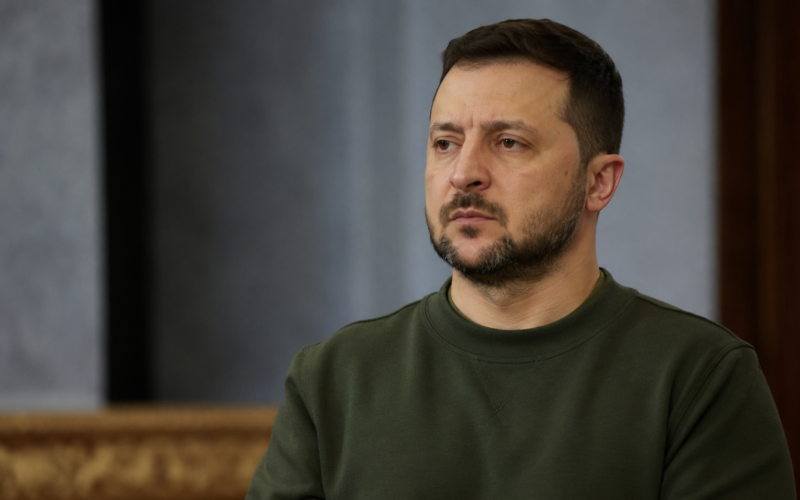
Ukrainian President Volodymyr Zelenskyy says Kyiv has developed a concise set of peace proposals with American and European officials that includes a ceasefire concept and a US idea for a third-party-administered free economic zone in eastern Donbas, as Ukraine attempts to revive diplomacy after earlier negotiations with Russia collapsed.
Zelenskyy said on August 25 that he sees a window for meaningful US mediation lasting through roughly the end of summer 2027, after which Washington’s 2028 presidential election campaign could make sustained diplomatic attention more difficult. The war has now continued for almost four and a half years since Russia’s full-scale invasion in February 2022.
The Kremlin immediately questioned the economic-zone proposal. Moscow says the disputed Donbas territory is part of Russia and argues that a third country therefore cannot administer it, highlighting how far the two sides remain apart even as they consider new negotiating formulas.
What is inside the new Ukraine-US-Europe peace proposal?
Zelenskyy described the document as covering three broad areas rather than a fully negotiated treaty.
The first is a possible ceasefire framework. The second concerns an earlier US proposal to create a free economic zone in parts of eastern Ukraine’s Donbas region under some form of third-party administration. The third addresses the roles of the European Union and NATO and what Ukraine might be prepared to do as part of a settlement.
Important details remain undisclosed. Zelenskyy did not explain which territory would form the proposed economic zone, who the administering third party would be or whether Russian and Ukrainian forces would withdraw from particular lines.
Those omissions mean the document should be understood as a negotiating framework rather than an agreed peace plan. Russia has not accepted it, and even the parties that helped prepare the ideas may differ over implementation.
Why is Donbas still the most difficult territorial issue?
Russia claims Donetsk, Luhansk, Zaporizhzhia and Kherson as Russian territory despite not controlling all four Ukrainian regions.
Moscow has repeatedly demanded that Ukraine recognise or surrender territory beyond areas Russian forces currently occupy, while Kyiv rejects being required to concede land its military still holds.
Donbas is particularly important because Russian forces continue attempting to capture Ukraine’s remaining fortified eastern cities. The military balance on the ground can therefore alter bargaining power even while diplomats discuss ceasefires.
A free economic zone could theoretically postpone the sovereignty dispute by creating a special administrative arrangement rather than forcing immediate recognition of either side’s claim.
The problem is that Moscow’s position begins from the assertion that the territory already belongs to Russia. If that premise remains non-negotiable, third-party administration becomes difficult to reconcile with Russian law and political messaging.
Why does Zelenskyy believe there is a diplomatic deadline in 2027?
US presidential politics shapes international diplomacy because administrations become increasingly consumed by domestic campaigning as an election approaches.
Zelenskyy believes the period from the December 2026 G20 summit through summer 2027 could offer the strongest window for sustained American involvement before attention moves towards the 2028 presidential contest.
Earlier US-led negotiations lost momentum as Washington and Kyiv failed to bridge Russian territorial demands and the United States became increasingly focused on its war with Iran. American negotiators Steve Witkoff and Jared Kushner last visited Moscow in January and had not yet travelled to Kyiv under the latest negotiating cycle.
The timetable is not a formal ultimatum. It is Zelenskyy’s assessment of when American political attention is most likely to remain available for intensive mediation.
That calculation shows how Ukraine’s diplomatic strategy increasingly depends not only on battlefield conditions but on election calendars in allied countries.
Could a ceasefire happen before a permanent peace agreement?
A ceasefire is generally easier to negotiate than a comprehensive political settlement because parties can stop or reduce fighting without resolving every territorial and security dispute immediately.
It is also fragile when the sides disagree over the line where forces stop, monitoring arrangements, sanctions, rearmament and what happens if negotiations fail.
Ukraine would want security guarantees strong enough to prevent Russia from using a pause simply to rebuild forces. Russia, meanwhile, continues demanding settlement of what it calls the conflict’s root causes and recognition of realities on the ground.
The new framework therefore matters because it suggests Kyiv and Western partners are again trying to identify intermediate steps rather than waiting for an all-encompassing agreement.
Whether that produces actual negotiations depends on Moscow. A one-page concept can narrow diplomatic questions, but it cannot overcome a fundamental territorial dispute unless both sides eventually conclude that continuing the war is worse than accepting an imperfect compromise.
Discover more from Business-News-Today.com
Subscribe to get the latest posts sent to your email.
