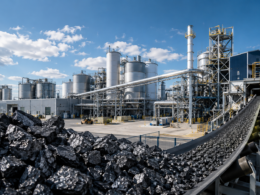




Yara International ASA (OSE: YAR) has agreed to acquire Gulf Coast Ammonia’s production facility in Texas City, Texas, for $1.3 billion plus customary working-capital adjustments. The transaction gives the Norwegian crop nutrition and ammonia group ownership of a synthesis loop, storage facilities and exclusive access to loading infrastructure capable of supporting approximately 1.3 million metric tonnes of annual ammonia production. Air Products and Chemicals Inc. will continue supplying hydrogen, nitrogen and other utilities under a long-term agreement, leaving Yara responsible for converting those industrial gases into ammonia and placing the output through its global commercial network. The facility remains in commissioning and is expected to reach stable operations by the end of 2026, subject to successful completion of outstanding work. The acquisition therefore combines a potentially attractive United States energy-cost position with one of the largest commissioning and capital-allocation tests Yara has accepted in recent years.
Why did Yara choose Gulf Coast Ammonia immediately after rejecting another US project?
The timing is one of the most revealing aspects of the transaction. Yara announced on June 30 that it would not proceed with the proposed acquisition of ammonia assets within Air Products’ Louisiana Clean Energy Complex because the expected financial returns did not satisfy its investment criteria.
Only two days later, Yara agreed to purchase Gulf Coast Ammonia. The rapid sequence does not necessarily indicate inconsistent strategy. It suggests Yara had been evaluating several United States ammonia opportunities simultaneously and considered the Texas asset more mature, commercially competitive or financially attractive than the Louisiana proposal.
The comparison is important because Yara is not abandoning American ammonia investment. It is reallocating capital toward a facility that is physically constructed, connected to established industrial infrastructure and already entering commissioning.
The Louisiana project would have required Yara to accept greater development and completion exposure before achieving commercial production. Gulf Coast Ammonia still carries commissioning risk, but much of the construction work has already been completed.
This difference can materially change project economics. A facility nearing production can begin generating revenue sooner, reducing the period during which capital remains committed without operating cash flow.
Gulf Coast Ammonia also offers immediate exposure to the United States gas market and the Texas Gulf Coast’s export and distribution infrastructure. Yara can connect the plant to its existing ammonia trading, shipping and fertiliser production network rather than waiting for a new complex to be completed from an earlier development stage.
The transaction therefore demonstrates selective appetite rather than indiscriminate expansion. Yara appears willing to deploy substantial capital when it believes construction maturity, energy exposure and commercial flexibility provide a sufficient return.
That interpretation will be tested by the actual plant ramp-up. Rejecting one project for inadequate returns looks disciplined only if the alternative acquisition performs better.
What exactly is Yara acquiring through the $1.3 billion Texas asset transaction?
Yara is acquiring the Gulf Coast Ammonia synthesis plant, related ammonia storage capacity and exclusive use of loading infrastructure in Texas City. The purchase does not include every stage of the production chain.
Air Products will own and operate the systems supplying hydrogen, nitrogen and other utilities. Yara will combine those inputs in the ammonia synthesis loop and control the resulting ammonia output.
This creates a divided ownership model. Air Products controls critical upstream industrial-gas supply, while Yara controls ammonia conversion, storage, marketing and distribution.
The arrangement resembles Yara’s existing operation in Freeport, Texas, where a comparable structure has allowed it to participate in ammonia production without owning all upstream gas-generation assets.
The advantage is capital efficiency. Yara does not need to purchase or operate the entire hydrogen and nitrogen supply system, reducing the complexity and capital intensity associated with the acquisition.
It also gains access to Air Products’ extensive United States hydrogen pipeline network. That infrastructure could provide dependable feedstock and utilities without requiring Yara to build separate facilities.
The disadvantage is operational dependence. The ammonia plant cannot function without reliable supplies from Air Products. Problems within the industrial-gas system, pipeline network or contractual relationship could constrain Yara’s output even when the synthesis plant itself is available.
Long-term agreements can reduce commercial uncertainty but cannot eliminate physical dependency. Pricing formulas, minimum-volume commitments, escalation clauses and outage responsibilities will influence the plant’s true cost position.
Those contract terms have not been disclosed publicly. Investors therefore know the purchase price and nameplate capacity but lack sufficient information to calculate the facility’s expected operating margin under different gas and ammonia price scenarios.
Is paying roughly $1,000 per tonne of annual capacity financially disciplined?
Dividing the $1.3 billion purchase price by the facility’s 1.3 million-tonne annual nameplate capacity produces a simplified acquisition cost of approximately $1,000 per tonne of annual capacity.
This measure provides a useful comparison point, but it should not be treated as an earnings multiple. The facility is still being commissioned, and Yara has not disclosed expected EBITDA, free cash flow or return on invested capital.
The price includes a largely constructed production asset, storage infrastructure and loading rights in one of the world’s most important chemical and energy corridors. It also includes the opportunity to earn cash flow sooner than would be possible from an undeveloped project.
However, Yara is acquiring commissioning risk. The purchase value assumes the facility can reach stable production, operate reliably and eventually perform at or above its 1.3 million-tonne nameplate capacity.
Every delay increases the effective cost. Yara will carry the capital commitment while receiving less production than planned, while remediation work or equipment changes could require additional expenditure.
The asset’s value also depends on utilisation. A plant operating at 70% of capacity has a very different economic profile from one consistently operating above nameplate output.
Yara believes the facility could become one of the most efficient and profitable assets in its global portfolio. That assessment follows technical due diligence, but it remains a forward-looking operational expectation rather than demonstrated performance.
The company’s long ammonia experience reduces execution risk compared with ownership by a purely financial investor. Yara can apply operating practices, maintenance standards, process knowledge and global procurement capabilities developed across its wider production network.
The seller’s auction process may have created competitive pressure around the purchase price. Lotus Infrastructure Partners and MB Energy had spent years developing, financing and constructing the project, and the near-complete status likely attracted buyers seeking immediate United States ammonia exposure.
Yara must therefore demonstrate that it purchased a high-return asset rather than winning an expensive auction.
How could Henry Hub gas exposure improve Yara’s global ammonia cost position?
Natural gas is one of the most important inputs in conventional ammonia production. It provides both the hydrogen feedstock and much of the energy required by the process.
Regional gas-price differences can therefore have a substantial effect on production costs. European ammonia producers have faced periods of extreme gas volatility since Russia’s invasion of Ukraine disrupted established energy flows.
The United States benefits from abundant domestic gas production and a deep Henry Hub-linked market. Although American gas prices can rise, they have generally offered a different and often more competitive cost profile than European benchmarks.
The Texas acquisition increases Yara’s economic exposure to United States gas. This provides geographic diversification across its global manufacturing system.
Diversification matters because Yara can shift ammonia and fertiliser flows according to regional economics. When one region becomes expensive, the company can rely more heavily on competitively positioned plants and imported ammonia.
The Gulf Coast location also supports international movement of product. Deep-water access and loading infrastructure allow ammonia to serve domestic customers or enter Yara’s global shipping and distribution network.
Yara can use the output internally within its fertiliser system or sell ammonia to external industrial customers. This optionality allows management to allocate volume toward the highest-value destination.
The asset could therefore create value even when United States fertiliser demand is weak. Yara is not limited to selling all production near Texas City.
However, the plant does not create a simple direct exposure to Henry Hub gas because Air Products supplies hydrogen and nitrogen under a contract. The commercial formula may reflect gas prices, service charges, capital recovery and other components.
Yara’s competitiveness will depend on whether the contract efficiently transfers United States energy advantages without giving Air Products an excessive share of the economic benefit.
Why does Gulf Coast Ammonia strengthen Yara’s internal sourcing and trading platform?
Yara is both an ammonia producer and a major global buyer, transporter and distributor of ammonia. Its fertiliser facilities require reliable ammonia supply, while industrial customers also purchase ammonia for chemical and manufacturing applications.
Owning additional production reduces dependence on third-party purchases. This can become particularly valuable during periods of market disruption, plant outages or geopolitical restrictions.
Yara experienced the vulnerability of external sourcing after sanctions and the war in Ukraine altered established trade flows. Third-party ammonia that had previously been available could no longer be assumed to remain accessible on similar terms.
A 1.3 million-tonne facility gives Yara greater control over physical supply. The company can direct production into its own downstream plants, fulfil external contracts or use the volume to optimise regional inventories.
The acquisition also strengthens Yara’s midstream platform, including shipping, terminals, storage and commercial trading. Those assets allow the company to extract value beyond plant-level manufacturing margins.
For example, Yara may move Texas ammonia to a region where local production costs are higher, provided freight and handling economics remain attractive. It may also use the asset to reduce purchases during tight markets and increase external sales during periods of surplus.
The value of this flexibility is difficult to capture in a simple acquisition multiple. A strategically located tonne can be worth more to an integrated network than to an independent plant owner with fewer distribution options.
Yara’s seven United States import and distribution terminals provide additional commercial reach. The Gulf Coast plant can reinforce an existing regional business rather than forcing the company to establish an entirely new sales organisation.
The risk is that theoretical flexibility becomes constrained by shipping availability, customer commitments or plant performance. Yara must still operate the facility reliably and move product economically.
What commissioning risks remain before the Texas ammonia plant reaches stable output?
The Gulf Coast Ammonia facility is not yet a fully demonstrated operating asset. It is undergoing commissioning, the stage during which individual systems are tested, connected and gradually brought into commercial operation.
Commissioning large chemical plants can expose problems that were not visible during construction. Equipment may fail to achieve design performance, control systems may require modification and individual units may operate correctly in isolation but struggle when the entire process is integrated.
Ammonia plants operate under high pressure and involve hazardous materials. Safety requirements limit the speed at which operators can troubleshoot and ramp production.
The facility has experienced a longer development timeline than originally expected. Construction began around 2020, while earlier plans anticipated commissioning before the current 2026 schedule.
Delays do not automatically mean the plant is technically flawed. Large industrial developments were affected by the pandemic, supply-chain disruptions, labour constraints and equipment-delivery problems.
Nevertheless, previous delays increase the importance of Yara’s due diligence. The company must understand the remaining work, contractor obligations, warranty coverage and potential cost of correcting deficiencies.
Yara expects stable operations by the end of 2026 and is targeting production at or above nameplate capacity. This creates a relatively short execution window after transaction completion.
The acquisition itself remains subject to regulatory approvals. The precise closing timetable has not been disclosed, meaning Yara may take ownership after additional commissioning progress has occurred.
Responsibility for problems discovered before and after closing will depend on the purchase agreement. Representations, warranties, indemnities and working-capital adjustments can shift some financial exposure, but they cannot prevent operational delay.
The first full year of operation will provide the clearest evidence. Investors should watch utilisation, maintenance stoppages, output and any additional capital expenditure required after closing.
How does the acquisition affect Yara’s leverage, capital expenditure and dividend flexibility?
The $1.3 billion consideration raises Yara’s expected 2026 capital outlay to approximately $2.5 billion. This is a substantial increase from the $950 million invested during 2025.
Yara considers the transaction part of its previously communicated ammonia investment allocation for 2026 through 2030. The deal therefore brings forward planned growth expenditure rather than adding an entirely unexpected strategic category.
The company reported net debt to EBITDA of approximately 1.00 at the end of the first quarter of 2026. Including the acquisition and the dividend paid in May, pro forma leverage is expected to rise to around 1.73.
That level remains within Yara’s targeted mid-to-long-term range of 1.5 to 2.0. The company also seeks to maintain a net debt-to-equity ratio below 0.60 and preserve its BBB or Baa2 credit rating.
The balance sheet can therefore accommodate the acquisition, but the transaction consumes much of the flexibility created through recent earnings improvement and cost reductions.
Yara generated $1.89 billion in operating cash flow during 2025 and reported EBITDA excluding special items of $2.80 billion. Those figures support the investment case, although fertiliser earnings remain exposed to commodity and energy cycles.
Management plans to limit further growth spending to selective high-return opportunities. This is important because the company cannot repeatedly add billion-dollar projects without affecting leverage, dividends or credit quality.
The transaction also creates a tension within Yara’s capital-allocation message. Management has emphasised strict discipline, cost reduction and shareholder returns, yet total 2026 spending is now materially higher.
The Gulf Coast plant must therefore produce attractive cash flow relatively quickly. A prolonged commissioning problem would weaken the argument that bringing expenditure forward accelerates returns.
Yara has not separately disclosed the mix of cash and debt used to fund the purchase. The economic effect will nevertheless appear through higher net debt and lower immediate liquidity after completion.
Can the Texas facility support Yara’s low-carbon ammonia strategy over time?
The plant will initially produce conventional ammonia using hydrogen and nitrogen supplied by Air Products. Its immediate investment case is based primarily on competitive production, energy diversification and supply flexibility rather than verified low-carbon output.
Yara has identified potential pathways to lower the facility’s emissions over time. These could involve lower-carbon hydrogen, carbon capture or other changes to the upstream industrial-gas supply.
The divided ownership model may provide flexibility because Air Products controls hydrogen production. Modifying the carbon intensity of that hydrogen could change the emissions profile of the ammonia without requiring Yara to redesign the entire synthesis loop.
However, low-carbon conversion will depend on economics, regulation, infrastructure and contractual cooperation. It should not be treated as guaranteed upside within the current purchase price.
United States tax incentives and carbon policies could improve the viability of carbon capture or cleaner hydrogen. Changes in federal policy could equally weaken those economics.
Customers may also pay premiums for lower-carbon ammonia, particularly in shipping, fertiliser, chemicals and power generation. Those markets remain at an early stage and premium durability has not been proven across all applications.
Yara’s global commercial network gives it a potential advantage in matching low-carbon supply with customers prepared to pay for verified emissions reductions.
The plant’s location could also support future ammonia exports as the molecule gains attention as a hydrogen carrier and marine fuel. Deep-water infrastructure is strategically useful even if those emerging markets develop more slowly than expected.
Yara should therefore preserve technical optionality without making the acquisition dependent on speculative green premiums. The facility must first compete as a conventional ammonia asset.
What competitive implications could the deal create for global fertiliser and ammonia producers?
The acquisition adds another major ammonia asset to a strategic operator at a time when United States Gulf Coast production is attracting substantial investment.
CF Industries Holdings Inc., Nutrien Ltd., OCI Global, Woodside Energy Group Ltd. and other companies have pursued or developed ammonia capacity linked to American gas and export infrastructure.
The Gulf Coast is becoming more important because it combines energy supply, chemical expertise, pipelines, ports and access to domestic and international customers.
Yara’s purchase removes a large independent project from the market and places its output inside an integrated global fertiliser and ammonia system. Competitors will no longer be dealing with a standalone producer whose primary objective may have been selling volume to external customers.
Yara can redirect production internally when that creates greater value. This could reduce merchant availability during certain market conditions and strengthen Yara’s bargaining position in ammonia procurement.
The transaction may also increase the value of other late-stage ammonia assets. Buyers may prefer acquiring projects near commissioning rather than accepting the cost and timing uncertainty of greenfield construction.
Infrastructure investors could view the sale as evidence that developing large chemical assets for strategic buyers remains a viable exit route. Lotus Infrastructure Partners and MB Energy moved the project from development through construction and commissioning before agreeing the sale.
The deal also reinforces the importance of long-term industrial-gas partnerships. Companies can divide capital commitments across synthesis, hydrogen, nitrogen and logistics rather than one owner funding every element.
Competitors must decide whether that model creates genuine cost efficiency or introduces too much supplier dependency. Yara’s operating results at Freeport and eventually Gulf Coast Ammonia will provide useful evidence.
What does Yara’s share-price performance reveal about investor sentiment toward the deal?
Yara shares closed at NOK434.20 on July 3, rising 0.28% during the session. The muted movement suggests investors did not immediately view the acquisition as either transformative value creation or a serious balance-sheet threat.
The shares were down approximately 0.69% over five trading sessions and 12.05% over one month. They remained within a wide 52-week range of NOK353.40 to NOK599.40.
Yara’s market capitalisation stood near NOK110.6 billion. The $1.3 billion purchase price is therefore material but manageable relative to the company’s equity value.
The one-month decline predates the acquisition and reflects broader concerns around fertiliser prices, energy markets, agricultural affordability and expectations after a strong earlier share-price period.
The Texas deal adds another investor debate. Supporters may view the transaction as a disciplined purchase of near-operating capacity with attractive United States energy exposure.
More cautious investors may focus on commissioning risk, the increase in leverage and the possibility that Yara paid a premium during a competitive auction.
The limited immediate reaction indicates the market wants more evidence. Investors cannot yet assess plant profitability because expected EBITDA and detailed production costs were not disclosed.
Yara’s second-quarter reporting and subsequent transaction updates should provide greater clarity on financing, closing timing and capital allocation.
The most important market catalyst will come after closing, when Yara begins reporting operating progress. Stable production near or above nameplate capacity could improve confidence in the purchase.
Repeated delays or higher spending would make the acquisition look less like disciplined reallocation and more like inherited construction risk.
What must Yara deliver for the Gulf Coast Ammonia acquisition to create shareholder value?
The first requirement is transaction completion without unexpected regulatory conditions or a material working-capital increase.
The second requirement is successful commissioning. The facility must reach stable production by the end of 2026 or close enough to that timetable that the economic case remains intact.
The third requirement is high utilisation. A 1.3 million-tonne nameplate figure creates value only when the plant operates consistently near that level.
The fourth requirement is dependable Air Products supply. Hydrogen, nitrogen and utility availability must support continuous operations at commercially competitive prices.
The fifth requirement is evidence that United States energy exposure improves Yara’s global production cost position. Investors should see the benefit through plant margins, sourcing optimisation or reduced third-party purchases.
The sixth requirement is capital discipline. Any additional spending required to complete or stabilise the plant must remain controlled.
The seventh requirement is balance-sheet repair after closing. Yara should use operating cash flow to keep leverage within its stated framework while preserving shareholder distributions.
The eighth requirement is commercial integration. The plant’s output must be allocated effectively across external customers, Yara’s fertiliser plants and international markets.
The acquisition gives Yara a rare opportunity to add world-scale ammonia capacity without waiting through an entire new construction cycle. It also means the company is paying before the plant has demonstrated a full year of reliable operation.
Yara has purchased the potential for a cost advantage. The commissioning process will determine whether that advantage becomes cash flow or merely an expensive engineering ambition.
Key takeaways on what Yara’s Gulf Coast Ammonia acquisition means for the industry
- Yara has agreed to pay $1.3 billion plus working-capital adjustments for the Gulf Coast Ammonia facility in Texas City.
- The facility has approximately 1.3 million metric tonnes of annual nameplate capacity, implying a simplified acquisition cost near $1,000 per tonne.
- The plant remains in commissioning and is expected to reach stable operations by the end of 2026.
- Yara will acquire the synthesis loop, storage and exclusive loading rights, while Air Products will supply hydrogen, nitrogen and utilities.
- The acquisition increases Yara’s exposure to United States energy economics and reduces dependence on volatile European gas markets.
- Yara can use the ammonia internally, sell it to industrial customers or distribute it through its global midstream network.
- The transaction raises expected 2026 capital expenditure to $2.5 billion and pro forma net debt to EBITDA to approximately 1.73.
- Yara abandoned the Louisiana Clean Energy Complex ammonia acquisition two days earlier because expected returns did not meet its criteria.
- The principal risks are commissioning delays, Air Products dependency, additional completion costs and weaker-than-expected utilisation.
- Shareholder value will depend on stable production, competitive margins, commercial integration and rapid cash-flow generation after closing.
Discover more from Business-News-Today.com
Subscribe to get the latest posts sent to your email.