


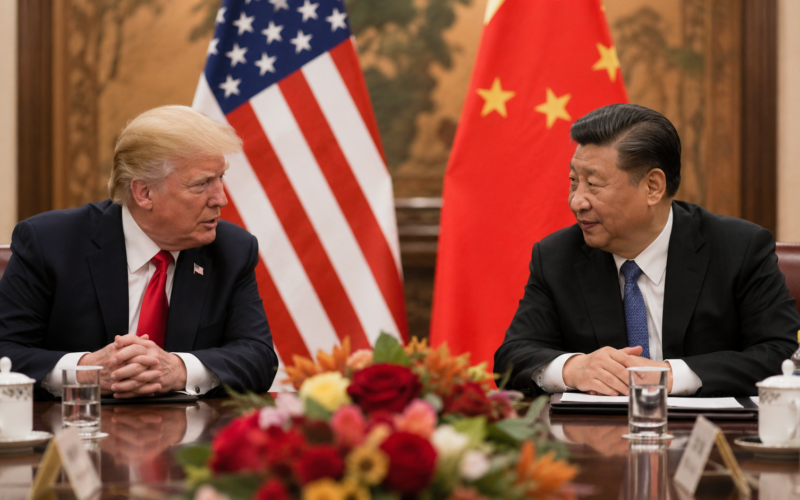
U.S. President Donald Trump and Chinese President Xi Jinping are set to continue talks in Beijing on Friday, May 15, 2026, as the two leaders close a two-day state visit shaped by trade announcements, diplomatic ceremony and a sharp warning from China over Taiwan. The visit has been framed by both governments as an effort to stabilise the world’s most consequential bilateral relationship, but the Taiwan issue has again emerged as the most sensitive flashpoint between the United States and China.
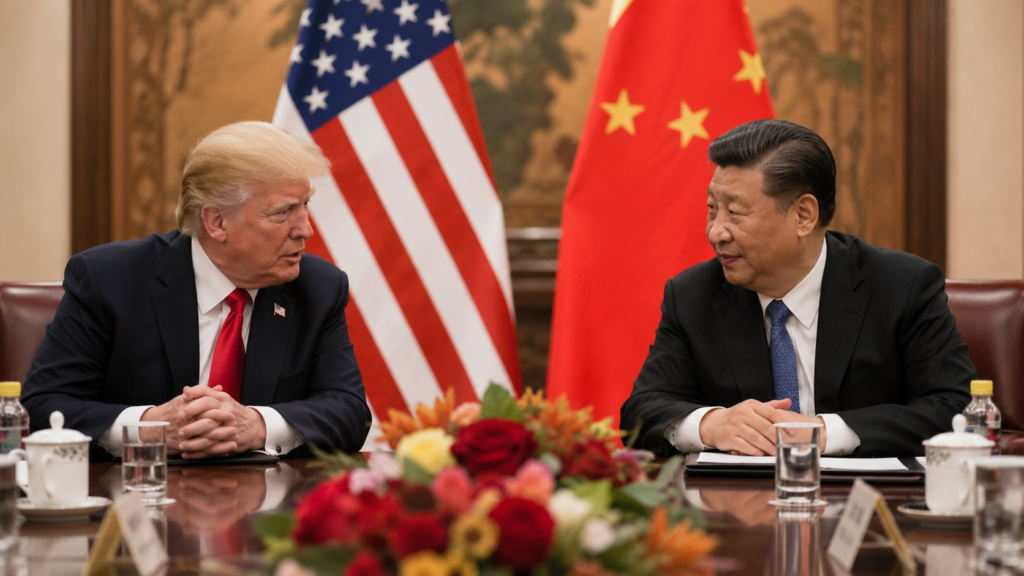
The talks follow a closed-door meeting on Thursday that lasted more than two hours at the Great Hall of the People. China’s Ministry of Foreign Affairs said Chinese President Xi Jinping told U.S. President Donald Trump that the Taiwan question remained the most important issue in China-United States relations and warned that poor handling of the matter could lead to clashes or even conflicts. The warning stood out because the broader visit also included formal welcomes, a state banquet, business delegation engagements and efforts to preserve a fragile trade truce between the two powers.
The two leaders are scheduled to have tea and lunch on Friday before U.S. President Donald Trump returns to the United States. Ahead of the second day of talks, U.S. President Donald Trump said on Truth Social that he hoped the United States relationship with China would become stronger and better than ever before. That upbeat public message contrasted with the sharper private and official language coming from Beijing over Taiwan, where China claims sovereignty and refuses to rule out the use of force.
Why did Taiwan become the central flashpoint in the Trump and Xi Beijing summit?
Taiwan moved to the centre of the summit because it sits at the intersection of Chinese sovereignty claims, United States security commitments and Indo-Pacific military risk. China’s Ministry of Foreign Affairs said Chinese President Xi Jinping described Taiwan as the most important issue in China-United States relations and said that “Taiwan independence” and peace across the Taiwan Strait were incompatible. The ministry also said the United States must exercise extra caution in handling the Taiwan question.
The United States position, as described by U.S. Secretary of State Marco Rubio during the visit, remained unchanged. U.S. Secretary of State Marco Rubio said Taiwan had been discussed, adding that China always raised the issue and that the United States always made its position clear before moving to other topics. He also said United States policy on Taiwan remained unchanged as of the summit.
Taiwan’s government responded by portraying China as the source of pressure in the Taiwan Strait. Taiwan’s Ministry of Foreign Affairs said China was the sole risk to peace after the remarks made during the summit, while Taiwan officials said Taipei remained in close contact with the United States side during the Trump and Xi Jinping meeting. Taiwan also expressed gratitude for repeated United States support.
How are trade deals and Boeing aircraft orders shaping the public optics of the visit?
Trade has remained the main area where both governments have sought visible progress. The summit is aimed in part at maintaining a fragile trade truce struck when U.S. President Donald Trump and Chinese President Xi Jinping last met in October 2025. Under that arrangement, U.S. President Donald Trump suspended triple-digit tariffs on Chinese goods, while Chinese President Xi Jinping moved away from curbs that could have tightened global rare earth supply.
U.S. Trade Representative Jamieson Greer said deals had been firmed up on Chinese purchases of farm goods, beef and Boeing aircraft. U.S. President Donald Trump told Fox News Channel that China had agreed to order 200 Boeing aircraft, marking the first Chinese purchase of United States commercial jets in nearly a decade. The number was below the 500 or more aircraft that markets had expected, and Boeing shares fell by more than 4 percent after the comments aired.
The trade discussions also included mechanisms to manage future bilateral trade. U.S. Trade Representative Jamieson Greer said both sides were expected to identify $30 billion of non-sensitive goods and added that the Taiwan issue should not derail progress. That framing shows how Washington is trying to keep commercial diplomacy separate from the strategic dispute over Taiwan, even as Beijing insists that Taiwan remains central to the broader relationship.
Why does the Strait of Hormuz discussion matter for United States and China diplomacy?
The summit has also moved beyond bilateral trade into global energy security, especially the Strait of Hormuz. A brief United States summary of Thursday’s talks highlighted what the White House described as a shared desire by the two leaders to reopen the Strait of Hormuz, a key waterway off Iran through which roughly a fifth of global oil and liquefied natural gas supplies normally pass.
The Strait of Hormuz discussion matters because it gives both governments a potential area of tactical cooperation at a time when other parts of the relationship remain highly strained. U.S. President Donald Trump has been expected to urge China to persuade Iran to reach a deal with Washington to end a war that has become unpopular with American voters. The same discussions have included China’s apparent interest in buying American oil to reduce its dependence on Middle Eastern supplies.
For China, the Strait of Hormuz issue links energy security, Middle East diplomacy and global trade flows. For the United States, it offers a way to test whether China is willing to act pragmatically on a crisis that affects both economies. U.S. Trade Representative Jamieson Greer said China did not want to be on the wrong side of the situation and that Washington had confidence Beijing would try to limit material support for Iran.
What does the summit reveal about the balance between ceremony and substance?
The Beijing visit has been heavy on ceremony. U.S. President Donald Trump was welcomed at the Great Hall of the People with a formal ceremony, military band performances, national anthems, a guard of honour and a 21-gun salute. The two leaders also appeared together at the Temple of Heaven and attended a state banquet, creating images of stability at a moment when the underlying strategic relationship remains deeply contested.
The ceremony helped both sides present the summit as a controlled and constructive engagement rather than a confrontation. Chinese President Xi Jinping said the China-United States relationship was the most important bilateral relationship in the world and that the two countries must make it work. U.S. President Donald Trump publicly praised Chinese President Xi Jinping and said the United States and China could do major things together.
Yet the substance of the talks shows that the relationship remains vulnerable to strategic shocks. Taiwan, trade, Iran, technology and global supply chains all remain active areas of tension. The summit appears designed less to resolve these disputes than to prevent them from breaking the wider relationship. That makes the second day of talks important not because it is expected to produce a sweeping reset, but because both governments are testing whether a managed rivalry can remain manageable.
How could the Trump and Xi talks affect the wider Indo-Pacific security environment?
The Indo-Pacific implications are significant because Taiwan is not only a bilateral issue between Washington and Beijing. The Taiwan Strait is central to regional security calculations involving Japan, South Korea, the Philippines, Australia and other United States partners. Any escalation around Taiwan would affect shipping routes, semiconductor supply chains, military deployments and alliance coordination across the Indo-Pacific.
China’s warning during the summit reinforces Beijing’s view that Taiwan is a core interest and that United States actions around Taiwan cannot be separated from the health of the wider China-United States relationship. Washington’s response, through U.S. Secretary of State Marco Rubio, was to emphasise continuity in United States policy. That continuity matters because the United States is bound by law to provide Taiwan with the means to defend itself, while also maintaining a longstanding policy that avoids recognising Taiwan as an independent state.
For Taiwan, the summit creates both reassurance and risk. The reassurance comes from repeated United States statements that policy remains unchanged. The risk comes from the possibility that Taiwan could become a bargaining pressure point in wider trade, energy or geopolitical negotiations. Taiwan’s public response indicates that Taipei is closely monitoring whether United States China diplomacy alters the practical balance of deterrence in the Taiwan Strait.
What are the key takeaways from the Trump and Xi talks after the Taiwan warning?
- The second day of talks between U.S. President Donald Trump and Chinese President Xi Jinping is not just a ceremonial wrap-up of the Beijing state visit, but a test of whether both governments can keep trade diplomacy moving while managing the Taiwan issue, the most politically sensitive dispute in the China-United States relationship.
- Chinese President Xi Jinping’s warning over Taiwan sharpened the tone of the summit by making clear that Beijing continues to view the Taiwan question as the core red line in relations with Washington, even as both sides publicly emphasise stability, economic engagement and high-level communication.
- The United States side has sought to separate commercial progress from strategic friction, with discussions covering Chinese purchases of farm goods, beef and Boeing aircraft, but the Taiwan warning shows that Beijing does not treat trade, security and sovereignty questions as fully separate tracks.
- Taiwan’s response underlined the wider Indo-Pacific stakes of the summit, as Taipei framed China as the principal source of cross-strait risk while continuing to look for reassurance that United States policy and support remain unchanged despite broader Trump-Xi negotiations.
- The summit’s business outcomes, including the expected Boeing aircraft order and possible commodity purchases, may help preserve the fragile trade truce, but investor and diplomatic attention is likely to remain fixed on whether those deals can survive renewed pressure from Taiwan, technology controls, tariffs and military competition.
- The Strait of Hormuz discussion added a global energy-security layer to the talks, showing that Washington and Beijing may still look for tactical cooperation on oil flows, Iran and supply-chain stability even while competing sharply over Taiwan and Indo-Pacific influence.
- The Beijing visit has projected diplomatic ceremony through state banquets, formal welcomes and leader-level messaging, but the underlying substance points to a managed rivalry rather than a reset, with both governments trying to prevent disputes from escalating into a broader rupture.
- For regional governments, the key signal from the Trump-Xi meeting is that Taiwan remains the highest-risk flashpoint in China-United States relations, and any shift in tone between Washington and Beijing will be closely watched by Japan, South Korea, the Philippines, Australia and other Indo-Pacific partners.
Discover more from Business-News-Today.com
Subscribe to get the latest posts sent to your email.