
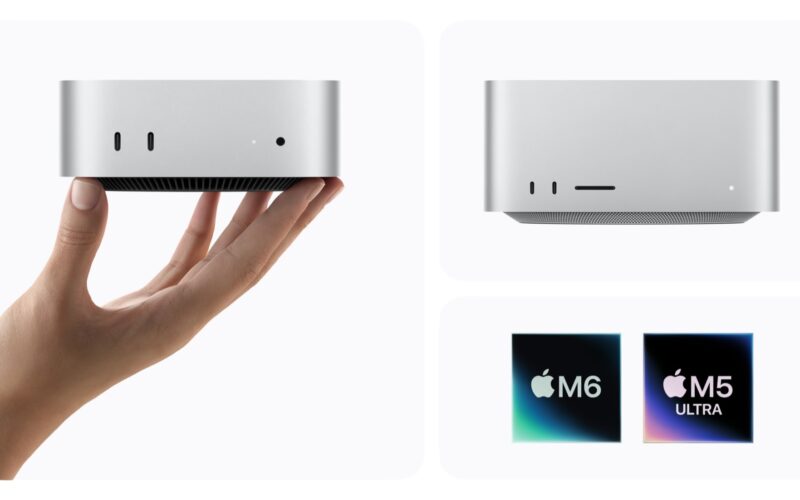
Apple Inc. (Nasdaq: AAPL) has launched new Mac mini and Mac Studio computers designed to run larger artificial intelligence models locally, presenting the machines as an alternative to repeatedly paying cloud providers for each unit of model usage. The Mac mini starts at $899, while the Mac Studio begins at $2,499 and reaches close to $20,000 in its most powerful configuration. Reuters reported that Apple is pursuing developers and enterprises that want predictable infrastructure costs, private data processing and enough unified memory to hold very large models.
The proposition is built on Apple silicon’s shared memory architecture, which allows the central processor, graphics processor and neural engines to access one high-bandwidth pool. The top M5 Ultra Mac Studio can be configured with 512 gigabytes of unified memory and more than 1.2 terabytes per second of memory bandwidth. Those specifications make model size and data movement, rather than conventional desktop productivity, central to the commercial message.
Apple is also enabling multiple Mac Studio systems to communicate through remote direct memory access over Thunderbolt 5. The company said clustered systems can deliver distributed inference performance up to three times that of a single machine, while Reuters described four Mac Studios running a trillion-parameter model from one wall outlet during a graphics debugging demonstration. The approach does not replace hyperscale training clusters, but it expands the range of sophisticated inference and development work that can remain on premises.
How do the new Mac mini and Mac Studio turn local AI into an enterprise proposition?
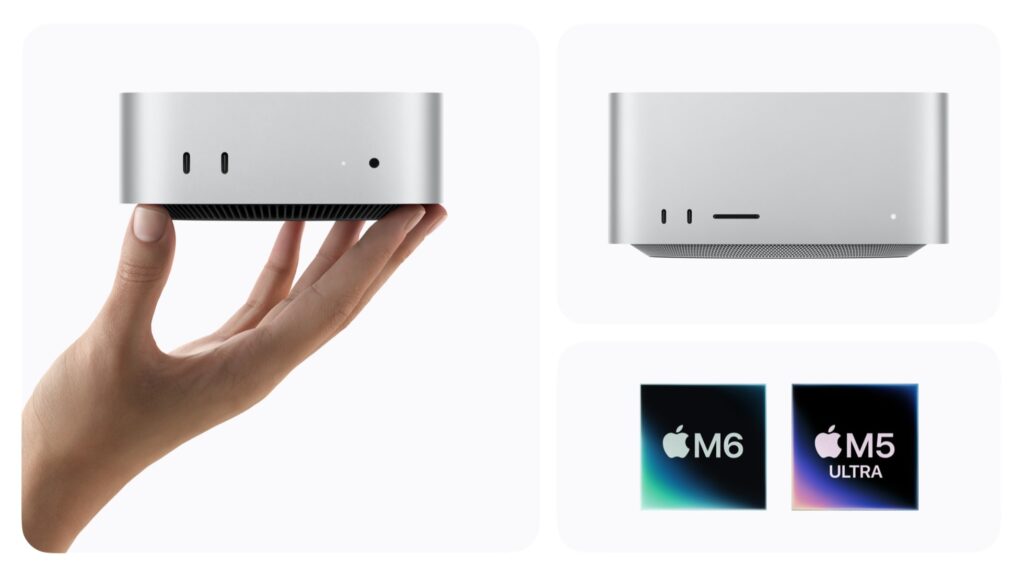
The new Mac range covers different points in the local-compute market. The M6 Mac mini starts with 16 gigabytes of memory and can be configured to 32 gigabytes, while the M5 Pro version supports as much as 64 gigabytes and 307 gigabytes per second of memory bandwidth. Mac Studio configurations extend much further, culminating in an M5 Ultra system with a 36-core CPU, an 80-core GPU and 512 gigabytes of unified memory.
That range lets a small software team begin with an inexpensive development box and move toward a workstation or a cluster without changing operating systems. Local execution can protect proprietary source code, customer records or design assets from leaving an organisation’s controlled environment. It can also keep tools available when connectivity is limited or a cloud service experiences an outage.
The cost argument becomes stronger for repetitive workloads. Cloud model providers generally charge by tokens, accelerator time or reserved capacity, so a heavily used internal coding assistant can generate a continuing operating expense. A Mac is purchased upfront and consumes electricity, support and staff time, giving buyers a different cost curve if utilisation remains high enough.
That does not mean local computing is automatically cheaper. Enterprises must account for deployment, security updates, model management, power, idle time and the risk that a machine becomes inadequate before it is fully depreciated. Apple’s case will be strongest where data sensitivity, predictable heavy usage and staff familiarity with macOS offset those operational burdens.
Why could unified memory and clustering lower the cost of running AI models?
Large models need extensive memory not only for parameters but also for context, caches and intermediate calculations. Conventional systems often divide CPU memory and GPU memory, forcing data transfers and limiting a workload to the capacity attached to individual accelerators. Apple’s unified architecture can reduce those transfers and make a larger share of installed memory directly useful to the model.
Thunderbolt 5 provides up to 120 gigabits per second of bandwidth, and the new remote direct memory access capability allows machines to exchange data without routing every transfer through conventional software layers. Apple said this can improve the efficiency of distributed inference across Mac Studio clusters. The practical benefit will depend on model architecture and communication overhead, so buyers should evaluate their own workloads rather than extrapolate from peak interface speed.
The economics differ sharply from Nvidia Corporation’s (Nasdaq: NVDA) data-centre systems. Nvidia offers far more mature scaling, software and performance for industrial training and high-throughput inference, while a Mac cluster provides a lower-power route for selected models and smaller teams. The two can coexist, with organisations training or fine-tuning in the cloud and then deploying compressed models locally.
Reuters said demand related to the open-source OpenClaw agent contributed to Mac mini sell-outs in China, illustrating how software enthusiasm can create sudden hardware demand. That episode supports Apple’s view that compact systems can become AI appliances, but it also shows the volatility of demand tied to fast-moving developer trends. Sustained enterprise purchases will require managed deployment, dependable frameworks and measurable productivity rather than one popular agent.
Can Apple challenge Microsoft and Nvidia in enterprise AI computing?
Apple starts from a small enterprise desktop position. IDC data cited by Reuters put Apple’s share at 4.6%, compared with 91.3% for systems running Microsoft Corporation’s (Nasdaq: MSFT) Windows. Corporate procurement, identity management, line-of-business software and technical support are deeply embedded around Windows, creating switching costs that hardware specifications alone cannot remove.
Microsoft is also pursuing what it calls unmetered intelligence by placing more AI capability on PCs, so Apple does not own the local-compute concept. Windows systems can draw on a wide range of Nvidia, Advanced Micro Devices and Qualcomm hardware, while Microsoft connects endpoints to Azure services and enterprise security controls. Apple’s more vertically controlled stack offers consistency, but Windows offers choice and a much larger installed base.
Nvidia presents a different challenge because its CUDA software environment has become a standard for advanced AI development. Many models and libraries are optimised first for Nvidia accelerators, and enterprises value compatibility with cloud instances that use the same tools. Apple needs frameworks such as MLX, broad model support and easy conversion paths to prevent memory capacity from becoming an impressive specification that developers struggle to exploit.
The opportunity is therefore narrower but still material. Apple can win local inference, prototyping, creative production and privacy-sensitive development without displacing data-centre accelerators or Windows across an entire company. If Mac clusters become approved departmental infrastructure, Apple could expand enterprise revenue while strengthening demand for its chips, operating system and services.
What does Apple’s stock performance say about the launch?
Apple shares closed at $339.75 on 22 September, up 0.23%, after touching an intraday high near $345 and briefly crossing a $5 trillion market value. The restrained closing move suggests the new Macs were supportive rather than transformative for a company of Apple’s size. Investors are likely to view the systems as one component of a much broader valuation built on iPhone demand, services, margins and expectations for artificial intelligence across the product portfolio.
The stock reaction also reflects the difference between a product capability and a reported financial contribution. Apple has not disclosed how many Mac Studio clusters it expects to sell, what share will be used for AI, or whether higher memory configurations will materially lift Mac gross profit. Quarterly Mac revenue, average selling prices and enterprise commentary will provide better evidence than launch-day market capitalisation.
For customers, the most important comparison is total cost over the expected life of a workload. A nearly $20,000 Mac Studio can look expensive beside a normal desktop but inexpensive beside months of continuously rented accelerator capacity, provided it remains fully used and sufficiently powerful. Procurement teams should test model latency, energy use, software compatibility and staff time before treating token avoidance as a saving.
Apple’s strategic advantage is that local AI can strengthen the value of hardware even when the company does not sell the underlying model. Its strategic risk is that cloud systems improve faster, making expensive local configurations obsolete or confining them to specialised work. The first evidence will come from availability, developer adoption and enterprise deployments after the 22 September release, with the 512-gigabyte Mac Studio scheduled to follow in late October.
Discover more from Business-News-Today.com
Subscribe to get the latest posts sent to your email.