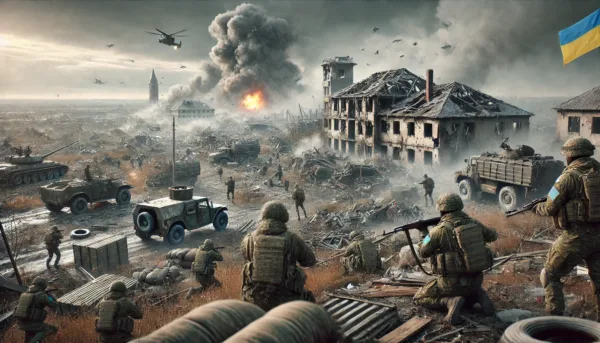


Ukraine used air-launched cruise missiles to strike an electronics manufacturing facility in the Russian city of Voronezh on June 22, 2026, in an attack that Ukraine identified as part of its campaign against Russia’s defence-industrial network. Voronezh regional authorities reported that five people were killed and several dozen sought medical treatment following the missile attack. An industrial facility on the left bank of the Voronezh River sustained extensive damage, while 10 apartment buildings and six privately owned homes were also affected. The Ukrainian General Staff said the facility produced electronic components used in Russian missiles, particularly the Iskander tactical missile system. The strike illustrates how the Russia-Ukraine war is expanding further into industrial centres and urban areas located far beyond the immediate ground battlefront.
The Ukrainian General Staff described the targeted Voronezh facility as an important component of Russian defence production. Russian authorities confirmed that an industrial enterprise had been struck but did not publicly identify the plant or confirm Ukraine’s description of its military function. Large fires and columns of black smoke were visible at multiple points inside the industrial complex following the attack.
The Voronezh strike occurred during another major exchange of missiles and drones between Russia and Ukraine. Russian attacks killed civilians in several Ukrainian regions, while Russian authorities reported intercepting hundreds of Ukrainian drones across Russian territory, Russian-occupied Crimea and surrounding maritime areas. Airports serving Moscow temporarily suspended flights as air-defence forces responded to drones approaching the Russian capital.
What happened during Ukraine’s June 22 missile strike on the Voronezh electronics plant?
The Ukrainian General Staff said the Ukrainian Air Force used precision air-launched cruise missiles against the Voronezh facility. Ukraine stated that other military units also participated in the operation, including formations responsible for unmanned systems. The statement indicated that the Voronezh strike formed part of a coordinated military operation rather than an isolated drone attack.
Voronezh is located less than 200 kilometres from the Ukrainian border and serves as an important industrial and logistical centre in western Russia. The city’s proximity to Ukraine places it within the range of several Ukrainian strike systems, while its industrial base makes the region significant to Russia’s broader military supply network.
Voronezh Governor Alexander Gusev said an industrial enterprise on the left bank of the Voronezh River sustained the most serious damage. A fire broke out at the facility before emergency personnel extinguished it. Alexander Gusev reported five deaths and said several dozen residents sought medical assistance, although most were allowed to return home after treatment.
The attack also caused damage beyond the industrial complex. Ten apartment buildings and six private homes were affected, demonstrating the risk faced by residents when military-linked production facilities are located within populated urban environments. Russian air-defence units had earlier reported destroying several high-speed targets above Voronezh, but the damage confirmed on the ground showed that the defensive response did not prevent the industrial site and nearby residential areas from being hit.
Images recorded after the attack showed thick smoke rising from at least two locations within the factory complex. The visual evidence established that the facility suffered a significant fire, although it did not reveal which production buildings, machines, component stocks or technical systems were damaged.
The confirmed facts therefore remain narrower than some of the initial claims surrounding the attack. A major industrial facility in Voronezh was struck, five deaths were reported, dozens of people required medical attention and nearby residential buildings were damaged. Ukraine identified the facility as a missile-electronics producer, while Russian regional authorities confirmed the industrial damage without publicly detailing the plant’s defence role.
Why does the Voronezh facility matter to Russia’s missile production and defence supply network?
The Ukrainian General Staff said the Voronezh plant manufactured electronics used in Russian missiles, including the Iskander tactical missile system. Iskander missiles have been used extensively during Russia’s war against Ukraine and can carry different conventional warheads against military installations, infrastructure and other targets.
Electronic components are essential to modern missile production because they support navigation, guidance, targeting, communications and onboard control systems. Damage to specialised electronics manufacturing can affect weapons production differently from damage to basic assembly buildings because advanced components may require precision equipment, controlled production environments and specialised technical personnel.
The strategic impact of the Voronezh strike will depend on which parts of the facility were damaged. A fire affecting offices, storage areas or non-essential buildings would have a different operational consequence from damage to fabrication equipment, testing laboratories, clean production rooms or inventories of difficult-to-replace electronic components.
Neither Russia nor Ukraine had provided a detailed assessment by June 23 showing how much production capacity was lost. There was also no confirmed information establishing how long repairs could take, whether manufacturing could be transferred to another facility or whether Russia held sufficient component reserves to maintain missile assembly.
The attack nevertheless places additional pressure on Russia’s defence-industrial protection system. Russian authorities must defend military bases, weapons factories, oil refineries, transport infrastructure, energy facilities, communications sites and major cities across a large geographic area. Each additional facility requiring protection forces Russia to distribute air-defence systems across more locations.
Ukraine’s campaign against weapons manufacturing is intended to affect the supply chain behind Russian attacks rather than only targeting missile launchers after deployment. The Voronezh operation therefore represents an attempt to reach further upstream into the production process, where electronics, engines, guidance systems and other specialised parts are manufactured.
How does the Voronezh attack fit into Ukraine’s expanding long-range campaign inside Russia?
Ukraine has increasingly used drones and missiles against military production facilities, oil refineries, fuel depots, transport systems and other infrastructure inside Russia. The Voronezh strike differs from many earlier attacks because Ukraine said air-launched cruise missiles were used against a specific defence-related industrial target.
The participation of Ukrainian unmanned-systems units alongside other forces suggests that the operation involved more than one military capability. Drones can be used for surveillance, reconnaissance, air-defence pressure or direct attack, while cruise missiles can deliver larger warheads at higher speeds against selected targets. Ukraine did not disclose the full operational sequence.
Russia reported a much broader Ukrainian air operation during the same period. Russian authorities said 84 drones approaching Moscow were intercepted over approximately 24 hours. The Russian Ministry of Defence reported that 301 Ukrainian drones were intercepted across multiple Russian regions, Russian-occupied Crimea, the Black Sea and the Sea of Azov.
Those figures were issued by Russian institutions and were not independently confirmed in full. However, temporary flight restrictions at Sheremetyevo, Domodedovo, Vnukovo and Zhukovsky airports demonstrated the operational disruption created by the attacks even when Russian authorities reported successful interceptions.
Ukraine’s long-range strategy imposes costs beyond the physical destruction caused by individual strikes. Russia must activate air defences, suspend aviation, deploy emergency services, protect industrial plants and repair affected facilities. Repeated attacks can also interrupt production schedules, transport movements and civilian activity even when the immediate structural damage is limited.
Russia continues to possess a substantially greater capacity to conduct large missile and drone attacks across Ukraine. Russian forces can strike Ukrainian cities, energy networks, industrial sites and military positions from several directions using ballistic missiles, cruise missiles, aerial bombs and long-range drones. Ukraine’s expanding strike range has increased Russia’s exposure without eliminating the broader imbalance in long-range firepower.
What did simultaneous Russian attacks on Sumy, Zaporizhzhia and Odesa reveal about the widening conflict?
Russian attacks across Ukraine killed at least six civilians during the same period as the Voronezh strike. The incidents showed that long-range operations by both countries were occurring simultaneously across a broad geographic area rather than as isolated exchanges confined to the front line.
A Russian drone struck a home in Ukraine’s northeastern Sumy region, killing a 13-year-old boy, his father and his grandmother. The boy’s mother and his 10-year-old brother were injured. Ukrainian authorities stated that the building was a civilian residence and that no military facility was located at the site.
Additional Russian attacks caused deaths and injuries in Zaporizhzhia and Odesa. Russian weapons struck residential and civilian infrastructure, damaged property and triggered fires. The attacks reinforced the vulnerability of cities located both near and far from active ground combat.
Ukraine’s Air Force said Russia launched 88 long-range attack drones and one ballistic missile during the overnight assault. Ukrainian air defences and electronic-warfare systems reportedly intercepted or disrupted 79 of the drones. The remaining weapons still caused casualties and damage, demonstrating that a high interception rate does not eliminate civilian risk during large-scale attacks.
The simultaneous operations also highlight the different strategic objectives pursued by Russia and Ukraine. Russia continues broad attacks against Ukrainian territory, including populated areas and critical infrastructure. Ukraine is increasingly directing long-range weapons at Russian military production, energy, logistics and communications facilities.
The geographic separation between the front line and the affected cities is becoming less relevant as missile and drone ranges increase. Voronezh, Moscow, Sumy, Zaporizhzhia and Odesa were all affected by the same cycle of strikes despite their different locations and military significance.
Why are civilian casualties increasing as Russia and Ukraine use more missiles and drones?
The United Nations Human Rights Monitoring Mission in Ukraine verified that at least 274 civilians were killed and 1,763 were injured in Ukraine during May 2026. The combined total was the highest monthly civilian casualty figure recorded in Ukraine since April 2022.
Long-range weapons, including missiles and drones, accounted for 45 percent of the verified civilian casualties during May. These weapons killed at least 115 civilians and injured 803, with many casualties occurring in urban centres located far from the front line.
Short-range drones were also responsible for record civilian harm near the front. The United Nations verified that short-range drones killed at least 64 civilians and injured 539 during May, the highest monthly total involving that weapon category since Russia launched its full-scale invasion on February 24, 2022.
The figures demonstrate how the growing availability and use of unmanned systems have expanded the areas in which civilians face danger. Missiles and long-range drones can reach major cities hundreds of kilometres from active ground fighting, while smaller drones create persistent risks for residents in frontline communities.
The Voronezh attack shows that similar risks are increasingly affecting civilians inside Russia. Five deaths and damage to residential buildings were reported even though Ukraine identified the principal target as an industrial facility supporting missile production.
International humanitarian law requires parties to armed conflict to distinguish between military objectives and civilian objects. It also requires attacks to comply with proportionality obligations and for feasible precautions to be taken to reduce civilian harm. The publicly available information about the Voronezh strike was not sufficient to determine the full military damage, targeting process or circumstances surrounding the civilian casualties.
What remains unknown about the Voronezh plant’s damage and Russia’s ability to restore production?
The most important unresolved question is whether the strike damaged specialised manufacturing capacity or primarily caused visible fires and structural damage. Smoke and flames can demonstrate that a facility was hit without establishing whether its most important production equipment was destroyed.
The size of any effect on Russian missile production will depend on the availability of replacement machines, reserve components, alternative suppliers and other manufacturing sites. Russia has expanded defence production during the war and has repeatedly repaired or adapted facilities following Ukrainian attacks.
There is no confirmed figure for the number of missile components produced at the Voronezh facility, the proportion of Russian demand supplied by the plant or the quantity of finished components stored there when the attack occurred. There is also no public evidence showing that the strike immediately reduced the number of missiles available to Russian forces.
Future evidence may emerge through satellite imagery, repair activity, procurement changes, factory announcements or additional strikes against the same industrial network. Changes in the frequency or composition of Russian missile attacks could also provide information, although such changes may have several causes unrelated to a single factory.
The broader significance is already clearer. Ukraine has demonstrated that an industrial facility inside a major Russian city can be reached by air-launched cruise missiles. Russia has demonstrated that it retains the capacity to conduct large drone and missile attacks throughout Ukraine. Civilians in both countries are increasingly exposed as the conflict expands deeper into urban and industrial territory.
What are the key takeaways from Ukraine’s strike on the Voronezh missile electronics plant?
- Ukraine said its Air Force used precision air-launched cruise missiles to strike an electronics manufacturing facility in Voronezh on June 22, 2026, less than 200 kilometres from the Ukrainian border.
- Voronezh Governor Alexander Gusev reported that five people were killed and several dozen sought medical assistance, although most of those treated were subsequently allowed to return home.
- An industrial enterprise on the left bank of the Voronezh River sustained the most extensive damage, while 10 apartment buildings and six privately owned homes were also affected by the attack.
- The Ukrainian General Staff identified the target as a facility producing electronic components for Russian missiles, particularly the Iskander tactical missile system, while Russia did not publicly confirm the plant’s military function.
- Images recorded after the strike showed large columns of black smoke rising from multiple locations within the industrial complex, but the extent of damage to manufacturing equipment and production capacity remained unknown.
- Russian authorities reported intercepting 84 drones approaching Moscow and 301 drones across a wider area that included Russian regions, Russian-occupied Crimea, the Black Sea and the Sea of Azov.
- Russian attacks during the same period killed civilians in Sumy, Zaporizhzhia and Odesa, including three members of one family who died when a drone struck their home in the Sumy region.
- United Nations monitors verified 274 civilian deaths and 1,763 injuries in Ukraine during May 2026, the highest combined monthly civilian casualty total recorded in the country since April 2022.
Discover more from Business-News-Today.com
Subscribe to get the latest posts sent to your email.