


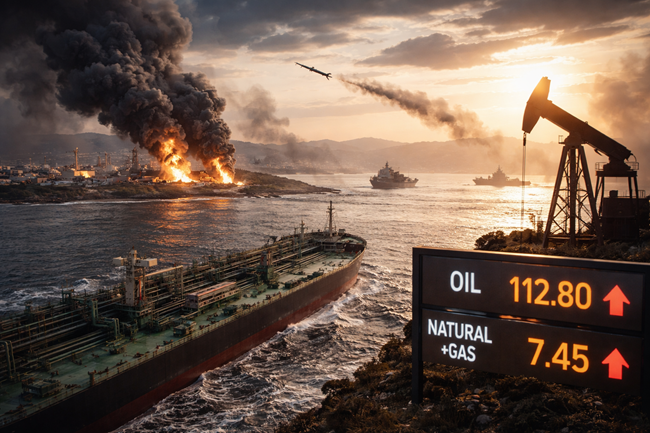
Global energy prices surged on Tuesday, March 3, 2026 as the Strait of Hormuz, the world’s most critical oil and gas shipping corridor, moved toward a de facto closure following coordinated United States and Israeli airstrikes on Iran launched on February 28, 2026, under Operation Epic Fury. The strikes killed Iran’s Supreme Leader Ali Khamenei and other senior officials of the Islamic Republic of Iran, prompting retaliatory missile and drone attacks by Iran’s Islamic Revolutionary Guard Corps against Israeli cities and United States military bases in the United Arab Emirates, Qatar, and Bahrain.
Brent crude futures surged more than 14% over two trading sessions, reaching $83.39 per barrel by the morning of Tuesday, March 3, 2026. United States West Texas Intermediate crude oil rose approximately 7% to $76.31 per barrel. European natural gas prices soared more than 70% over the same period, with the Dutch Title Transfer Facility front-month contract rising more than 40% to 45.38 euros per megawatt hour and the British futures contract up approximately 30%.
What is the Strait of Hormuz and why does it control global oil and gas prices?
The Strait of Hormuz, located between Iran and Oman at the southern end of the Persian Gulf, is 33 kilometres wide at its narrowest point, with unidirectional shipping lanes approximately three kilometres wide in each direction. According to the United States Energy Information Administration, the strait carried an average of 20 million barrels of oil and oil products per day in 2024, representing approximately 20% of global petroleum liquids consumption. The waterway also serves as the transit route for approximately 20% of global liquefied natural gas exports, predominantly originating from Qatar.
The strait’s strategic importance derives from the concentration of major oil-exporting nations whose only viable maritime export route passes through it. Saudi Arabia, Iraq, Iran, Kuwait, Qatar, and the United Arab Emirates all depend on unimpeded transit through the Strait of Hormuz to reach international markets. While limited overland pipeline alternatives exist, analysts at Morningstar have noted these are nowhere near sufficient to replace flows through the strait. Iran has repeatedly used the threat of Hormuz closure as a strategic lever during periods of tension with the United States and Israel, most recently during a brief partial closure in mid-February 2026 that preceded the current conflict by approximately two weeks.
How did the Iran crisis formally close the Strait of Hormuz to commercial shipping?
On March 2, 2026, a senior commander of Iran’s Islamic Revolutionary Guard Corps officially confirmed that the Strait of Hormuz was closed and warned that any vessel attempting to pass through the waterway would be set ablaze. By shortly after midnight on March 2, vessel-tracking data showed no tankers in the strait broadcasting automatic identification system signals. Protection and indemnity insurance for vessel transits was withdrawn effective March 5, 2026, making the economic risk of passage prohibitive for most commercial ship operators.
The closure has been achieved primarily through insurance withdrawal rather than a formal naval blockade, a distinction with legal and diplomatic significance but no practical relevance for commercial operators. Commodity intelligence firm Kpler described the situation as a de facto closure, comparable in mechanism to the Red Sea shipping disruption of 2023 to 2025 but involving volumes many times larger. War-risk insurance premiums rose from 0.125% to between 0.2% and 0.4% of insured vessel value per transit in the days before the strikes, representing an increase of approximately $250,000 for very large crude carriers.
Major container shipping companies including Denmark’s Maersk, Germany’s Hapag-Lloyd, and France’s CMA CGM suspended or sheltered their vessels. The United Kingdom Maritime Trade Operations Center reported attacks on several vessels and warned of elevated electronic interference to navigation systems. A bomb-carrying drone boat struck a Marshall Islands-flagged oil tanker in the Gulf of Oman, killing one mariner. At least five tankers have been damaged, two personnel killed, and approximately 150 ships are stranded in the vicinity of the strait.
Why did QatarEnergy halt LNG production and what does it mean for European gas markets?
Qatar’s state-owned energy company QatarEnergy announced it would pause liquefied natural gas production following military attacks on QatarEnergy’s operating facilities. QatarEnergy did not provide a timetable for resuming output. Qatar operates the world’s largest single-site liquefied natural gas production complex and is among the three largest liquefied natural gas exporters globally.
The halt triggered the sharpest single-week rise in European natural gas prices in years. Europe’s exposure is structurally significant because European nations have relied heavily on Qatari liquefied natural gas imports since 2022 to replace Russian pipeline gas supplies cut following Russia’s full-scale invasion of Ukraine. Any prolonged interruption to QatarEnergy output or to liquefied natural gas transit through the Strait of Hormuz would directly affect European household energy costs, industrial output, and power generation capacity heading into the spring 2026 refilling season for European gas storage.
How are Iran’s attacks on Gulf energy infrastructure affecting oil production beyond the Strait of Hormuz?
Iran’s retaliatory strikes targeted a broader range of Gulf energy infrastructure beyond the strait itself. Saudi Arabia’s largest oil refinery sustained damage from Iranian strikes. The Jebel Ali port in the United Arab Emirates, one of the region’s primary container transshipment hubs, was also struck. Iraqi oil production in southern and Kurdish-administered areas was curtailed, with the Kormor gas field halting operations as a precautionary measure. These attacks broadened the scope of the energy disruption from a shipping chokepoint event to a production and infrastructure crisis across multiple Gulf Cooperation Council member states simultaneously.
What are the oil price forecasts and how do analysts assess the duration risk?
Analysts at Barclays told clients that Brent crude could reach $100 per barrel if the security situation in the Middle East escalates further. Analysts at UBS said a material disruption could push Brent spot prices above $120 per barrel. JPMorgan said a three- to four-week restriction on Strait of Hormuz traffic could force Gulf producers to curtail output and push Brent above $100 per barrel. Citi analysts forecast Brent to trade between $80 and $90 per barrel in the near term. Goldman Sachs noted that globally visible oil inventories stand at 7.827 million barrels, sufficient to cover approximately 74 days of demand, providing some near-term buffer against the disruption.
Eight member states of the OPEC+ oil producers’ alliance pledged a combined production increase of 206,000 barrels per day for April 2026. However, analysts at RBC Capital noted that every OPEC+ producer except Saudi Arabia is currently producing at or near capacity, significantly limiting the alliance’s ability to offset a prolonged Hormuz supply disruption through additional output.
United States President Donald Trump said on March 2, 2026 that the United States military projected a campaign duration of four to five weeks against Iran, while retaining the capability to continue operations far longer. JPMorgan Chase Chief Executive Jamie Dimon said that if the conflict is prolonged, the inflationary impact would become materially significant. GasBuddy analyst Patrick de Haan estimated that the crude oil price spike would push United States retail gasoline prices up by 10 to 30 cents per gallon on average in the near term, with some stations potentially seeing increases of up to 85 cents.
Which countries face the greatest economic exposure to the Strait of Hormuz crisis?
The concentration of risk falls most heavily on major Asian economies. China, India, Japan, and South Korea collectively account for approximately 69% of all crude oil and condensate flows through the Strait of Hormuz, with approximately 84% of crude oil and condensate shipments transiting the strait destined for Asian markets. A sustained closure would directly affect manufacturing, transportation networks, and power generation across East and Southeast Asia’s largest economies, with potential cascading effects on global supply chains.
European nations face acute exposure through the liquefied natural gas channel, while the United States, as a net energy exporter, is positioned to benefit from higher crude prices. Shares in Exxon Mobil, Chevron, and ConocoPhillips rose sharply in early trading following the outbreak of hostilities. Shipping companies rerouting vessels around Africa’s Cape of Good Hope face transit time increases of several weeks and significantly higher operating costs, adding further pressure to global freight rates.
What this means: Key developments in the Iran Strait of Hormuz energy crisis
- Brent crude oil surged more than 14% over two trading sessions to $83.39 per barrel by March 3, 2026, while European natural gas prices rose more than 70% following Iran’s official closure of the Strait of Hormuz and QatarEnergy’s halt to liquefied natural gas production.
- The Strait of Hormuz carries approximately 20% of global petroleum liquids consumption and 20% of global liquefied natural gas exports daily; the de facto closure resulted primarily from withdrawal of protection and indemnity insurance effective March 5, 2026, rather than a formal naval blockade.
- Iran’s Islamic Revolutionary Guard Corps struck Saudi Arabia’s largest oil refinery, the Jebel Ali port in the United Arab Emirates, and Iraqi oil production fields, extending the energy disruption beyond shipping to regional production and infrastructure.
- OPEC+ pledged an additional 206,000 barrels per day for April 2026, but analysts at RBC Capital noted that every OPEC+ producer except Saudi Arabia is at or near production capacity, limiting the alliance’s buffer capacity.
- China, India, Japan, and South Korea account for approximately 69% of crude flows through the Strait of Hormuz and face the greatest direct exposure; investment banks including Barclays, UBS, and JPMorgan have flagged the potential for Brent crude to exceed $100 per barrel if the disruption extends beyond three to four weeks.
Discover more from Business-News-Today.com
Subscribe to get the latest posts sent to your email.