
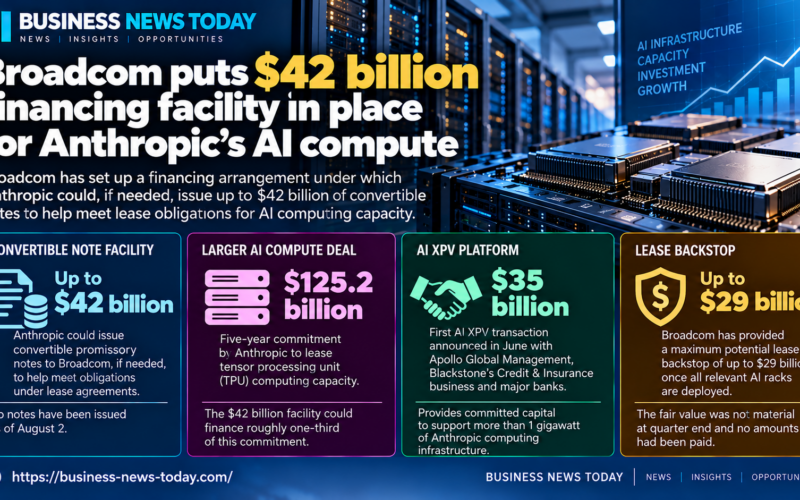
Broadcom Inc. (NASDAQ: AVGO) has put in place a financing arrangement under which Anthropic PBC could, under specified conditions and if needed, issue up to $42 billion of convertible promissory notes to Broadcom to help meet obligations associated with leased artificial intelligence computing capacity, adding a remarkable financial dimension to one of the fastest-growing relationships in the AI semiconductor industry.
Reuters reported the Anthropic connection on October 1 after reviewing the artificial intelligence company’s confidential initial public offering prospectus. Broadcom had already disclosed the underlying mechanics in its September quarterly filing without naming the customer, stating that convertible notes with an aggregate principal amount of up to $42 billion could be issued in connection with lease agreements that provide access to compute capacity. Crucially, Broadcom also disclosed that no such notes had been issued as of August 2, meaning the headline $42 billion is a conditional financing ceiling rather than cash already advanced to Anthropic.
The facility could finance roughly one-third of a $125.2 billion five-year commitment by Anthropic to lease tensor processing unit, or TPU, computing capacity, according to Reuters’ review of the prospectus. The arrangement places Broadcom in an unusually broad position because it is not simply designing semiconductor technology for Anthropic’s infrastructure. Through a wider network of agreements, Broadcom is involved in the chips, networking, equipment financing and financial architecture supporting the capacity Anthropic expects to consume.
That makes the central question more interesting than whether Broadcom is lending an AI company $42 billion. The deeper issue is whether semiconductor suppliers increasingly have to help finance their customers in order to sustain the extraordinary level of infrastructure spending now underpinning frontier artificial intelligence.
Is Broadcom really lending Anthropic $42 billion in cash?
The headline number requires careful interpretation. Broadcom’s own Form 10-Q says the customer may, under certain circumstances and if needed, issue convertible promissory notes to Broadcom with aggregate principal of up to $42 billion. The proceeds, if any, must be used solely for the customer’s obligations under the associated lease arrangements.
That is materially different from Broadcom transferring $42 billion into Anthropic’s bank account immediately. The notes are conditional, the maximum amount may never be drawn, and Broadcom said none had been issued as of August 2. Reuters additionally reported that Broadcom could designate a financing partner and that Anthropic did not expect any of the notes to be sold before completion of its proposed initial public offering.
The structure nevertheless creates potentially significant exposure because Broadcom could ultimately become both an important technology supplier and a creditor to one of its most consequential AI customers. If convertible notes are eventually issued, Broadcom could also gain the ability to convert debt instruments into Anthropic equity under the terms described in the confidential prospectus.
This is therefore better understood as a large contingent vendor-financing facility rather than a conventional $42 billion corporate loan that has already been funded. That distinction matters enormously for investors assessing Broadcom’s liquidity, risk and potential return.
Why should the $42bn facility, $35bn XPV and $29bn backstop not be added together?
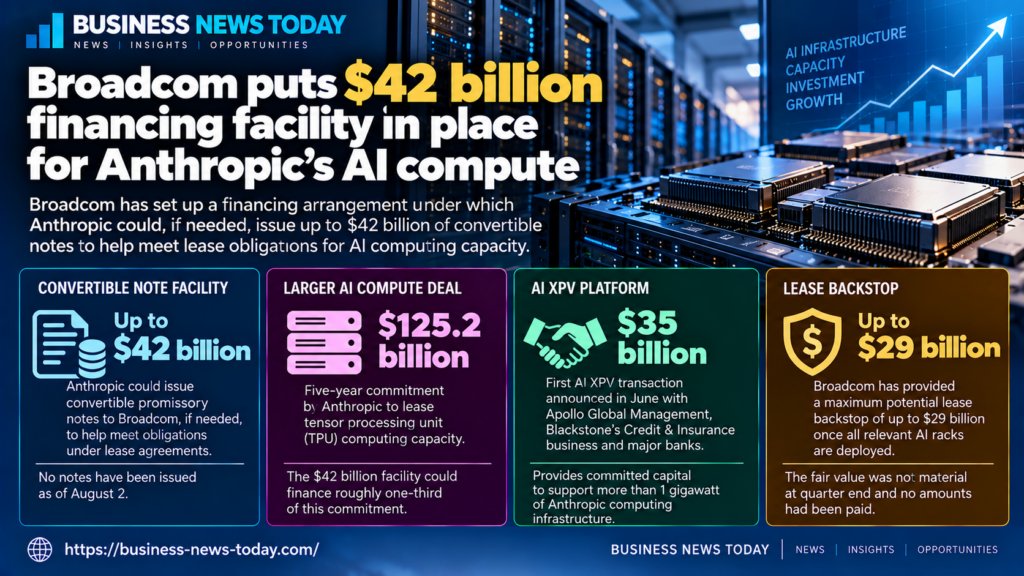
Broadcom’s AI financing structure contains several enormous numbers, but treating them as separate piles of incremental exposure would produce a misleading picture. The $42 billion convertible-note ceiling, the $35 billion AI XPV transaction announced in June and Broadcom’s maximum potential $29 billion lease backstop represent different layers of an interconnected financing system.
Broadcom launched its AI XPV Platform in June with Apollo Global Management, Blackstone’s Credit & Insurance business and major banks. The first transaction provides $35 billion of committed capital across a multi-year draw schedule to support more than 1 gigawatt of Anthropic computing infrastructure, while the broader XPV Platform is designed to enable more than 20 gigawatts of AI compute capacity through 2028.
Under that structure, financial investors take on agreements to purchase AI racks built around custom accelerators designed by Broadcom and then support leases that give the AI customer access to the computing capacity. Broadcom, however, has provided a backstop covering certain lease obligations. Its September filing put the maximum potential undiscounted liability under that backstop at approximately $29 billion once all relevant AI racks are deployed.
That does not mean Broadcom has $29 billion of current losses or even a $29 billion booked liability. Broadcom said the fair value of the backstop was not material at the end of the quarter and that no amounts had been paid under it. The potential liability would arise in a lease-default scenario and is calculated after taking account of the value recovered from selling the AI racks.
The $42 billion convertible-note facility provides another potential mechanism for supporting lease payments if required. The figures therefore interact economically and should not be summed to suggest that Broadcom has suddenly assumed $106 billion of separate exposure. The more useful question is how much risk Broadcom ultimately retains after outside investors, leases, collateral values, convertible financing and contractual protections are taken into account.
Why is Broadcom willing to take financing risk to support Anthropic?
The commercial prize is unusually large. Anthropic said in April that it had agreed with Google and Broadcom to access multiple gigawatts of next-generation TPU capacity beginning in 2027, with Broadcom subsequently disclosing that approximately 3.5 gigawatts of Anthropic capacity would be accessed through its technology as part of the broader deployment.
Anthropic’s own growth helps explain why so much infrastructure is being contracted. In April, the company said its revenue run rate had surpassed $30 billion, up from approximately $9 billion at the end of 2025, while the number of business customers spending more than $1 million on an annualised basis had doubled to more than 1,000 in less than two months. A revenue run rate is not the same as recognised annual revenue, but it indicates why Anthropic and its infrastructure suppliers are racing to secure capacity well before future demand is fully realised.
Broadcom is already benefiting from the wider AI buildout. Fiscal third-quarter 2026 AI semiconductor revenue reached $16.7 billion, up 221% from a year earlier and 54% sequentially. Broadcom expects AI semiconductor revenue to reach approximately $21.7 billion in the fourth quarter, which would represent growth of 236% year over year.
Total fiscal third-quarter revenue reached $29.6 billion, up 86%, while Broadcom generated $13.7 billion of free cash flow and ended the quarter with approximately $24.0 billion of cash and cash equivalents. The comparison is important because a $42 billion financing ceiling exceeds Broadcom’s quarter-end cash balance, reinforcing why the facility should not be interpreted as an immediate cash commitment. Broadcom has strong internal cash generation, but the structure has explicitly been designed to bring private capital and financing partners alongside the semiconductor supplier.
How does the Broadcom and Google TPU relationship fit into Anthropic’s expansion?
Broadcom’s role begins well before the financing layer. Google LLC and Broadcom have a long-term agreement covering the development and supply of future generations of Google Tensor Processing Units, along with networking and other components for next-generation AI racks through as late as 2031.
Anthropic uses several hardware platforms rather than committing exclusively to one semiconductor ecosystem. The company has said it trains and runs Claude using Amazon Web Services Trainium processors, Google TPUs and NVIDIA GPUs, allowing workloads to be matched with different chips. Amazon remains Anthropic’s primary cloud provider and training partner, while the Google and Broadcom relationship gives Anthropic another very large source of compute capacity.
That diversification makes Broadcom’s position especially interesting. Broadcom does not need Anthropic to abandon NVIDIA or Amazon Web Services to build a major business. It needs Anthropic’s overall compute consumption to grow fast enough that custom TPU infrastructure becomes increasingly important alongside those alternatives.
The arrangement also illustrates why the AI semiconductor market is becoming less like a traditional component business. Broadcom is not simply shipping chips to a customer and collecting an invoice. Its economics increasingly extend into custom silicon design, networking, rack infrastructure, leases, financing partners, residual-value protection and the long-term availability of power-intensive computing capacity.
What risk does Broadcom carry if Anthropic cannot meet its commitments?
The greatest financial concern is not necessarily that Anthropic suddenly stops growing. It is that infrastructure commitments are being made years in advance against revenue that still needs to scale sufficiently to support them.
Reuters reported from Anthropic’s prospectus that the company has made approximately $518 billion of cloud, computing and infrastructure commitments over coming years. The same documents showed 2025 revenue of nearly $4.6 billion and an operating loss of approximately $8.06 billion, while a much larger reported net loss of about $42 billion included roughly $34 billion of accounting charges associated largely with the changing value of financing instruments rather than cash consumed in ordinary operations.
Those historical figures need to be read alongside Anthropic’s far higher 2026 revenue run rate rather than treated as a current revenue snapshot. Even so, the contrast demonstrates why financiers care about both the speed of future growth and the enforceability of long-duration infrastructure commitments.
Broadcom’s filing acknowledges the underlying risk directly through its backstop mechanics. If the customer defaults on relevant leases, Broadcom’s potential obligation is linked to 85% of outstanding amounts covered by the backstop less the value realised from selling the AI racks. That means the residual value of custom AI equipment becomes important, particularly if future semiconductor generations make existing racks less economically attractive.
The ability to resell hardware, assume a lease or use other contractual remedies can reduce potential losses, but those protections do not make the exposure risk-free. The structure effectively ties part of Broadcom’s financial risk to Anthropic’s ability to monetise enormous amounts of computing capacity over the lease period.
Does Broadcom’s financing create a conflict between selling chips and underwriting demand?
Anthropic itself has flagged the relationship as a potential source of conflicts of interest, according to Reuters’ review of its prospectus. Broadcom’s involvement across supply, leasing and financing means decisions about hardware availability and pricing could potentially influence Anthropic’s infrastructure access, costs and margins.
The concern is not that such arrangements are inherently improper. Vendor financing has existed for decades in industries where customers need large amounts of expensive equipment and suppliers have a strong interest in enabling purchases. Telecommunications equipment, aircraft, industrial machinery and energy infrastructure have all used variations of the model.
What makes AI different is the velocity and concentration of the spending. A handful of frontier laboratories and hyperscalers are contracting for infrastructure at scales that can materially influence the revenue outlook of semiconductor companies worth more than a trillion dollars. If suppliers begin financing more of that demand themselves, investors will increasingly ask how much reported growth reflects independent customer economics and how much depends on the vendor helping fund the purchase.
Broadcom’s involvement of Apollo, Blackstone and major banks reduces the need for Broadcom itself to finance every dollar. At the same time, its willingness to provide a sizeable backstop and potential convertible financing shows that Broadcom is prepared to use its financial capacity strategically to accelerate deployment of its custom AI architecture.
Could financing become a competitive weapon against NVIDIA?
The financing race is no longer unique to Broadcom. NVIDIA Corporation has also been working with large financial institutions to expand the capital available for AI infrastructure, reflecting a broader industry recognition that chip demand can grow faster than customers’ conventional financing capacity.
For Broadcom, the strategic attraction is particularly strong because its competitive proposition differs from NVIDIA’s dominant merchant-GPU model. Broadcom specialises in custom accelerators and networking designed around the requirements of a relatively small group of extremely large customers. Helping those customers finance infrastructure can deepen relationships that may last across multiple chip generations.
Reuters reported that Anthropic is expected to become Broadcom’s largest compute customer in 2027. The same prospectus reportedly includes Broadcom projections for AI semiconductor revenue reaching about $115 billion in fiscal 2027 and $230 billion in fiscal 2028, figures that illustrate how important successful infrastructure deployment could become to Broadcom’s future revenue mix.
Those projections should still be treated as forward-looking rather than guaranteed sales. AI infrastructure schedules can change because of financing conditions, power availability, construction delays, semiconductor supply, model economics or slower-than-expected customer monetisation. Broadcom’s own April regulatory filing stated that Anthropic’s expanded compute consumption depends on Anthropic’s continued commercial success.
What does Broadcom’s share price say about investor sentiment toward the Anthropic exposure?
Broadcom shares closed October 1 at $343.64, down 2.15% for the session, even as the broader S&P 500 finished modestly higher. The stock was roughly 31% below its 52-week high of $495 reached in early June, showing that exceptional AI revenue growth has not prevented investors from reassessing valuation and risk during recent months.
It would be inappropriate to attribute the October 1 decline solely to the Anthropic financing disclosure. Treasury yields were volatile, technology valuations were under pressure and multiple AI-financing stories were competing for investor attention. The stock movement nevertheless shows that the market did not treat the headline $42 billion facility as an uncomplicated positive.
That reaction makes sense because the financing cuts both ways. If Anthropic continues expanding rapidly, Broadcom could gain unusually deep exposure to one of the largest buyers of frontier AI infrastructure while potentially participating in upside through convertible financing. If Anthropic’s economics deteriorate, Broadcom could face greater customer concentration and financial exposure at the same time that semiconductor demand weakens.
Broadcom’s powerful free cash flow provides meaningful protection, but investors now have more to analyse than accelerator shipments and networking revenue. Credit structure, backstop exposure, collateral values and customer financial health have become part of the Broadcom AI investment story.
What should investors watch as Anthropic moves toward an IPO?
The first question is how much of the $42 billion facility Anthropic actually uses. Broadcom’s disclosure that no notes had been issued as of August 2 is a crucial baseline because future issuance would show whether Anthropic increasingly needs vendor-supported financing to meet infrastructure obligations.
The second question is how the $35 billion XPV deployment progresses. The initial transaction is intended to fund more than 1 gigawatt of Anthropic compute infrastructure at Fluidstack-based sites, while the broader platform targets more than 20 gigawatts for frontier AI laboratories through 2028. Deployment milestones will reveal whether the financing architecture converts smoothly into operating compute capacity.
The third question is Anthropic’s IPO. Anthropic confirmed in June that it had confidentially submitted a draft Form S-1 to the United States Securities and Exchange Commission, while Reuters has reported that a public offering could value the company at more than $2 trillion. A successful listing could materially expand Anthropic’s access to equity capital, but valuation, proceeds and timing remain dependent on market conditions and have not been fixed by the company.
The broader significance of the Broadcom-Anthropic relationship is therefore not simply the size of one financing facility. It shows how the economics of artificial intelligence are evolving from a straightforward technology supply chain into a tightly connected system in which chip designers, cloud providers, AI laboratories, private-credit firms, banks and infrastructure investors increasingly depend on one another.
Broadcom’s $42 billion facility could ultimately remain only partly drawn, while the company’s $29 billion maximum lease backstop may never produce a material cash payment. Yet their existence matters because they reveal what suppliers are increasingly prepared to do to secure the next generation of AI demand.
The biggest unanswered question is whether rapidly rising Claude revenue and broader AI adoption will eventually generate enough cash flow to make these enormous infrastructure commitments look routine. If they do, Broadcom may have secured an unusually valuable position at the intersection of AI silicon and infrastructure finance. If they do not, the semiconductor industry may discover that financing demand can create a very different risk profile from simply selling chips.
Discover more from Business-News-Today.com
Subscribe to get the latest posts sent to your email.