




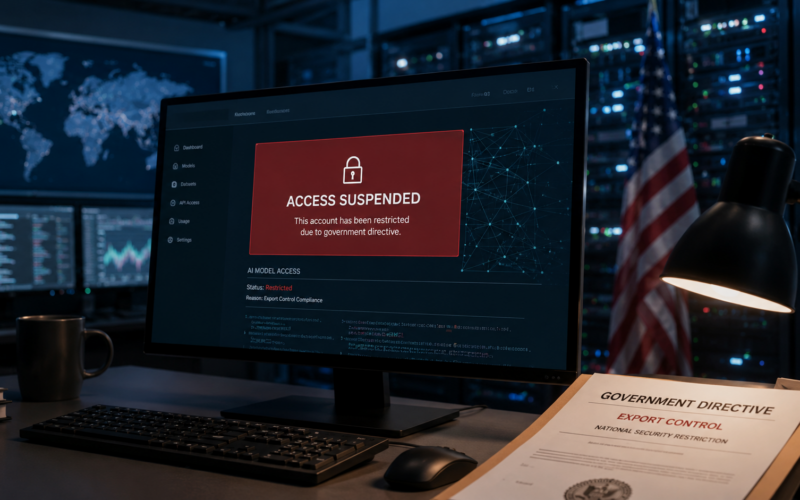
Anthropic, PBC has suspended access to Claude Fable 5 and Claude Mythos 5 after a US government export control directive barred access by foreign nationals, including non-US Anthropic employees. The directive has forced the private artificial intelligence company to disable the two models broadly for customers, even though access to other Claude models remains unaffected. The immediate relevance is larger than a single product interruption because Claude Fable 5 had been positioned as Anthropic’s most capable generally available model, while Claude Mythos 5 was designed for controlled use by cyberdefenders and selected infrastructure partners. The timing is especially sensitive because Anthropic has recently submitted confidential paperwork for a potential initial public offering, making regulatory execution risk a more visible part of the company’s investment story.
Why does the US directive against Anthropic’s Claude Fable 5 and Claude Mythos 5 matter for enterprise AI buyers?
The suspension matters because it changes how large customers may evaluate frontier artificial intelligence procurement. Until now, enterprise adoption of advanced models has largely turned on capability, pricing, privacy, data retention, compliance, and integration with cloud or developer workflows. The Anthropic directive adds another variable that is harder for chief information officers to manage: the risk that access to a model can be withdrawn quickly because national security authorities determine that its capabilities are too sensitive to remain widely available.
For customers using Claude Fable 5 in software engineering, research, document analysis, long-running agentic workflows, or scientific work, the issue is not only downtime. The more serious concern is planning reliability. If a company designs internal tools around a frontier model and that model is abruptly suspended, the switching cost can be operational, financial, and reputational. In enterprise technology, trust is not just about model accuracy. It is also about continuity, auditability, and knowing that a mission-critical vendor will not disappear from a workflow faster than a bad expense report on a Friday afternoon.
The directive also complicates multinational deployment. A model that can be used by some employees but not others becomes difficult to integrate into global engineering, cybersecurity, pharmaceutical, financial services, and consulting operations. Large enterprises do not operate neatly within national borders, and many of their most valuable artificial intelligence use cases depend on distributed teams. If access eligibility becomes tied to nationality rather than merely location, vendor selection could become entangled with human resources, compliance screening, and internal access-control architecture.

How could the Anthropic model suspension reshape competition among frontier AI providers?
Anthropic’s suspension creates a strategic opening and a warning for other frontier artificial intelligence providers at the same time. Competitors may benefit if customers shift workloads away from Claude Fable 5 and Claude Mythos 5 toward alternative models that remain available. However, the longer-term lesson is less comforting for the sector because any provider with sufficiently advanced cyber or scientific capabilities could face similar scrutiny if regulators decide model access itself is an export-controlled technology.
The competitive implication is that safety positioning may no longer be enough to shield a model from regulatory intervention. Anthropic has built much of its market identity around cautious deployment, safety systems, red-teaming, and controlled access. If even that posture does not prevent a forced suspension, competitors that move faster with looser controls may face tougher questions from governments, enterprise buyers, and strategic investors. The industry may be entering a phase where the strongest commercial pitch is not simply “our model is better,” but “our model can remain legally available.”
The decision may also create a split between general-purpose enterprise models and restricted high-capability models. Providers could choose to maintain more conservative public systems while reserving the most advanced cyber, biology, coding, and autonomous research capabilities for trusted access programs. That would slow mass-market monetisation but potentially reduce regulatory exposure. The uncomfortable trade-off is clear: the more useful a model becomes for high-value technical work, the more likely it is to be treated as a strategic asset rather than a normal software product.
Why is the Anthropic Fable 5 decision especially important before a potential IPO?
The timing creates a valuation question for Anthropic because public-market investors tend to dislike regulatory surprises, especially when they affect flagship products. Anthropic has taken an early step toward a possible listing by confidentially submitting draft registration paperwork. That does not guarantee a listing, but it does mean the company’s risk profile is moving from private-market storytelling toward public-market scrutiny.
For prospective investors, the central issue is not whether Claude Fable 5 and Claude Mythos 5 return quickly. The deeper issue is whether Anthropic’s revenue model can scale predictably if the most advanced model tiers remain exposed to sudden government action. A frontier artificial intelligence company can justify a premium valuation only if investors believe capability gains can be converted into durable revenue. If the most capable products are also the most politically sensitive, then revenue quality becomes harder to assess.
This does not necessarily damage Anthropic’s long-term equity story. In one sense, regulatory attention confirms that the company is operating at the edge of strategic artificial intelligence capability. That is not a small signal. However, it also raises the cost of governance, compliance, customer assurance, and product segmentation. Public investors may be willing to pay for frontier capability, but they will want more detail on how Anthropic manages government directives, customer disruption, foreign access, data retention, and model safety obligations.
What does the shutdown reveal about the new frontier between AI safety and export controls?
The Anthropic case shows that artificial intelligence regulation is moving beyond voluntary safety commitments and into the territory of enforceable national security controls. For years, the policy conversation focused heavily on chips, data centres, compute access, and model training. This directive suggests that deployed model access itself can become the regulated object. That is a major shift because the model is no longer treated only as software. It begins to resemble dual-use infrastructure.
The government’s apparent concern centres on whether safeguards around Claude Fable 5 could be bypassed to identify software vulnerabilities. Anthropic has argued that the issue involved narrow potential jailbreak behaviour rather than a broad failure of model safety. The strategic dispute is therefore not simply technical. It is about who gets to decide when a frontier model is safe enough for commercial deployment, and what evidence is required before access can be restricted.
This creates a policy precedent that the rest of the artificial intelligence sector will study closely. If regulators use narrow vulnerabilities as the basis for broad access suspension, providers may slow releases, reduce international availability, or build more conservative model-routing systems. If regulators later clarify a transparent review process, the sector could adapt. Without clarity, companies face a foggy operating environment, and fog is not exactly famous for helping executives drive fast.
How could this affect customers in cybersecurity, life sciences, and software engineering?
Cybersecurity customers may face the most immediate strategic disruption because Claude Mythos 5 was designed for trusted cyberdefense use, while Claude Fable 5 was marketed with strong software engineering and long-horizon reasoning capabilities. Defensive teams increasingly use advanced models to inspect code, identify vulnerabilities, improve remediation speed, and automate repetitive security analysis. A blanket suspension may slow some of those workflows, particularly for customers that had already started testing the models in high-value technical environments.
Life sciences and research customers also have reason to watch the case closely. Anthropic had described Claude Mythos 5 as capable of supporting protein design, molecular biology hypothesis generation, and genomics research. Those use cases are commercially attractive, but they also sit in a dual-use zone where scientific acceleration and safety concerns overlap. The same capability that helps a legitimate researcher shorten discovery cycles may also invite scrutiny if regulators believe it could provide uplift to risky biological work.
Software engineering buyers may be more resilient because alternative models remain available, including other Claude systems. However, if Claude Fable 5 materially improves long-running coding tasks, migration projects, and autonomous development workflows, losing access could affect productivity roadmaps. The practical outcome may be a more diversified model strategy. Enterprises may decide that reliance on one frontier model is risky, even when that model is technically superior.
What happens next if Anthropic restores access or if the directive becomes a wider industry template?
If Anthropic restores access quickly, the episode may be remembered as a short but costly regulatory shock. The company would still need to reassure customers that future access will not be disrupted without clearer process. That would likely require stronger customer communication, more transparent access tiers, tighter identity controls, and possibly deeper government engagement before launching future Mythos-class products.
If the directive becomes a template for wider frontier artificial intelligence regulation, the consequences will be much larger. Model providers may need to build nationality-based access controls, government review workflows, model capability disclosures, and pre-release safety evidence packages into their product launch calendars. That would raise the operating cost of frontier AI and could favour the best-capitalised companies. Smaller challengers may struggle if compliance becomes as important as compute.
The second-order effect could be a slower but more defensible commercialisation model. Instead of releasing the most capable systems broadly and then narrowing access when problems emerge, companies may launch through sector-specific trusted programs first. That would be less exciting for growth narratives, but perhaps more acceptable for regulators and enterprise buyers. In a sector where speed has often been treated as strategy, this episode suggests that permission may become part of the product roadmap.
Key takeaways on what Anthropic’s Fable 5 shutdown means for AI regulation, enterprise customers, and frontier model competition
- Anthropic’s suspension of Claude Fable 5 and Claude Mythos 5 turns model availability into a boardroom risk, not just a technical support issue for customers.
- The directive signals that US export controls may increasingly apply to deployed frontier artificial intelligence models, not only chips, compute, or training infrastructure.
- Anthropic’s safety-first positioning did not prevent regulatory intervention, which may pressure all frontier AI companies to strengthen pre-release government engagement.
- Enterprise buyers may reduce dependence on a single advanced model and build multi-model architectures to protect workflows from sudden access disruption.
- Cybersecurity and life sciences customers face the most complex trade-off because the highest-value use cases also carry the strongest dual-use concerns.
- Anthropic’s potential IPO story now includes a sharper regulatory risk factor, even if the company’s long-term capability position remains strategically strong.
- Competitors could benefit from short-term workload shifts, but the broader sector may face the same scrutiny as model capabilities approach sensitive thresholds.
- Trusted access programs may become a more common commercial structure for high-capability AI, especially in cyberdefense, biology, and critical infrastructure.
- The central unresolved issue is process: frontier AI companies need clearer rules on evidence, review, appeal, and remediation when governments intervene.
- The episode may slow some frontier model launches, but it could also push the industry toward more durable governance standards for commercial AI deployment.
Discover more from Business-News-Today.com
Subscribe to get the latest posts sent to your email.


