

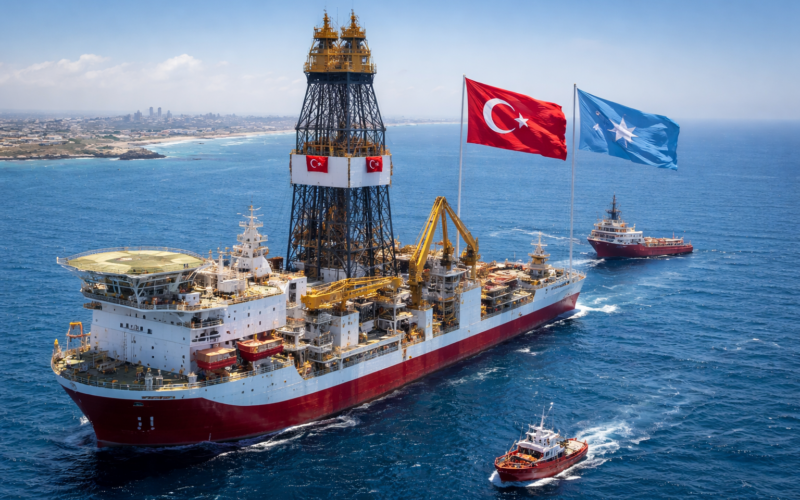
The Turkish Petroleum Corporation (TPAO), Türkiye’s state-owned national energy company, has commenced its first-ever overseas deep-sea drilling operation, deploying the ultra-deepwater drillship Cagri Bey to the Curad-1 well located approximately 372 kilometres off the Somali coastline near Mogadishu. The operation, which kicked off with a ceremony at the Port of Mogadishu on 10 April 2026, targets a total drill depth of 7,500 metres, comprising roughly 3,500 metres of water column and an additional 4,000 metres below the seabed. Turkish Energy and Natural Resources Minister Alparslan Bayraktar, who attended the ceremony, framed the mission as a structural inflection point in Ankara’s energy ambitions, stating that Türkiye aims to reach 500,000 barrels per day of oil-equivalent hydrocarbon production by 2028, with plans to double that output through overseas exploration and production-sharing agreements. The Curad-1 well, if commercially productive, would represent one of the deepest offshore wells drilled anywhere in the world, and opens the possibility of Somalia emerging as a material East African energy producer for the first time in its modern history.
What the Cagri Bey mission means for Türkiye’s overseas energy strategy and TPAO’s global ambitions
For the better part of two decades, Türkiye’s energy posture was defined primarily by its role as a transit corridor, serving as a bridge for Russian gas flows into Europe and Central Asian oil through the Baku-Tbilisi-Ceyhan pipeline. That positioning, while strategically valuable, left Ankara a structural consumer rather than a producer. The deployment of the Cagri Bey to Somalia marks a deliberate shift in that calculus. The vessel departed from Mersin’s Tasucu Port on 15 February 2026, taking a 45-day route around the Cape of Good Hope because its 114-metre rig tower cannot clear the Suez Canal, arriving under escort from three Turkish naval warships, the TCG Sancaktar, the TCG Gokova, and the TCG Bafra, with roughly 180 personnel aboard. The logistical complexity and cost of that deployment signal a degree of institutional commitment that goes well beyond opportunistic exploration.
TPAO holds exclusive exploration and production rights to three Somali offshore blocks under a July 2024 agreement. The groundwork was laid when the seismic research vessel Oruc Reis was dispatched to Somali waters in October 2024, completing a 234-day mission that collected 3D seismic data across 4,464 square kilometres spanning three offshore blocks before returning to Türkiye in July 2025. Curad-1 was identified as the primary target from that seismic campaign. The sequencing, from seismic survey to drillship deployment in under 18 months, reflects an operational tempo that is unusually fast for ultra-deepwater frontier exploration and suggests TPAO’s seismic data showed compelling enough structures to justify the expenditure without further delay.
The financial scale of the undertaking is significant. Drilling a single deep-water well is a capital project typically costing between 40 million and more than 100 million US dollars, a financial burden Somalia cannot bear independently. TPAO is absorbing that risk entirely, which explains in part why the revenue-sharing structure is weighted so heavily in Türkiye’s favour. The mission also reinforces Bayraktar’s broader messaging that Türkiye is no longer simply a player in domestic exploration, but a state building competitive capability in frontier basins internationally.

How Türkiye’s Somalia energy deal compares with global production-sharing agreement norms
The commercial architecture of the Türkiye-Somalia hydrocarbon agreement deserves scrutiny independent of the geopolitical narrative surrounding it. Reports indicate that Türkiye is permitted to recover up to 90 percent of its operational costs from produced oil and gas before sharing profits with Somalia, a rate considered extremely high by international standards, while Somalia is reportedly entitled to only 5 percent in royalties in the initial phase. TPAO is also exempt from paying signature, development, or production bonuses, which are common in international energy contracts to provide early revenue to host nations, and is further exempt from paying taxes in Somalia.
By comparison, standard production-sharing agreements in established deepwater markets such as Angola, Nigeria, or Brazil typically see the host government retain royalty rates of between 10 and 20 percent from first production, with cost-recovery ceilings in the 60 to 80 percent range. Somalia’s arrangement sits at the extreme end of host-government concession, a product of the asymmetric bargaining position between a fragile state that lacks capital, technology, and security infrastructure, and a sovereign partner that can provide all three simultaneously. Critics, including members of Somalia’s Parliamentary Natural Resources Committee, have argued that the deal violates the Somali Petroleum Law, as it lacked a competitive bidding process and proper oversight, with the federal government accused of signing away resources without consulting regional states such as Puntland and Jubaland.
The counterargument from Mogadishu’s pragmatist camp is straightforward: without TPAO’s capital and the security umbrella of the Turkish navy, Somalia’s offshore acreage would simply remain undrilled. No Western major or independent has shown the risk appetite to operate in an active conflict zone without the kind of state-backed security cover Türkiye is providing. The debate is legitimate on both sides, but the operative reality is that the drillship is already at the wellsite, and the commercial terms are unlikely to be renegotiated until there is something worth renegotiating over.
What Somalia’s offshore hydrocarbon potential means for East African energy markets and regional geopolitics
Seismic data suggests Somalia’s offshore basins could hold between 30 billion and 40 billion barrels of oil and gas equivalent. Those figures, while unconfirmed by independent drilling, would place Somalia among the largest untested hydrocarbon frontiers remaining globally. For context, Uganda’s commercially confirmed Lake Albert reserves, which have drawn sustained interest from TotalEnergies and CNOOC, stand at approximately 6 billion barrels. If even a fraction of Somalia’s estimated offshore resource base proves commercially productive, the implications for East African energy supply chains, regional fiscal dynamics, and the strategic calculus of the Horn of Africa would be considerable.
The geopolitical dimension of this operation extends well beyond energy. The drilling mission comes amid intensifying geopolitical competition in the Horn of Africa following Israel’s recognition of Somaliland in December 2025, the breakaway region that declared independence from Somalia in 1991 but is recognised only by Israel. Following that move, Türkiye formally designated Somalia’s territorial integrity as a national security priority, underscoring the strategic stakes tied to its expanding footprint. Ankara has built a comprehensive strategic presence in Somalia since 2017, operating Camp TURKSOM, its largest overseas military base, which has trained Somali national army units. Turkish firms manage Mogadishu’s airport and seaport. The energy agreement fits into a broader architecture of political, military, and economic interdependence that few other foreign powers have assembled in any African state.
The operation targets the Curad-1 well within one of three designated offshore blocks, with the overall acreage under the 2024 Somali-Turkish hydrocarbon exploration agreement covering approximately 15,000 square kilometres. The three-block offshore structure, combined with the onshore exploration agreement signed in April 2025, gives TPAO arguably the most comprehensive access to Somali hydrocarbon acreage of any state entity currently active in the country.
Why governance and revenue management will determine whether Somalia benefits from any commercial discovery
The historical record of resource-rich frontier states is uneven at best. Angola, Nigeria, and the Democratic Republic of Congo each hold vast hydrocarbon or mineral wealth, yet the translation of that wealth into broad-based economic development has been partial and, in many cases, actively harmful to institutional stability. Somalia faces governance challenges that are materially more severe than any of those comparators at the time of their major resource discoveries. The Transparency Somalia Initiative, which confirmed the Cagri Bey’s arrival at the wellsite, immediately called on the federal government to publicly disclose petroleum agreements, clarify the ownership structures of companies involved, and establish an open revenue management system, noting that natural resource wealth without proper governance tends to concentrate among a narrow group rather than reaching ordinary citizens.
Internal tensions in Somalia have also escalated, with disputes between Mogadishu and regional administrations over constitutional changes intensifying alongside Türkiye’s expanding military footprint, including the deployment of F-16 fighter jets, helicopters, and tanks earlier in 2026, a move that has drawn increased scrutiny from domestic opposition figures. Somali opposition voices have characterised the arrangement as a client-state relationship engineered to allow exploitation of national resources under a security umbrella that primarily serves federal government interests over those of regional states.
The structural risk is real. Revenue flows from oil production, if they materialise, will enter a governance environment where fiscal transparency mechanisms are nascent, where federal-regional power-sharing remains unresolved, and where the Al-Shabaab insurgency continues to constrain economic activity across large portions of the country. Whether an oil discovery would catalyse Somalia’s economic reconstruction or deepen existing fault lines depends less on the geology of Curad-1 and more on the institutional choices the federal government makes in the years ahead.
What are the execution risks that could delay or complicate the Cagri Bey drilling programme
Ultra-deepwater drilling in frontier basins carries execution risks that even technically capable operators regularly underestimate. The Curad-1 well profile, at 7,500 metres total depth with a 3,500-metre water column, places it among the most technically demanding wells in any current global drilling programme. Operations are scheduled to run for six to ten months, with the timeline subject to weather and monsoon conditions. A support fleet of auxiliary vessels will manage logistics, positioning, and personnel transfers, with offshore security provided by Turkish naval assets. The monsoon window in the Indian Ocean introduces a hard seasonal constraint that could disrupt well operations or force temporary suspension.
There is also the question of what happens if Curad-1 encounters geological complexity inconsistent with the seismic interpretation. Seismic surveys, however detailed, provide probabilistic rather than deterministic assessments of subsurface conditions. A dry hole or a non-commercial discovery at Curad-1 would not necessarily invalidate the broader Somali offshore thesis, but it would materially reset the timeline for any commercial development and would subject the terms of the original 2024 agreement to intensified political scrutiny both in Mogadishu and Ankara.
Experts warn that exploiting commercially confirmed reserves could require three to five years of sustained investment once a viable discovery is confirmed, meaning that even in an optimistic scenario, Somalia is unlikely to be a producing nation before the end of the decade. The upstream-to-downstream infrastructure chain, absent in Somalia today, would require parallel investment in pipelines, storage, and export terminals that would dwarf the cost of the initial drilling campaign.
Key takeaways on what Türkiye’s Somalia deep-sea drilling mission means for TPAO, Mogadishu, and regional energy markets
- TPAO’s deployment of the Cagri Bey represents the most operationally significant step yet in Türkiye’s transition from energy transit state to overseas exploration operator, a strategic ambition supported at the highest levels of the Erdogan government.
- The Curad-1 well, targeting 7,500 metres total depth approximately 372 kilometres off Mogadishu, is among the deepest offshore wells in any current global drilling programme, making this a technically ambitious frontier operation by any standard.
- Türkiye’s 2024 production-sharing terms, under which TPAO retains up to 90 percent of production as cost recovery before profit-sharing begins, are among the most favourable extended to any operator in a major offshore acreage package and reflect Somalia’s near-complete lack of independent exploration capacity.
- Somalia’s estimated offshore hydrocarbon resource base of 30 to 40 billion barrels of oil equivalent, if partially confirmed by drilling, would reshape East African energy supply dynamics and represent one of the largest frontier discoveries of the current decade.
- The operation’s geopolitical architecture, combining energy access, military presence, port and airport management, and security cooperation, gives Türkiye a degree of embedded strategic influence in Somalia that no other external power currently replicates in the Horn of Africa.
- Governance risk is the single largest variable in determining whether any commercial discovery benefits the Somali population. Absent transparent revenue management, federal-regional power-sharing agreements, and independent oversight, oil revenues carry the demonstrated potential to intensify rather than resolve existing political and fiscal tensions.
- The monsoon seasonality of the Indian Ocean, the complexity of the well profile, and the frontier nature of the Somali basin introduce material execution risk that could extend the drilling timeline beyond the current 288-day estimate.
- Israel’s recognition of Somaliland in late 2025 and the resulting shift in regional alignment has directly elevated the strategic weight Ankara places on Somalia’s territorial integrity, making the energy partnership simultaneously a commercial venture and a geopolitical instrument.
- Even an optimistic commercial discovery at Curad-1 would require three to five years of follow-on investment and infrastructure development before Somalia generates meaningful export revenues, meaning the near-term economic transformation narrative needs to be tempered by realistic development timelines.
- For peer frontier exploration operators and energy investors tracking East Africa, the Curad-1 result will serve as a critical data point for re-rating the entire Somali offshore basin, with implications for adjacent acreage interests held by other operators across the region.
Discover more from Business-News-Today.com
Subscribe to get the latest posts sent to your email.