
The Grand International Exposition of Sacred Piprahwa Relics inaugurated by Prime Minister Narendra Modi on January 3, 2026, in New Delhi has drawn global attention not only for its spiritual and archaeological significance but also as a symbol of India’s evolving cultural diplomacy. After more than 125 years abroad, the sacred relics—associated directly with Bhagwan Buddha—have returned to India and are now on public display at the Rai Pithora Cultural Complex in the capital. The exhibition, titled “The Light & the Lotus: Relics of the Awakened One,” is being positioned as a civilizational milestone in the reclamation of Indian spiritual heritage.
What are the Piprahwa relics and why are they important to the global Buddhist community?
Discovered in 1898 during excavations at Piprahwa in present-day Uttar Pradesh, the relics are widely believed to be among the earliest archaeological remains directly associated with Bhagwan Buddha. The site is considered a part of ancient Kapilavastu, the location where Siddhartha Gautama is said to have spent his early life before renunciation. The artefacts include fragments placed in reliquaries inscribed with dedications to the Buddha and his Shakya clan, making them both spiritually revered and academically significant.
Over the decades, parts of these relics were removed from India and circulated in global collections, with some facing public auction attempts. The recent return of a core set of these relics was made possible through what Prime Minister Modi described as a combination of government effort, institutional cooperation, and public-private partnership. The Godrej Group was acknowledged for its role in the repatriation.
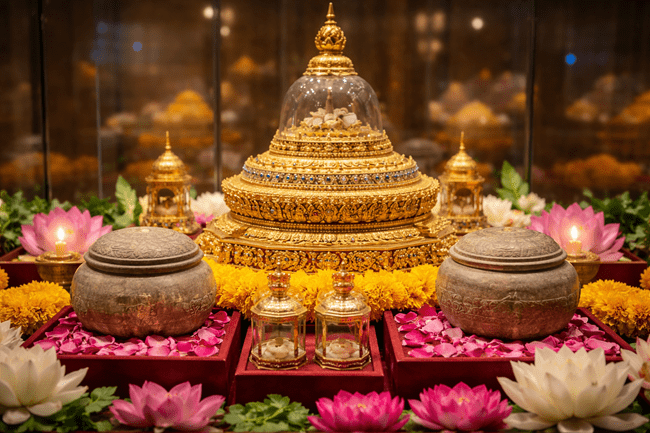
India has now integrated these relics with additional materials preserved in the National Museum, New Delhi, and the Indian Museum, Kolkata. For the first time, a unified exposition presents the relics in a reconstructed interpretive model inspired by the Sanchi Stupa.
How is the exhibition structured and what does it aim to convey to visitors?
The exposition is organized across several thematic sections that cover both tangible artefacts and intangible cultural heritage. The centerpiece is a reconstructed stupa display, surrounded by curated zones titled “Piprahwa Revisited,” “Vignettes of the Life of Buddha,” “Intangible in the Tangible,” and “Expansion of Buddhist Art and Ideals Beyond Borders.” Another section highlights the challenges and successes of cultural repatriation.
To make the experience accessible, the exhibition incorporates digital reconstructions, immersive films, and multimedia storytelling. These elements chronicle the history of the Piprahwa relics, their movement across geographies, and the larger visual and philosophical traditions of Buddhism.
How does this event fit into Prime Minister Modi’s broader cultural and foreign policy strategy?
Prime Minister Modi has consistently framed India’s Buddhist heritage as a cornerstone of its global soft power. In his address, he stated that India is not merely the custodian of Bhagwan Buddha’s relics, but the living carrier of his teachings. He emphasized that the return of the Piprahwa relics symbolizes the recovery of not just artefacts, but civilizational dignity lost during colonial subjugation.
The Prime Minister referred to the relics’ global tour before their repatriation, citing strong public sentiment and turnout in countries like Thailand, Vietnam, Mongolia, and Russia. According to official counts, more than 40 lakh people visited the relics in Thailand, 1.75 crore in Vietnam, and over 1.5 lakh in Russia’s Kalmykia region—figures interpreted as evidence of the enduring global resonance of Bhagwan Buddha’s legacy.
These international engagements align with India’s wider policy to build spiritual and cultural bridges with Asia-Pacific nations and beyond. India has also taken a lead role in restoring damaged Buddhist sites in countries like Nepal and Myanmar, actions that further reinforce its claim to moral and cultural stewardship in the Buddhist world.
What role does language and education play in India’s Buddhist revivalism?
One of the key institutional developments highlighted by the Prime Minister was the formal recognition of Pali as a classical language in India. As the language in which many of Bhagwan Buddha’s teachings were first recorded—particularly in the Abhidhamma and other canonical texts—Pali plays a foundational role in Buddhist scholarship.
By elevating Pali’s status, India aims to foster new research pathways and educational initiatives that can make Buddhist teachings more accessible to a broader audience. The government’s efforts also include supporting global summits, such as the Global Buddhist Summit, and celebrating Buddhist festivals like Vaishakh and Ashadha Purnima on the international calendar.
What investments are being made to modernize Buddhist sites and pilgrimage infrastructure?
Over the past decade, India has initiated several projects to enhance pilgrimage experiences and improve connectivity between major Buddhist sites. The Prime Minister cited developments in Bodh Gaya, where a convention and meditation centre have been constructed, and in Sarnath, where a light and sound show and theme park have been introduced. Similar upgrades have been implemented in Shravasti, Kapilvastu, Kushinagar, Amaravati, and Nagarjun Sagar, including the addition of digital infrastructure.
India is also developing a formal “Buddhist Circuit” to connect major pilgrimage sites through improved transportation and tourist services. This project aims to serve both domestic and international visitors and aligns with India’s tourism and cultural diplomacy goals.
What new discoveries have been made recently in India related to Buddhist heritage?
The Prime Minister referred to a major archaeological discovery in Baramulla, Jammu and Kashmir, where a Buddhist-era site was recently unearthed. He stated that preservation work is being accelerated at the site. In Gujarat’s Vadnagar—Modi’s own birthplace and a site historically linked to Buddhism—numerous relics have been discovered, and a new experiential museum has been inaugurated that showcases 2,500 years of continuous history.
These efforts signal India’s intent to not only preserve but also reinterpret its Buddhist heritage through science and public history. The government is backing these initiatives with both institutional investment and community engagement, in a model that blends archaeology, education, and cultural revivalism.
What does the Piprahwa exhibition symbolize in terms of India’s post-colonial identity?
For the Indian government, the Piprahwa relics’ return is emblematic of a larger civilizational reclamation. Prime Minister Modi underscored the idea that colonial-era losses were not limited to economics or sovereignty, but also extended to cultural and spiritual assets. By reversing the exile of these relics, the state frames itself as both guardian and rejuvenator of civilizational values.
The event is also designed to link India’s ancient spiritual legacy with contemporary national aspirations. By inviting young people, students, and the general public to attend the exhibition, the government seeks to instill historical consciousness as a civic virtue. The Prime Minister closed his address with an appeal for mass participation, calling the exhibition a bridge between India’s glorious past and its envisioned future.
What are the key takeaways from the Piprahwa relics exhibition and India’s Buddhist diplomacy strategy?
- India publicly inaugurated the Grand International Exposition of Sacred Piprahwa Relics in New Delhi, marking the return of relics after more than 125 years abroad.
- Prime Minister Narendra Modi emphasized that these relics are not mere artefacts but civilizational symbols of India’s spiritual heritage and identity.
- The exhibition incorporates national museum collections, immersive storytelling, and global diplomatic outreach, reinforcing India’s leadership in Buddhist cultural diplomacy.
- India has formalized Pali as a classical language and is expanding Buddhist educational and pilgrimage infrastructure as part of its heritage revival strategy.
- The Piprahwa relics and their repatriation represent a broader effort to reclaim post-colonial spiritual and cultural dignity while advancing regional soft power.
Discover more from Business-News-Today.com
Subscribe to get the latest posts sent to your email.