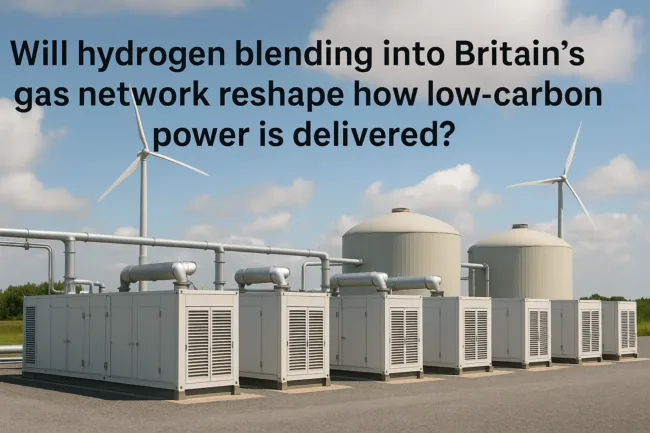
The UK Government’s latest consultation on hydrogen blending into the National Transmission System has received early support from hydrogen-focused power generators, including Terra Firma Energy. The London-based developer, whose Miners Road facility in Wrexham operates on nine Finning CAT hydrogen-ready generators, has publicly endorsed the Department for Energy Security and Net Zero’s (DESNZ) proposal to enable hydrogen blending at the transmission level—marking what it sees as a crucial step toward operationalizing Britain’s net zero ambitions.
While earlier policy efforts focused on distribution-level networks, this new consultation expands the debate to the high-pressure transmission grid that supplies major industrial users and regional distribution nodes. Terra Firma Energy noted that all of its assets have been engineered from inception to accommodate hydrogen blending, offering a flexible foundation that aligns with evolving regulations and fuel transitions.
Why is the UK government considering hydrogen blending at the transmission level in 2025?
The DESNZ consultation, published in mid-2025, explores whether introducing hydrogen into Britain’s National Transmission System (NTS) at levels up to 2% by volume would be both strategically and economically valuable. Blending hydrogen with natural gas is being positioned as a transitional mechanism, designed to support early-stage hydrogen production while reducing the carbon intensity of the existing gas network.
According to the consultation, a 2% hydrogen blend could serve as an “off-taker of last resort,” creating a backstop market for hydrogen producers during periods of low dedicated demand. This is particularly relevant as the UK scales up hydrogen production hubs but lacks widespread downstream adoption infrastructure, such as fuel cell transport or large-scale industrial switching.
The plan has been shaped by prior research into blending hydrogen into distribution networks—typically lower pressure and serving more localized or residential demand—but the inclusion of the transmission grid introduces new technical and stakeholder complexities.
What risks and benefits are outlined for industrial users and hydrogen producers?
The primary advantage of blending hydrogen at this stage lies in its ability to support supply-side confidence. For hydrogen producers seeking bankability, the assurance of a stable fallback market could justify new investment, stimulate project financing, and ultimately accelerate deployment. For policymakers, it also offers a near-term emission reduction tool without the need to wait for full electrification or sectoral fuel-switching.
However, industrial users connected to the transmission network have raised concerns. Many of these facilities, such as manufacturing plants and chemical refineries, depend on highly consistent gas quality. Even a modest 2% hydrogen addition could impact flame temperatures, compressor tolerances, and sensor readings—necessitating revalidation or replacement of existing infrastructure.
Terra Firma Energy has responded to such concerns by underscoring its readiness. Its generation systems, the firm stated, are capable of operating with up to 20% hydrogen content, well beyond the initial 2% under discussion. This foresight, it added, was a deliberate strategy to future-proof its portfolio in anticipation of precisely this kind of policy shift.
How could cross-border gas flows complicate hydrogen blending implementation?
While Britain is advancing hydrogen-blending discussions, the European Union has already established frameworks under the Hydrogen and Decarbonised Gas Market Package, which allows—but does not mandate—Member States to blend up to 2% hydrogen by volume.
This divergence poses interoperability risks, especially concerning interconnectors linking Britain to Ireland, Belgium, and the Netherlands. If Britain proceeds with blending at levels above the EU’s harmonized threshold, gas quality discrepancies could disrupt cross-border flows or necessitate additional filtration and monitoring infrastructure.
The consultation acknowledges this issue and has called for stakeholder input on technical, contractual, and regulatory pathways to manage such interoperability challenges. Any deviation from EU norms would need to be carefully planned to avoid creating friction in international gas trade—a vital component of UK energy security during winter peaks.
What does Terra Firma Energy’s strategy reveal about hydrogen readiness in power generation?
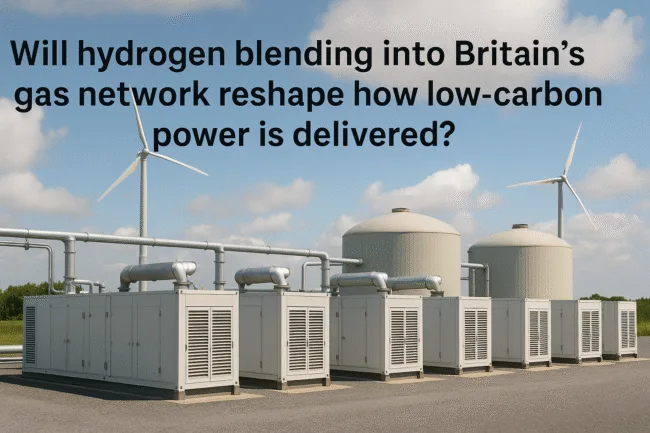
The case of Terra Firma Energy illustrates how certain power generation developers have preemptively aligned with the hydrogen transition. Its Miners Road project in Wrexham, for example, runs on equipment configured from day one to handle hydrogen-enriched fuel mixes. With Finning CAT hydrogen-ready generators installed on site, the facility demonstrates practical readiness rather than theoretical compatibility.
By investing in hydrogen-ready assets across its portfolio, Terra Firma Energy aims to mitigate regulatory lag risk and position itself as a flexible power supplier in an increasingly carbon-constrained market. This strategic posture reflects a broader trend among distributed energy producers: decarbonization-readiness is now viewed as a competitive advantage rather than a compliance burden.
The firm also noted that its asset configuration enables rapid adaptation to both regulatory and market changes, including the addition of hydrogen at varying blend levels. By combining this technical foresight with strong positioning in flexible generation, it hopes to be a key player in bridging Britain’s energy transition gap.
How does institutional sentiment frame the UK’s hydrogen blending policy outlook?
Institutional investors and energy analysts appear cautiously optimistic about hydrogen blending, provided it is implemented in a phased and consultative manner. From a capital deployment perspective, infrastructure that can accommodate hydrogen blends is increasingly seen as a hedge against future regulation. However, concerns persist about stranded assets if the policy environment remains fragmented or if blending proves technically unviable at scale.
A key sentiment emerging from the consultation period is that enabling early-stage blending—even at 2%—signals long-term commitment to a hydrogen-inclusive energy future. If hydrogen producers perceive the policy as durable, it could unlock the kind of capital commitments needed to scale upstream supply, electrolyzer manufacturing, and regional transport pipelines.
That said, the move also carries reputational risk for policymakers if end users experience unintended costs or operational disruptions. The government has thus been careful to frame the 2% blend as a starting point—not a mandated standard—while also commissioning independent feasibility assessments and stakeholder engagement sessions.
What are the future implications of the consultation for the UK’s hydrogen economy?
The hydrogen blending consultation marks an inflection point in the UK’s approach to low-carbon fuels. Should DESNZ move forward with enabling legislation, hydrogen could soon shift from a niche pilot fuel to a more integrated component of Britain’s national energy strategy.
For energy developers like Terra Firma Energy, the move validates their early-stage hydrogen readiness. For industrial users, it could prompt a wave of retrofitting, revalidation, and operational planning. For policymakers, it serves as both a test case and a bridge strategy—a way to de-risk hydrogen adoption without full-scale downstream conversion.
As Britain edges closer to its 2050 net zero goal, every marginal reduction in grid carbon intensity matters. Blending hydrogen into the transmission grid, if carefully managed, could offer one of the few scalable solutions that balance climate urgency with technical realism.
Discover more from Business-News-Today.com
Subscribe to get the latest posts sent to your email.