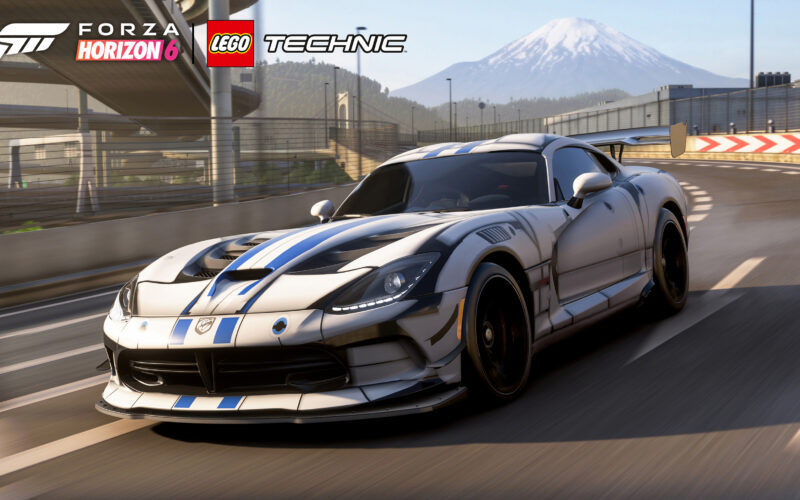
Stellantis N.V. (NYSE: STLA) is extending the commercial life of the Dodge Viper through a collaboration with Microsoft Corporation and the LEGO Group, bringing a 2016 Dodge Viper ACR into Forza Horizon 6 with LEGO Technic branding while launching an 805-piece physical model. The campaign became available on August 1, 2026, connecting a live-service racing game, a licensed construction set and one of Dodge’s most recognisable performance nameplates. Strategically, the arrangement allows Dodge to reach younger consumers and global gaming audiences without committing capital to a new Viper production programme. The central question is whether this connected digital and physical campaign can create durable brand relevance, or whether it will remain a short-lived nostalgia activation.
The in-game component introduces the 2016 Dodge Viper ACR with an exclusive LEGO Technic livery in Forza Horizon 6. The real-world product is the LEGO Technic Dodge Viper GTS-R Sports Car, set number 42234, which includes 805 pieces and carries a recommended United States retail price of $64.99. The LEGO Group says the model includes a V10 engine with moving pistons, a differential, an adjustable rear wing and opening doors and bonnet, while instructions supplied with the set can be used to unlock a special LEGO Technic livery within Forza Horizon 6.
Dodge Chief Executive Officer Matt McAlear said the partnership was intended to connect virtual driving with physical building experiences while introducing Dodge performance heritage to another generation of enthusiasts. That objective matters because the Viper has not been produced since August 31, 2017, meaning the latest campaign represents a revival of the nameplate as intellectual property rather than a return to vehicle manufacturing. Neither Dodge nor Stellantis announced a new Viper production programme as part of the collaboration.
Why is Dodge using the discontinued Viper ACR to reach gamers and younger performance-car fans?
The Dodge Viper retains qualities that make it unusually useful as a digital marketing asset. It has a distinctive silhouette, a clear American performance identity and enough scarcity to carry nostalgia without appearing commonplace. The 2016 Dodge Viper ACR featured an 8.4-litre V10 engine producing 645 horsepower and 600 pound-feet of torque, while its aerodynamics and track-focused engineering helped establish the ACR as the most extreme factory version of the car. Dodge has also highlighted multiple North American circuit records achieved by the model during its production era.
Those characteristics translate effectively into a racing game. Players do not need to understand Stellantis’ broader corporate strategy to recognise an aggressive, high-performance vehicle that offers a different driving experience from modern electric cars, sport utility vehicles or highly computerised supercars. The Viper therefore gives Forza Horizon 6 a culturally familiar vehicle while allowing Dodge to reinforce its historical association with large-displacement engines and visually dramatic performance cars.
The choice of the ACR is also more strategically useful than selecting a routine production vehicle. A mainstream Dodge model could provide greater relevance to current dealership sales, but it would be less likely to attract attention from gamers, collectors and automotive enthusiasts. The Viper operates as a halo product even though it is no longer sold, creating awareness that can indirectly support the broader Dodge brand.
This is the central advantage of heritage-led licensing. Stellantis does not need to reopen a factory, homologate a new vehicle or fund a full product-development programme to put the Viper back in front of consumers. It can instead monetise and circulate the nameplate through gaming, toys, apparel and other licensed categories, preserving the emotional value of the asset at a comparatively modest operational cost.

How does the Forza Horizon 6 and LEGO Technic partnership connect digital play with physical collectibles?
The campaign is structured around a digital-to-physical engagement loop. Forza Horizon 6 provides immediate global visibility and allows players to experience the Viper virtually. The LEGO Technic set then converts part of that attention into a physical purchase, while the unlockable livery sends buyers back into the game. Each partner therefore supports a different stage of the consumer journey.
Forza Horizon 6 launched on May 19, 2026, for Xbox Series X and Series S consoles and personal computers, following early access for premium customers from May 15. The Japan-based open-world racing game debuted with more than 550 vehicles, giving Dodge access to a large automotive audience but also placing the Viper inside an extremely competitive digital showroom. The branded livery and LEGO connection help distinguish the vehicle from hundreds of other playable cars.
For the LEGO Group, the collaboration creates a reason for gaming audiences to consider a physical construction product. The $64.99 price places the Dodge Viper GTS-R below the cost of many large premium automotive sets, making it more accessible to younger builders and casual collectors. The age recommendation of 10 years and above also supports Dodge’s stated ambition to introduce the brand to a new generation rather than relying entirely on existing Viper owners or older muscle-car enthusiasts.
Microsoft Corporation gains additional licensed content that can extend player engagement following the initial release of Forza Horizon 6. Live-service racing games depend on a continuing flow of vehicles, challenges, events and collaborations to give players reasons to return. The Dodge and LEGO Technic activation therefore serves Microsoft’s engagement model even though the direct financial contribution from one licensed vehicle is unlikely to be material to the company.
The commercial terms were not disclosed. Dodge, Microsoft Corporation and the LEGO Group did not reveal licensing payments, revenue-sharing arrangements, expected set sales or targets for digital livery redemptions. Consequently, the strategic logic is visible, but the direct economics cannot yet be independently assessed.
What does the Viper campaign reveal about Stellantis’ wider brand-building challenge in North America?
The collaboration arrives as Stellantis works to rebuild operating momentum in North America while managing a complicated transition across powertrains, vehicle segments and consumer preferences. Dodge must preserve its performance identity while participating in a portfolio that increasingly includes electrified vehicles, more efficient internal-combustion engines and software-led customer experiences.
That transition creates a branding problem. Established Dodge customers may associate the company with V8 engines, drag racing and traditional muscle cars, while younger consumers increasingly encounter automotive brands through games, video platforms and digital communities before entering a dealership. The Viper campaign bridges those audiences without requiring Dodge to choose between heritage and modern distribution channels.
Stellantis reported second-quarter 2026 net revenue of €43.5 billion, an increase of 13% from the previous year, supported by higher shipments and improved North American performance. North American net revenue increased 32%, while consolidated shipments rose 10% to approximately 1.6 million vehicles. The company also reported €800 million of adjusted operating income, a 1.8% adjusted operating margin and €1 billion of industrial free cash flow.
The revenue recovery is encouraging, but the operating margin shows why inexpensive brand-building initiatives remain attractive. A licensing and gaming partnership can generate attention without the capital exposure associated with developing a low-volume sports car. It cannot materially repair Stellantis’ margins by itself, but it can support brand visibility while management concentrates resources on vehicle launches, manufacturing efficiency, pricing and dealer execution.
Business News Today analysis suggests that the campaign is best understood as a capital-light brand activation rather than evidence of a new sports-car strategy. Its relevance lies in demonstrating how Stellantis can continue using discontinued products as active commercial assets. The greater opportunity would be to create a repeatable licensing system across several recognised nameplates rather than treating the Viper collaboration as an isolated promotion.
Can heritage-led licensing create measurable value when the Dodge Viper is no longer in production?
An inactive vehicle nameplate can still generate value through licensing fees, content engagement, merchandise sales and increased interest in the parent brand. However, the connection between those activities and vehicle revenue is difficult to measure.
A player who downloads the Viper in Forza Horizon 6 may become more familiar with Dodge but may not be in the market for a vehicle. A LEGO buyer may be interested primarily in the construction experience rather than the automotive brand. Even strong sales of the physical set would therefore not automatically indicate higher demand for current Dodge vehicles.
The more realistic value lies in maintaining cultural relevance. Automotive brands can lose emotional visibility when distinctive models disappear from showrooms. Reintroducing the Viper through gaming allows Dodge to keep the vehicle in circulation among consumers who may never have seen one on the road. That matters particularly as the original ownership community ages and physical examples become less accessible.
The campaign could also provide useful behavioural data. Digital livery downloads, vehicle usage, event participation, social engagement and geographic demand can help the partners understand where the Viper name retains the strongest appeal. LEGO Technic sales and retailer reorders may provide another indication of whether the nameplate can support additional licensed products.
However, no such performance data has yet been disclosed. Until Dodge reports measurable engagement, licensing expansion or evidence of cross-selling, the collaboration should be treated as a promising marketing experiment rather than a confirmed commercial success.
How should investors interpret the Dodge partnership against Stellantis’ improving but still thin margins?
Stellantis shares closed at $5.76 in New York on July 31, 2026. The stock gained approximately 1.2% over the five sessions from July 24 but was broadly unchanged from its June 30 closing level. Its 52-week performance remained negative by roughly 36%, while the share price continued to trade much closer to its annual low than its annual high.
The shares declined 2.5% on July 30 and another 1.7% on July 31, moves that coincided with the release and assessment of Stellantis’ second-quarter results. The reaction suggested that investors remained cautious despite stronger revenue, higher shipments and positive industrial free cash flow. A 1.8% quarterly adjusted operating margin leaves limited protection against pricing pressure, launch delays or renewed weakness in key markets.
The Dodge Viper activation is not financially significant enough to alter that investment debate. Its value is strategic and incremental. It demonstrates a way to generate brand attention without committing substantial manufacturing capital, but Stellantis’ valuation will continue to depend primarily on vehicle volumes, pricing, margins, cash generation and the execution of its product pipeline.
Microsoft Corporation shares closed at $464.72 on July 31 after rising sharply during the preceding sessions. That performance was associated with Microsoft’s financial results and cloud-computing outlook, rather than the Forza and Dodge collaboration. For Microsoft, the Viper initiative is best viewed as engagement content for the Xbox ecosystem, not a material earnings catalyst.
Investor sentiment toward Stellantis therefore remains cautious rather than decisively positive. Operational indicators have improved, particularly in North America, but the market appears to require stronger and more sustained margin evidence before assigning greater value to the recovery. Brand collaborations can support that recovery at the edges, but they cannot substitute for profitable vehicle execution.
What will show whether the Dodge Viper omniverse campaign becomes more than a one-off activation?
The first measurable indicators will be LEGO Technic sales, retailer availability, digital livery redemptions and player engagement with the Dodge Viper ACR inside Forza Horizon 6. Repeat production runs or sustained retail demand for set 42234 would indicate that the physical product has moved beyond initial enthusiast purchases.
The second test will be whether the collaboration expands. Additional Dodge vehicles, themed in-game events, new LEGO Technic models or linked automotive merchandise would suggest that the partners see sufficient commercial and engagement value to continue the programme.
A third indicator would be evidence that the campaign is directing consumers toward Dodge’s active product portfolio. Increased website traffic, social engagement, configurator activity or dealership enquiries following the activation would provide a stronger commercial connection than digital downloads alone.
The most important strategic test is whether Stellantis can turn its library of historic vehicles into a coordinated licensing platform. The company owns numerous brands and recognisable nameplates that could be activated across gaming, construction sets, collectibles and digital media. A systematic approach could create recurring licensing income while keeping dormant automotive assets visible.
For now, the Viper collaboration improves Dodge’s cultural reach without resolving Stellantis’ larger operating challenge. What has improved is the company’s ability to put an iconic discontinued vehicle in front of a new global audience through two established entertainment platforms. What remains unresolved is whether that attention can produce repeatable revenue, measurable brand conversion or stronger demand for current Dodge products.
Key takeaways from the Dodge Viper ACR, Forza Horizon 6 and LEGO Technic partnership
- Dodge introduced a 2016 Viper ACR with exclusive LEGO Technic branding into Forza Horizon 6 on August 1, 2026.
- The physical LEGO Technic Dodge Viper GTS-R Sports Car contains 805 pieces and is priced at $64.99 in the United States.
- Instructions included with the LEGO set allow buyers to unlock a special livery in Forza Horizon 6.
- The campaign uses the discontinued Viper as an intellectual-property and heritage asset rather than announcing renewed vehicle production.
- Forza Horizon 6 gives Dodge access to a global automotive gaming audience following the game’s May 2026 launch.
- The collaboration creates a digital-to-physical engagement loop connecting gameplay, collectibles and automotive branding.
- Financial terms, licensing revenue, sales targets and digital redemption expectations were not disclosed.
- Stellantis’ improving North American revenue contrasts with a still-thin 1.8% quarterly adjusted operating margin.
- The next proof points will be LEGO sales, in-game engagement, further licensed products and evidence of interest in Dodge’s active vehicle portfolio.
Discover more from Business-News-Today.com
Subscribe to get the latest posts sent to your email.