RTX Corporation (NYSE: RTX) has secured a US Navy contract valued at up to $24.4 billion for Standard Missile-6 interceptors, giving its Raytheon business a five-year production agreement with two additional option years as the United States attempts to rebuild missile inventories and expand the industrial capacity behind one of its most versatile naval weapons.
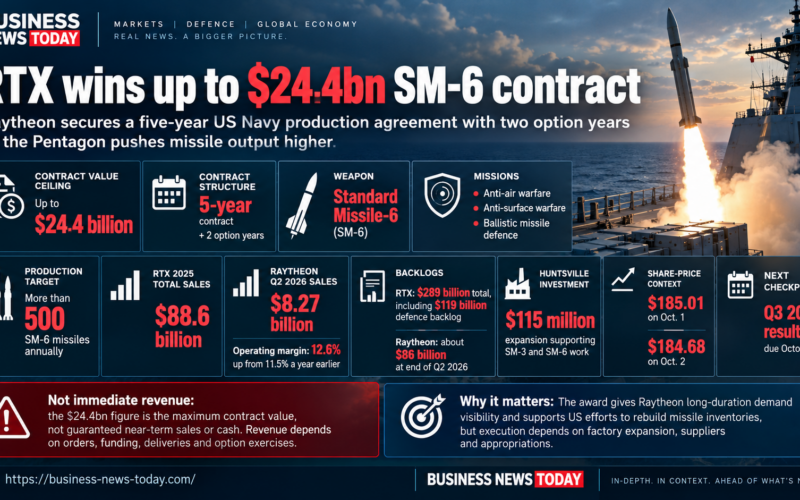
The award, announced on October 1, is not the same as $24.4 billion of immediate revenue or cash committed to RTX. The figure represents the maximum stated value of the multiyear arrangement, while the Navy and RTX have not publicly disclosed the number of missiles covered by the contract or the amount initially obligated. Actual revenue recognition will depend on orders, deliveries, funding and exercise of the additional option years.
That distinction is especially important because the headline number is enormous even by defence-contracting standards. RTX reported $88.6 billion of total company sales in 2025, while its Raytheon segment generated $8.27 billion of sales during the second quarter of 2026. The SM-6 ceiling is therefore almost three times one quarter of Raytheon segment revenue, but it could be spread across as many as seven years and should not be treated as a single-period addition to sales or backlog.
The strategic significance lies elsewhere. Earlier this year, RTX and the US Department of War established a production framework intended to lift annual SM-6 output to more than 500 missiles, alongside major increases for AMRAAM, Tomahawk and Standard Missile-3 interceptors. The new $24.4 billion award moves that ambition from an industrial framework toward a long-duration procurement commitment, putting the pressure squarely on manufacturing execution.
What does the $24.4 billion RTX Standard Missile-6 contract actually cover?
Raytheon describes the agreement as a five-year contract with two additional option years for SM-6 interceptors used by the US Navy. The missile is designed for several missions that would traditionally require different weapons, including anti-air warfare, anti-surface warfare and ballistic missile defence.
That versatility is one reason the SM-6 occupies an unusually important position inside US naval inventories. A single missile family can be used against aircraft and cruise missiles, surface vessels and some ballistic-missile threats, allowing commanders to use the weapon across several layers of naval combat rather than reserving it for one narrowly defined target category.
The US Navy has deployed the SM-6 primarily from surface combatants equipped with the Aegis weapon system, while the missile has also been demonstrated from land-based launchers. That expanding mission set increases its military utility but also increases potential demand because the same production line supports more than one operational requirement.
The government described the multiyear agreement as a way to increase manufacturing throughput while giving industry enough predictability to expand capacity and strengthen supply chains. Multiyear procurement can be particularly valuable for complex weapons because manufacturers and suppliers can plan labour, equipment and material purchases against a more stable demand signal than they receive through smaller annual orders.
However, the maximum contract value does not reveal exactly how many SM-6 missiles the Navy will ultimately receive. Neither RTX’s October announcement nor the government’s public award statement specifies a final missile quantity, so dividing $24.4 billion by an assumed unit cost would create a misleading estimate because the contract may include different configurations, support, spares, production investments or other elements alongside complete missiles.

Why is the target of more than 500 SM-6 missiles a year so important?
The production target provides a better indicator of what the Pentagon is trying to achieve operationally. In February, RTX said its broader munitions agreements with the Department of War were designed to increase annual SM-6 output to more than 500 missiles.
That is a manufacturing-rate target rather than a statement that 500 missiles will immediately be delivered every year under the October contract. Production lines generally require time to add equipment, qualify suppliers, train workers and remove bottlenecks, while government orders and funding also determine the eventual delivery schedule.
RTX has already been investing ahead of the new award. The company completed a $115 million expansion at its Huntsville, Alabama, facility where portions of SM-3 and SM-6 systems are assembled into completed munitions. Raytheon has also said it is increasing its skilled workforce, automating production and strengthening supplier relationships to support higher output.
Those investments form part of a much wider capacity push. RTX said its 2025 capital expenditure included approximately $2.6 billion of investment supporting projects such as munitions-production expansion, while Raytheon has been working with additional suppliers to strengthen areas of the missile industrial base that can constrain overall output.
The economics are straightforward but unforgiving. A prime contractor cannot sustainably increase final missile deliveries if motors, electronics, guidance systems, energetics or other critical components remain constrained upstream. The $24.4 billion award therefore provides visibility not just to RTX but potentially to a large network of lower-tier manufacturers that must invest alongside it.
Why has the US Navy suddenly committed so much money to missile production?
The award comes amid a much broader reassessment of how quickly the United States can replace precision-guided weapons after sustained military operations. Missile inventories built over many years can be consumed rapidly during periods of intensive combat, while replenishment often moves at the slower speed of specialised manufacturing.
That problem has become particularly visible across air and missile defence. Business News Today has previously examined how heavy interceptor use during conflicts involving Iran and continued support for Ukraine have placed pressure on Western inventories, raising questions about whether existing industrial capacity is sufficient for a prolonged high-intensity conflict.
The Pentagon’s answer increasingly appears to be longer contracts and much higher planned production rates. Just days before the SM-6 announcement, Raytheon received another multiyear agreement valued at up to $20.7 billion for Advanced Medium-Range Air-to-Air Missiles, or AMRAAMs. The earlier February framework targeted annual AMRAAM production of at least 1,900 missiles.
Those two awards alone carry combined maximum values above $45 billion, but that figure again represents contract ceilings rather than guaranteed near-term RTX revenue. What matters strategically is the direction of procurement: Washington is attempting to convert episodic annual missile purchases into multi-year industrial demand that can justify much larger factory investments.
That shift is significant because defence manufacturers have historically been reluctant to expand expensive production lines without confidence that government demand will persist long enough to recover their investment. A seven-year procurement horizon can potentially change that calculation by giving both primes and suppliers a more credible reason to add capacity.
How does the SM-6 award compare with RTX’s existing defence backlog?
RTX was already carrying a substantial order book before the new contract was announced. At June 30, 2026, the company reported total backlog of $289 billion, including $119 billion of defence backlog and $170 billion of commercial backlog.
Within Raytheon specifically, backlog stood at approximately $86 billion at the end of the second quarter, up from $75 billion at the end of 2025. Raytheon recorded approximately $20 billion of defence bookings during the quarter and $27 billion during the first six months of the year.
Those figures provide context but should not be combined mechanically with the $24.4 billion SM-6 ceiling. RTX has not yet reported third-quarter results, and the accounting treatment of bookings under the new agreement will depend on the firm orders, funding and performance obligations recognised by the company.
RTX is scheduled to report third-quarter 2026 results on October 20, making that earnings release the first major financial checkpoint after the SM-6 and AMRAAM announcements. Investors will be able to see whether and how the awards affect reported bookings, Raytheon backlog and management’s assumptions about production investment.
The latest operating trend is already strong. Raytheon generated second-quarter sales of $8.27 billion, up 18% from $7.00 billion a year earlier, while operating profit increased 29% to approximately $1.04 billion. RTX as a whole generated $24.7 billion of quarterly sales, $3.5 billion of operating cash flow and $2.9 billion of free cash flow.
That financial capacity gives RTX room to support factory expansion, but the company will still need the government to convert long-term procurement intentions into appropriately funded orders.
Why is the SM-6 more strategically valuable than a single-purpose missile?
The SM-6 occupies a distinctive position because it spans offensive and defensive missions. Raytheon describes it as capable of anti-air warfare, anti-surface warfare and ballistic missile defence, allowing the same basic weapon family to contribute to fleet air defence while also attacking hostile ships and selected missile threats.
That flexibility matters increasingly in the Indo-Pacific, where US naval planners must prepare for large numbers of aircraft, cruise missiles, ballistic missiles and surface threats across enormous distances. Magazine space aboard a warship is finite, which makes missiles capable of addressing several threat categories operationally attractive.
It also complicates inventory planning. A weapon consumed in one mission is no longer available for another, so a missile with broad utility can experience competing demands from multiple operational scenarios. Production planning therefore has to consider not only how many weapons have already been expended but also how much strategic reserve is required for contingencies that have not yet occurred.
The missile’s expanding launch options add another dimension. SM-6 has been fired from US Navy ships as well as land-based launch systems, broadening the circumstances in which the weapon could be deployed. That flexibility can strengthen demand for the missile but also means the Navy and Pentagon have to think about inventory across a wider set of missions.
For RTX, that creates the possibility of unusually durable production demand if the weapon continues to occupy several roles across US and allied force structures. The risk is that expanding mission requirements expose production limitations more quickly if factories cannot reach the planned higher output.
Does the $24.4 billion contract guarantee a major earnings boost for RTX?
No. The contract materially improves long-term demand visibility, but the headline ceiling cannot be translated directly into profit.
Revenue will be recognised as RTX fulfils its contractual obligations, while margins will depend on negotiated pricing, manufacturing efficiency, inflation, supply-chain performance and programme execution. Accelerating production can initially require substantial investment, and defence contractors can suffer margin pressure when suppliers cannot deliver components at expected cost or schedule.
Multi-year contracts can provide advantages because they allow larger material purchases, longer supplier commitments and more predictable factory utilisation. Those efficiencies are part of the government’s stated rationale for the SM-6 agreement, but investors will need future RTX disclosures to determine how much of that benefit ultimately flows through to margins.
The contract also arrives when Raytheon’s profitability has been improving. Second-quarter 2026 Raytheon operating margin reached 12.6%, compared with 11.5% a year earlier. Maintaining or improving that margin while substantially increasing missile output would provide evidence that capacity expansion is translating into profitable growth rather than merely higher volume.
The next several quarters therefore matter more than the maximum award value. Bookings, backlog conversion, Raytheon margins, capital expenditure and supplier performance will show whether the contract is developing into an attractive long-duration earnings stream.
Why did RTX stock barely react to a $24.4 billion missile award?
RTX shares closed at $185.01 on October 1 and $184.68 on October 2, a decline of 0.18% in the first full trading session after the late October 1 announcement. The shares had already fallen from $189.40 on September 25, leaving RTX down roughly 2.5% across the five trading sessions through October 2 despite the separate AMRAAM and SM-6 contract announcements.
That muted performance should not be interpreted as proof that investors dislike the contracts. Defence stocks move with numerous factors including valuation, interest rates, expectations for future defence budgets, geopolitical developments, programme margins and broader equity-market positioning.
The response does suggest that investors are looking beyond headline contract ceilings. RTX already had an enormous backlog before the new awards, so the market may be more focused on how rapidly the company converts demand into revenue and cash flow and whether production investments can earn acceptable margins.
This is an important distinction for a company with approximately $289 billion of backlog. At that scale, another large contract strengthens future visibility, but execution increasingly becomes the differentiator.
The October 20 earnings report will therefore be more informative than the immediate share-price movement. Investors should gain a clearer picture of defence bookings, capital requirements, margins and whether management changes its 2026 outlook after the latest procurement awards.
Can RTX actually deliver the missile-production expansion the Pentagon wants?
That is the central question behind the $24.4 billion number.
Raytheon has already committed to increase annual SM-6 production beyond 500 missiles, while simultaneously scaling AMRAAM, Tomahawk and SM-3 production. Each programme competes for specialised labour, supplier capacity, manufacturing equipment and critical components within a defence industrial base that is being asked to expand across numerous weapons at once.
RTX has attempted to address that problem through factory investment, automation, workforce additions and supplier partnerships. The completed $115 million Alabama expansion provides physical capacity for SM-3 and SM-6 work, while broader investments are intended to strengthen the supply chain feeding final assembly.
Longer contracts can also help suppliers finance expansion. A smaller manufacturer may be unwilling to purchase new machinery or hire workers for a one-year order but could make a different decision when demand is supported by a five-year contract and two additional option years.
The remaining constraint is government funding. A contract ceiling and industrial framework establish authority and intent, but annual appropriations and individual orders still influence the rate at which money turns into production. RTX cannot recognise the entire $24.4 billion simply because the agreement has been signed.
That makes the contract a test of industrial policy as much as corporate execution. The government has provided a large demand signal; RTX and its suppliers must now demonstrate that missile factories can expand rapidly enough to convert it into physical inventory.
What should investors watch next after RTX’s $24.4 billion SM-6 award?
The first financial milestone arrives on October 20 when RTX reports third-quarter results. The most useful disclosures will be Raytheon bookings and backlog, segment margins, capital expenditure and any management commentary about how the new SM-6 and AMRAAM agreements affect production planning.
The second milestone is evidence that SM-6 output is moving toward the stated rate of more than 500 missiles annually. RTX has publicly established that objective, so future production updates will provide a measurable way to judge execution rather than relying solely on contract values.
Supplier expansion will be equally important. A missile-production programme is only as fast as its slowest constrained component, meaning investments outside RTX’s own factories could determine whether the targeted production rate is achievable.
Finally, investors should watch how much of the seven-year contract value becomes funded orders. The maximum $24.4 billion figure creates extraordinary revenue potential, but option exercises, appropriations and delivery schedules will determine how much of that potential ultimately appears in RTX’s financial statements.
The opportunity for RTX is substantial. Raytheon already entered the second half of 2026 with an $86 billion backlog and double-digit sales growth, while the Pentagon is giving the company longer and larger demand signals across several strategically important missile families.
Yet the SM-6 award is ultimately less a story about winning $24.4 billion than about producing enough missiles to justify it. If Raytheon can lift annual output above 500 while maintaining margins and controlling supply-chain costs, the contract could become one of the most consequential long-duration growth programmes in RTX’s defence portfolio. If production bottlenecks persist, the enormous ceiling will matter much less than the number of interceptors that actually leave the factory.
Discover more from Business-News-Today.com
Subscribe to get the latest posts sent to your email.