Europe has identified copper as strategically important to renewable energy, power grids, electric vehicles, digital infrastructure, aerospace and defence. It has also established policy targets intended to increase domestic extraction, processing and recycling while reducing excessive dependence on individual external suppliers.
Turning those targets into actual tonnes of copper is considerably harder.
Euro Sun Mining Inc. (TSX: ESM) is attempting to develop the Rovina Valley gold-copper project in Romania, one of the projects recognised under the European Union’s Critical Raw Materials framework. In September 2026, the company signed a non-binding memorandum of understanding with Macquarie Bank Limited and Trafigura Pte Ltd for a proposed senior project-finance facility of up to US$400 million, while a Trafigura affiliate agreed terms for a separate US$3 million strategic equity investment.
The proposed debt sounds large until compared with the project’s estimated initial capital cost. Euro Sun Mining’s latest disclosed feasibility work puts initial capital expenditure at approximately US$607.1 million.
The difference captures one of Europe’s central critical-minerals problems. Governments can designate mines as strategically important, streamline processes and encourage investment, but somebody still has to commit hundreds of millions of dollars before the first tonne of ore becomes commercial production.
Why has copper become a strategic material for Europe?
Electrification is copper intensive because copper is used across power cables, transformers, motors, renewable-energy equipment, charging infrastructure, electronic systems and industrial machinery. Europe’s energy transition therefore increases demand for a material already essential to its existing industrial economy.
European Commission material accompanying Critical Raw Materials Act projects says European Union copper demand could increase by more than 50% by 2050. It estimates the bloc is approximately 48% dependent on third-country supply at the extraction stage, even though its refining and processing position is considerably stronger.
The Critical Raw Materials Act establishes 2030 benchmarks intended to increase European capacity. The framework targets domestic extraction equivalent to at least 10% of annual consumption, processing capacity of at least 40%, recycling of at least 25%, and no more than 65% dependence on a single third country for any strategic raw material at a relevant processing stage.
Those targets are as much about industrial resilience as climate policy. Electricity networks, defence equipment and advanced manufacturing cannot expand on schedule if key materials become unavailable or excessively concentrated in politically risky supply chains.
Copper therefore sits at the intersection of decarbonisation and economic security.
What makes Rovina Valley strategically important?
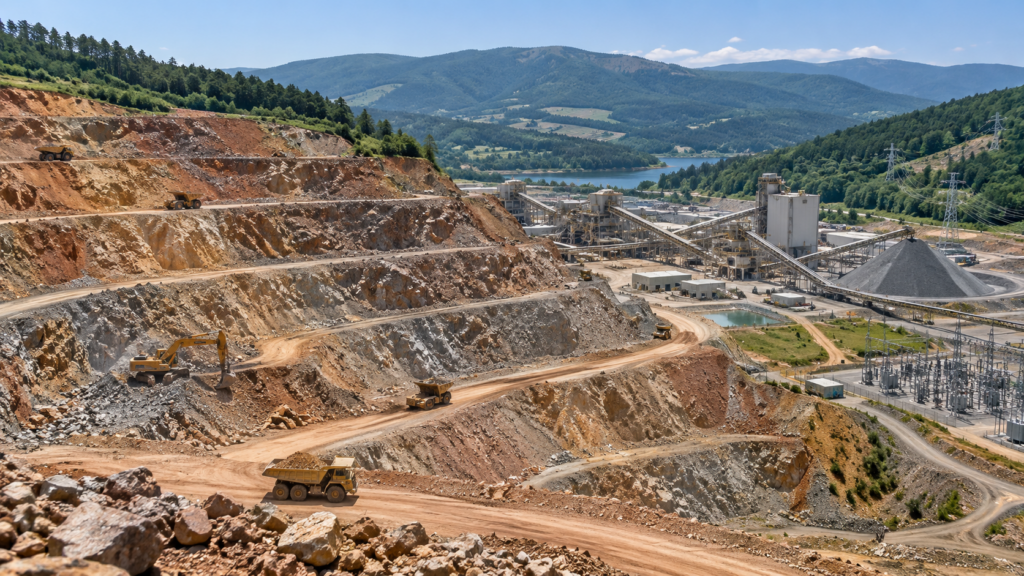
Euro Sun Mining describes Rovina Valley in west-central Romania as one of Europe’s largest undeveloped copper-gold projects. The wider resource contains substantial gold and copper, while the company’s feasibility work contemplates a project life extending well beyond a decade.
Location matters because material produced inside the European Union can potentially feed established European industrial and smelting networks without the same geopolitical exposure associated with long-distance imports from more concentrated jurisdictions.
The European Commission included Rovina among projects receiving strategic recognition under the Critical Raw Materials Act. Strategic status is designed to improve coordination, accelerate permitting and help promoters gain access to financing support and offtake relationships.
That recognition is important, but it should not be confused with a construction decision. Strategic status does not remove geological uncertainty, engineering risk, financing requirements or environmental obligations.
Indeed, European Commission documents have themselves referred to permitting bottlenecks affecting strategic projects including Rovina, illustrating the gap between policy ambition and implementation.
Why is mine financing so difficult even when copper demand looks strong?
A development-stage miner generally spends years consuming capital before producing operating cash flow. Investors must therefore fund exploration, feasibility work, permitting, engineering, early construction and infrastructure while accepting commodity-price risk that may not be resolved until several years later.
Debt providers face an additional problem. Banks want confidence that the mine can operate economically, repay debt and withstand adverse commodity scenarios. This means project finance normally requires exhaustive technical, legal, environmental and commercial due diligence.
Euro Sun Mining’s September memorandum gives Macquarie Bank and Trafigura an 18-month mandate to conduct due diligence, develop a financing structure and seek approvals toward a potential commitment. The proposed US$400 million facility itself remains non-binding.
That wording matters. An announced financing framework can materially improve project credibility without putting US$400 million into the company’s bank account.
Trafigura’s participation may nevertheless be strategically significant because commodity traders can play several roles around a mine, including financing, marketing and offtake. Euro Sun Mining also said the new arrangements sit alongside an existing US$200 million Trafigura commitment.
The eventual capital structure will determine how much of the US$607.1 million initial requirement is funded through senior debt, equity, strategic capital or other instruments.
Can Europe accelerate mines without weakening environmental standards?
This is one of the most politically sensitive parts of the critical-minerals strategy.
Mining projects affect land, water, biodiversity and local communities, while major European projects can face organised opposition and legal challenges. Rovina itself has been the subject of requests for internal review concerning its strategic-project designation.
The policy challenge is therefore not simply to make permitting faster. It is to make permitting sufficiently predictable that projects can attract capital without removing substantive environmental safeguards.
Investors dislike indeterminate timelines because every additional year before construction increases financing costs and exposes projects to changing commodity prices, engineering assumptions and political conditions. Communities, however, have legitimate reasons to demand rigorous assessment of environmental and social consequences.
Europe’s competitive disadvantage can emerge when these objectives are handled sequentially rather than simultaneously. A project can spend years navigating approvals, then begin financing discussions, then revisit engineering assumptions that changed while approvals were pending.
The Critical Raw Materials Act attempts to improve coordination, but Rovina demonstrates why execution at national and local levels remains decisive.
What would success at Rovina Valley actually prove?
A completed Rovina financing would not solve Europe’s copper deficit by itself. Its significance would be demonstrative.
The European Union needs evidence that strategically designated mining projects can progress from policy recognition to permits, financing, construction and production within commercially reasonable timeframes. If that chain works, strategic status becomes meaningful to investors. If projects remain trapped between approvals and funding, the designation risks becoming largely symbolic.
Rovina could also test whether European policy can attract combinations of banks, commodity traders and equity investors into projects carrying substantial upfront capital requirements.
The same mechanism may be needed across lithium, rare earths, nickel, graphite and other materials where Europe is trying to build domestic or diversified supply chains.
What is Euro Sun Mining’s share price signalling?
Euro Sun Mining shares closed at approximately C$0.165 on September 11. The stock had jumped about 20% to C$0.18 immediately after the financing announcement on September 4 before giving back part of that gain over subsequent sessions.
That is a rationally mixed reaction. Naming Macquarie Bank and deepening Trafigura’s participation makes the financing pathway more tangible, but investors still face the distinction between a non-binding framework and committed construction funding.
Euro Sun Mining remains a development-stage company, so equity value is highly sensitive to permitting, financing terms, commodity assumptions and dilution. A US$3 million equity investment is strategically useful but modest relative to a project requiring more than US$600 million of initial capital.
For Europe, however, the more important question lies beyond one junior mining stock.
The continent has already identified the strategic materials it needs and has started identifying the mines it wants. The next test is whether its financial system, regulatory institutions and political processes can convert those maps into producing assets quickly enough.
Rovina Valley is therefore not just a copper project. It is a live experiment in whether Europe’s critical-minerals strategy can move from legislation to construction.
Discover more from Business-News-Today.com
Subscribe to get the latest posts sent to your email.