


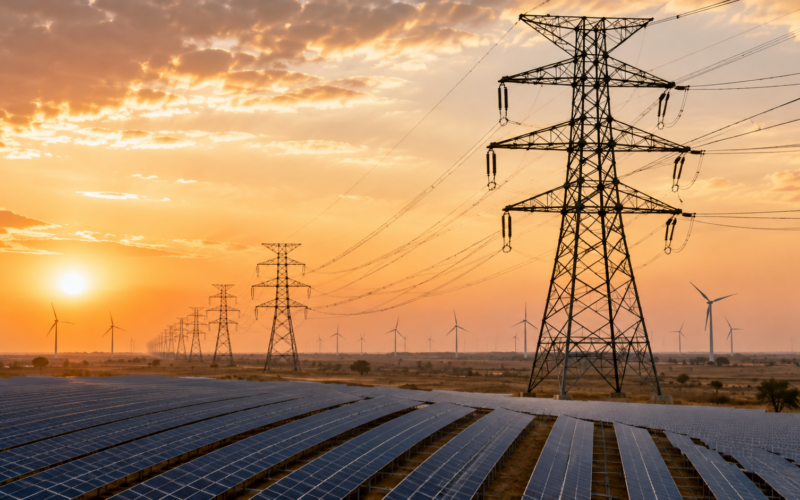
Power Grid Corporation of India Limited (NSE: POWERGRID) has been declared the successful bidder for an interstate transmission system designed to integrate 6.5 GW of renewable-energy capacity in Gujarat, securing the project at a discovered annual transmission tariff of ₹822.91 crore. The state-controlled transmission utility received the Letter of Intent on August 21, 2026 for the project covering the 5.5 GW Jam Khambhaliya Renewable Energy Zone Phase II and the 1 GW Jamnagar Phase I development, with the system to be implemented through the tariff-based competitive bidding route on a build, own, operate and transfer basis.
The annual tariff makes the win particularly substantial compared with many transmission announcements where only the physical project scope is disclosed. POWERGRID’s FY25 transmission-business revenue was ₹40,843.21 crore, meaning the ₹822.91 crore annual tariff is equivalent to roughly 2% of that historical transmission revenue base before allowing for project commissioning, tariff commencement and subsequent growth elsewhere in the portfolio. The comparison does not suggest that ₹822.91 crore immediately becomes revenue, but it gives a clearer indication of the project’s eventual scale within an already enormous transmission business.
What will POWERGRID build for the Jam Khambhaliya and Jamnagar renewable zones?
The transmission system is designed to provide grid integration for 5,500 MW of renewable generation in Jam Khambhaliya Phase II and another 1,000 MW in Jamnagar Phase I. Project information indicates that the scheme includes a new gas-insulated substation at Kalyanpur together with high-capacity transmission infrastructure, information and communication technology augmentation and bay-extension works at other substations in Gujarat.
The 6.5 GW capacity should be understood as renewable generation that the transmission system is designed to integrate rather than generation capacity owned by POWERGRID itself. The company is effectively building the high-voltage infrastructure that enables future wind and solar plants in the renewable-energy zones to connect with the wider interstate transmission system and move electricity toward demand centres.
That role becomes increasingly important as generation expands faster than local consumption in renewable-rich regions. Large solar and wind clusters can be commercially stranded if transmission capacity does not arrive on time, making evacuation infrastructure a prerequisite for turning sanctioned renewable projects into usable electricity.
The broader planning exercise in Gujarat is even larger. National transmission planning has considered Jam Khambhaliya Phase II and Jamnagar Phase I alongside the 7.5 GW Lakadia Phase II renewable zone, creating a combined 14 GW requirement for onward evacuation from parts of Gujarat toward load centres including southern Gujarat and Maharashtra. Official tender documents for associated schemes show that the network is being developed through several interdependent transmission packages rather than one standalone line.
How significant is the ₹822.91 crore annual tariff?
Transmission bidding differs from a conventional EPC contract because the headline tariff is not the capital value of a construction order. POWERGRID will invest in the project, commission the required assets and receive transmission charges under the contracted tariff framework once the system becomes commercially operational, subject to applicable terms and performance requirements.
That means the ₹822.91 crore figure represents recurring annual tariff potential rather than a one-time ₹822.91 crore construction award. The distinction is important for investors because a successfully commissioned tariff-based competitive bidding asset can produce a multi-year regulated-style revenue stream, while POWERGRID must initially fund and execute the underlying capital programme.
Earlier transmission-planning analysis placed the estimated investment for the Jam Khambhaliya Phase II and Jamnagar Phase I integration system at about ₹7,688 crore. On that planning estimate, the ₹822.91 crore discovered annual tariff is equivalent to approximately 10.7% of estimated capital cost, although this simple ratio is not an investment return because it ignores financing costs, operating expenses, taxes, depreciation, tariff escalation provisions and the eventual executed project cost.
The absolute size is nevertheless notable. POWERGRID’s transmission portfolio contains hundreds of assets and competitive-bidding subsidiaries, so individual projects rarely transform group economics, but an annual tariff approaching ₹823 crore is large enough to provide meaningful incremental revenue visibility after commissioning.

Why is Gujarat creating such a large transmission opportunity?
Gujarat has become one of India’s most important renewable-energy development regions because of its combination of solar resources, wind potential, industrial demand and available land in western parts of the state. The central government’s 500 GW non-fossil capacity ambition for 2030 has consequently created a parallel need for high-voltage infrastructure capable of carrying renewable electricity from generation clusters to industrial and urban demand centres.
Transmission planning documents show the scale of that challenge. The Lakadia Phase II, Jam Khambhaliya Phase II and Jamnagar Phase I clusters together represent about 14 GW, while the common evacuation network includes 765 kV and 400 kV infrastructure designed to transfer power across Gujarat and toward Maharashtra.
POWERGRID is particularly well positioned for this buildout because it combines an existing national transmission footprint with experience in 765 kV systems, gas-insulated substations and tariff-based competitive bidding projects. Its opportunity is not limited to one Gujarat award because renewable-zone expansion is generating repeated transmission packages in Rajasthan, Gujarat, Karnataka and other states.
The risk is largely execution-linked. Transmission projects of this size require land, rights of way, substation construction, equipment procurement and coordination with generating projects and adjoining grid assets. A delay in interdependent transmission packages can postpone utilisation even when POWERGRID completes its own elements.
What does the BOOT structure mean for POWERGRID?
Under a build, own, operate and transfer structure, POWERGRID is not functioning merely as an EPC contractor that builds infrastructure and hands it over immediately. The company will develop and own the transmission assets during the contracted operating period, creating the recurring tariff stream that makes competitive transmission projects economically attractive.
This also means upfront capital requirements are considerably larger than the annual tariff figure might initially suggest. POWERGRID must finance construction before the asset begins earning its full transmission charges, so project returns depend on delivering within the assumed cost, financing and commissioning framework.
The model nevertheless fits POWERGRID’s balance sheet and operating expertise. At FY25 end, the group reported consolidated income of ₹47,459 crore, profit after tax of ₹15,521 crore, gross fixed assets of about ₹2.91 lakh crore and debt of approximately ₹1.31 lakh crore, illustrating the scale at which it already finances long-duration electricity infrastructure.
The Gujarat award therefore adds another sizeable asset to an established infrastructure-financing model rather than pushing POWERGRID into an unfamiliar business.
How did POWERGRID shares react to the Gujarat transmission win?
POWERGRID shares closed at ₹272.40 on August 21, rising 2.87% during the session on unusually heavy volume of about 18 million shares. The stock traded between ₹264.20 and ₹275.95 and finished around 16% below its 52-week high of ₹324.95 while remaining above the 52-week low of ₹250.
The strong same-day gain does not prove that the Gujarat project alone caused the move, but the timing provides a positive market backdrop for the announcement. The company’s market capitalisation stood at approximately ₹2.46 lakh crore at the August 21 close, so even a large transmission project remains incremental to the broader valuation rather than transformational by itself.
For investors, the more meaningful milestones will come after the Letter of Intent. POWERGRID must complete the formal project acquisition and contracting process, finance construction and deliver the infrastructure within the prescribed schedule before the ₹822.91 crore annual tariff becomes an operating revenue stream. If execution stays on track, the Gujarat project will reinforce one of the central themes behind POWERGRID’s growth outlook: India’s renewable expansion requires not only new generation but an enormous parallel investment in the electricity grid.
Discover more from Business-News-Today.com
Subscribe to get the latest posts sent to your email.