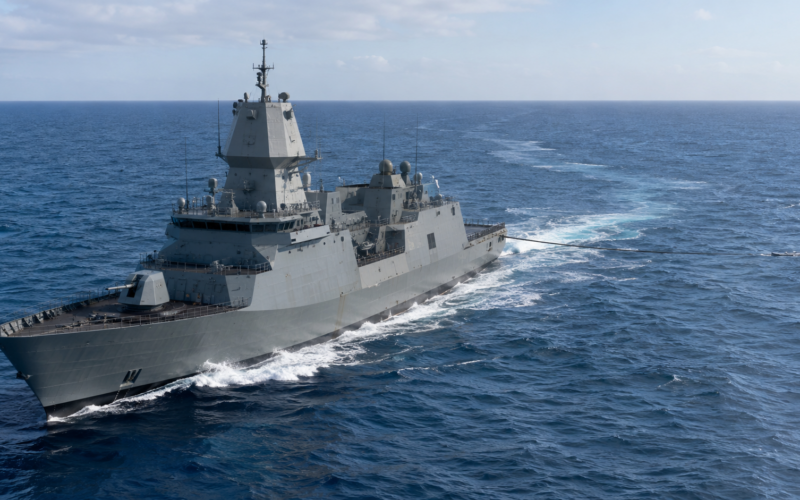
Oki Electric Industry Co., Ltd. (Tokyo Stock Exchange: 6703) has signed a supply contract with Mitsubishi Heavy Industries, Ltd. (Tokyo Stock Exchange: 7011) for towed passive sonar equipment intended for Australia’s new general-purpose frigates. The July 27, 2026 announcement places OKI’s underwater acoustic technology inside one of the most strategically important naval procurement programmes linking Japan and Australia. It gives the Japanese electronics and public-infrastructure group a role in a fleet designed to strengthen the Royal Australian Navy’s undersea warfare, local air-defence and long-range maritime operations. The central question is whether this initial equipment position develops into a larger, recurring franchise across follow-on construction, Australian sustainment and future upgrades.
What does the OKI sonar contract add to Australia’s upgraded Mogami frigate programme?
The contract makes OKI part of the industrial network supporting Mitsubishi Heavy Industries’ upgraded Mogami-class design for Australia’s General Purpose Frigate programme, also known as SEA 3000. Australia signed contracts in April 2026 for the first three vessels, which will be built at Mitsubishi Heavy Industries’ Nagasaki Shipyard and Machinery Works. The first frigate is scheduled for delivery in December 2029, with operational service expected from 2030.
Australia plans to acquire as many as 11 general-purpose frigates. The first three are being built in Japan to accelerate entry into service, while the remaining ships are intended to transition to construction at the Henderson Defence Precinct in Western Australia, subject to industrial preparations. The Australian government has committed up to A$20 billion over the decade to the programme.
For OKI, the importance extends beyond an initial hardware sale. Naval sonar can create a long relationship involving testing, configuration control, spare parts, maintenance, software support and capability upgrades. A place on the first ships could become more valuable if the same equipment is retained across the wider fleet and supported through an Australian sustainment arrangement.
Why is towed passive sonar strategically important for Royal Australian Navy undersea warfare?
A towed passive sonar listens for underwater acoustic signatures without transmitting an active sonar pulse. Its sensor array is streamed behind the frigate, distancing it from some of the ship’s machinery, propeller and hydrodynamic noise. That separation can improve the ability to detect and track submarines, particularly when ocean conditions reduce the effectiveness of sensors fixed to the hull.
The system’s effectiveness still depends on array sensitivity, signal processing, environmental data, operator training and integration with other assets. Its real operational value comes from combining the sonar picture with the combat management system, other ship sensors, maritime helicopters, sonobuoys and weapons rather than treating the array as an isolated component.
Australia selected the upgraded Mogami design as a general-purpose platform capable of undersea warfare as well as air and surface defence. The ships are expected to have a range of up to 10,000 nautical miles, a 32-cell vertical launch system, surface-to-air and anti-ship missiles, and the ability to operate the Royal Australian Navy’s MH-60R Seahawk maritime combat helicopter. The relatively small crew of about 92 personnel also increases the importance of automation, reliable information processing and maintainable sensors.
The sonar contract therefore supports a capability near the centre of Australia’s naval requirements. The Royal Australian Navy is seeking ships that can operate across large distances, protect maritime approaches and contribute to a networked force in an Indo-Pacific environment where submarine activity is becoming more consequential.
How does the contract expand OKI’s role in Japan’s defence export supply chain?
Oki Electric Industry has worked on underwater acoustics since the 1950s and has built experience in sonar, underwater acoustic sensors and related maritime systems. The Australian contract converts that long-standing domestic capability into a position within a foreign naval programme led by Mitsubishi Heavy Industries. Defence exports require rigorous documentation, interoperability, quality assurance and long-term supplier accountability, which can improve a supplier’s credibility in later international competitions.
The upgraded Mogami programme is also a test of Japan’s ability to export an integrated warship rather than a standalone technology. Mitsubishi Heavy Industries supplies the platform, but the frigate’s operational value depends on a wider Japanese supplier base covering radar, electronic systems, information processing, sonar and underwater equipment. OKI’s contract shows how a successful platform export can pull specialist domestic suppliers into international revenue streams.
The award also aligns with OKI’s New Management Plan 2031, which places Defence Systems inside the Public Solutions segment and identifies government growth-investment areas as a priority. Management is targeting group sales of at least JPY600 billion and an operating margin of at least 7% by fiscal 2031, supported by JPY295 billion of planned investment. The contract validates the strategic direction, although the financial contribution will depend on order scale, timing and margins.
Why does OKI’s Numazu factory expansion matter for delivery risk and follow-on orders?
The sonar award arrives as OKI is increasing manufacturing capacity for underwater acoustic systems and sensors at its Numazu plant in Shizuoka Prefecture. The company announced in April 2026 that it would invest about JPY3 billion in a new production building, with completion planned for September 2027 and operations expected to begin around December 2027. OKI intends to expand production of sonar, sonobuoys and related underwater acoustic sensors by about 50% compared with fiscal 2023 levels.
The timing strengthens the industrial logic of the Australian contract. The planned factory ramp-up precedes the first upgraded Mogami delivery in late 2029, reducing the risk that OKI must meet growing defence demand entirely with existing capacity. It also suggests management expects underwater sensing to remain a meaningful growth area rather than a single project.
Capacity alone does not guarantee delivery. Naval programmes require qualified components, secure supply chains, repeatable testing, export-control compliance and close coordination with the prime contractor. A delayed sensor can disrupt harbour trials, combat-system testing or ship acceptance even when the hull is progressing. OKI’s execution test will be whether the Numazu expansion delivers reliable throughput and quality discipline.
The follow-on opportunity will depend on how Australia divides production and support responsibilities for the locally built ships. OKI could retain high-value sensor manufacturing in Japan while developing Australian testing, repair or technical-support capabilities. That balance will influence margins, resilience and the political acceptability of the sustainment model.
What does the award reveal about Mitsubishi Heavy Industries’ supplier and integration challenge?
Mitsubishi Heavy Industries is the platform prime, but the Australian frigate is becoming a multinational industrial system. The upgraded Mogami design combines Japanese shipbuilding and sensors with weapons, propulsion components and support arrangements drawn from allied supply chains. This can improve capability and interoperability, but it also increases integration and configuration-management complexity.
The OKI contract shows the programme moving from platform selection into detailed supplier execution. Schedule credibility now depends on whether design, production and testing decisions remain aligned. Sensor interfaces, power, cooling, cabling, software baselines and stern deployment arrangements all have to work inside the ship’s weight, space and acoustic constraints.
Australia’s preference for an accelerated and relatively stable design reduces some development risk, but it does not remove the challenge of adapting a Japanese naval platform for Royal Australian Navy operations. Australian communications, training standards, certification requirements and support practices must be incorporated without allowing change requests to erode the schedule advantage that made the upgraded Mogami attractive.
The longer-term issue is technical knowledge transfer. Australia needs enough access to support fleet availability and local shipbuilding, while Japanese suppliers must protect intellectual property and avoid creating duplicate, expensive support structures. The programme’s success will depend as much on this industrial architecture as on the performance of any individual sensor.
What does the sonar award mean for OKI earnings and investor sentiment?
Oki Electric Industry reported fiscal 2026 net sales of JPY421.6 billion, down 6.8%, while operating income rose 1.2% to JPY18.8 billion. Profit attributable to owners of the parent increased 72.4% to JPY21.5 billion. For the fiscal year ending March 2027, the company forecasts sales of JPY440 billion and operating income of JPY22 billion, representing projected increases of 4.4% and about 17%, respectively.
The Public Solutions segment, which includes Defence Systems, is forecast to generate JPY147 billion of sales and JPY18 billion of operating profit. Sales are expected to be broadly stable, while segment operating profit is projected to decline. The sonar contract is strategically supportive, but Business News Today has no basis to treat it as an immediate upgrade to near-term guidance without clearer information on delivery timing and economics.
Using the latest completed Tokyo session before this July 28 review, OKI shares closed at JPY3,400 on July 27, up 1.49% for the day. The stock had gained about 11.1% across the previous five trading sessions from its July 17 close of JPY3,060, but remained roughly 9.7% below its June 29 close of JPY3,765. Its 52-week range was approximately JPY1,455 to JPY3,970, placing the July 27 close about 14.4% below the high but more than 130% above the low.
That pattern suggests strong longer-term rerating alongside recent volatility rather than a clean contract-driven move. Investor sentiment is likely to remain tied to the company’s July 30 quarterly results, progress under Management Plan 2031 and evidence that defence growth can offset pressure or restructuring elsewhere in the portfolio. The sonar award adds strategic credibility, but order economics and execution evidence will determine whether it provides lasting valuation support.
Which milestones will show whether the OKI sonar contract becomes a durable defence franchise?
The first proof point will be manufacturing and integration progress ahead of the initial frigate’s planned December 2029 delivery. The second will be confirmation that the sonar configuration is carried through the broader Australian fleet rather than limited to a narrow initial scope. The third will be an efficient Australian sustainment model that protects fleet availability and gives OKI a recurring role after ship delivery.
The contract improves OKI’s position because it connects established underwater acoustic capability, new factory investment and an international naval programme with strong government backing. What remains unresolved is the financial scale, the timing of revenue recognition and the extent of follow-on participation. The thesis will strengthen if OKI demonstrates on-time delivery, fleet-wide commonality and recurring support revenue. It will weaken if programme changes, localisation disputes or integration delays restrict the company to a small hardware contribution.
What are the key takeaways from OKI’s sonar contract for Australia’s Mogami frigates?
- Oki Electric Industry has secured a contract from Mitsubishi Heavy Industries to supply towed passive sonar for Australia’s new general-purpose frigates.
- The award places OKI inside the upgraded Mogami-class industrial ecosystem supporting Royal Australian Navy undersea warfare.
- Australia has contracted the first three frigates for construction in Japan, with the first delivery scheduled for December 2029.
- The wider programme could include up to 11 ships, with follow-on construction intended for Western Australia.
- OKI is investing about JPY3 billion in new Numazu production capacity and targets a 50% increase in underwater sensor output.
- The contract supports OKI’s Management Plan 2031 and its emphasis on Defence Systems within Public Solutions.
- Near-term earnings impact cannot be assumed without clearer information on contract economics, delivery timing and margins.
- Fleet-wide equipment commonality, on-time delivery and Australian sustainment participation are the main long-term tests.
Discover more from Business-News-Today.com
Subscribe to get the latest posts sent to your email.