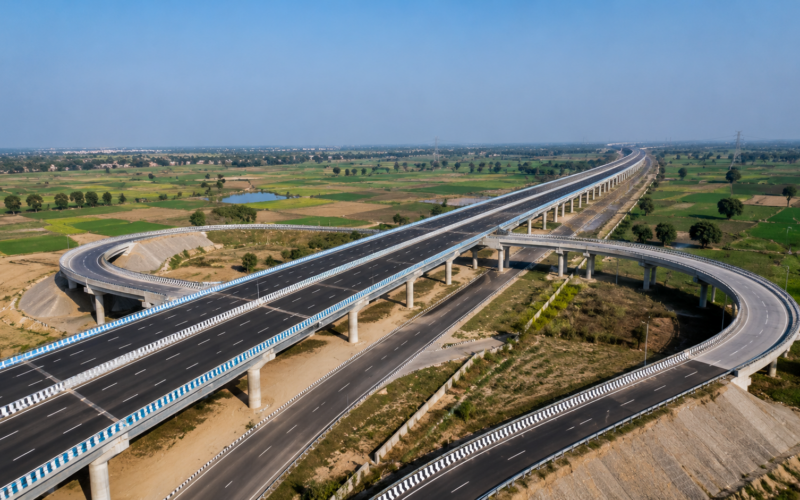
Uttar Pradesh has allocated approximately ₹15,400 crore toward a new wave of expressway and connectivity projects through its first supplementary budget for FY27, with most of the money earmarked for land acquisition rather than immediate civil construction. The largest provisions include ₹6,500 crore for land required for the proposed Vindhya Expressway and ₹5,700 crore for an extension of the Ganga Expressway, alongside funding for the Purvanchal Link Spur and several connecting corridors.
The funding sits within Uttar Pradesh’s ₹59,019.54 crore supplementary budget, which adds substantial capital expenditure across industry, infrastructure, energy and other state priorities. The Finance Department’s official budget portal confirms publication of the FY27 first supplementary budget, giving the expressway allocations a budgetary basis rather than leaving them as conceptual project proposals.
The critical distinction is project stage. A budget allocation for land acquisition does not mean that ₹15,400 crore of road-construction contracts have been awarded, nor does it establish that every proposed expressway has entered physical construction. The funding primarily prepares the land and development pathway required before full-scale civil packages can be tendered and executed.
How is Uttar Pradesh dividing the ₹15,400 crore expressway allocation?
The largest individual provision is ₹6,500 crore for land acquisition associated with the proposed Vindhya Expressway. The planned corridor is intended to connect the Ganga Expressway toward Sonbhadra through eastern Uttar Pradesh, with a route involving areas around Prayagraj, Mirzapur, Varanasi and Chandauli.
Another ₹5,700 crore has been earmarked for land acquisition related to extension of the Ganga Expressway, while approximately ₹2,300 crore is allocated for land needed for the Purvanchal Link Spur connecting the Sonbhadra side of the emerging network with Chandauli and Ghazipur. Those three land provisions alone total ₹14,500 crore, showing that land assembly dominates the latest financial commitment.
Additional provisions include ₹250 crore for the proposed Noida International Airport-Ganga Expressway greenfield link through Bulandshahr and ₹400 crore for a greenfield connection between the Agra-Lucknow Expressway and Ganga Expressway through the Hardoi-Farrukhabad corridor. Smaller amounts are set aside for civil works and project development across the broader network.
The allocation therefore represents several projects at different development stages rather than one ₹15,400 crore expressway. That matters for both contractors and investors because civil EPC opportunities will emerge package by package only after land, design and statutory preparation advance sufficiently.
Why is ₹6,500 crore being committed to the Vindhya Expressway before construction?
Land acquisition is often one of the largest schedule risks for Indian greenfield highways. Contractors can mobilise only limited sections if the project authority does not possess a sufficiently continuous right of way, while delayed compensation and litigation can disrupt both financing and construction.
By allocating ₹6,500 crore specifically for land, Uttar Pradesh is attempting to resolve a major prerequisite before large-scale construction begins. This approach can make future EPC or concession packages more bankable because bidders have greater confidence that the state can provide access to the required corridor.
The proposed Vindhya Expressway would also extend the economic reach of the Ganga Expressway deeper into eastern and southeastern Uttar Pradesh. Rather than functioning as an isolated road from one city to another, the project is being planned as part of an interconnected network linking the Meerut-Prayagraj corridor with Varanasi, Chandauli and Sonbhadra.
That network logic is economically important. Sonbhadra is a major power and industrial district, while Varanasi and adjoining eastern districts have significant logistics, manufacturing, agricultural and tourism activity. Faster controlled-access connections can shorten road travel and potentially improve freight movement between production centres, consumption markets and other national corridors.

How does the new funding build on the completed Ganga Expressway?
The six-lane Ganga Expressway has already created a 594-kilometre controlled-access spine between the Meerut side of western Uttar Pradesh and Prayagraj, passing through districts including Hapur, Bulandshahr, Amroha, Sambhal, Badaun, Shahjahanpur, Hardoi, Unnao, Rae Bareli and Pratapgarh. The project was inaugurated on April 29, 2026 after development expenditure exceeding ₹36,000 crore.
The next phase of state strategy is increasingly about links and extensions rather than building only disconnected expressways. Funding the Vindhya corridor, airport connection and Agra-Lucknow link can increase the utility of the original Ganga Expressway by feeding additional traffic into it from industrial and population centres not directly located on the core route.
This creates a network effect. A highway connecting two endpoints has one level of utility, but its economic value can rise when feeder expressways connect airports, manufacturing clusters, logistics parks and additional cities to the same controlled-access system.
The Noida International Airport-Ganga Expressway link is an obvious example. If completed as planned, it could create a more direct high-speed connection between the Jewar airport region and the Ganga Expressway, improving passenger and freight connectivity from the airport toward central and eastern Uttar Pradesh.
When will construction companies actually see contracts from the allocation?
The land-heavy nature of the budget means contractors should not treat the ₹15,400 crore allocation as an immediate order pipeline of the same value. Land payments go primarily to landowners and acquisition processes, while civil packages require separate detailed project reports, approvals, procurement structures and tender awards.
For EPC companies, the more relevant milestones will be requests for qualification, requests for proposal, package values and Letters of Award. Depending on the project, Uttar Pradesh could use EPC, hybrid annuity, concession or other implementation structures, and the eventual distribution of construction value among contractors remains unknown until procurement advances.
The earlier Ganga Expressway provides a useful precedent. Uttar Pradesh Expressways Industrial Development Authority split that project into construction groups and packages that were competitively awarded to developers, rather than handing the entire 594-kilometre corridor to one contractor. A similar packaging strategy for future corridors could create opportunities for multiple large road developers.
Construction demand would extend beyond contractors. Expressways generate requirements for cement, steel, aggregates, earthmoving equipment, toll systems, lighting, safety barriers and associated structures, while interchanges can stimulate warehousing, industrial and real-estate development around access points.
Could the ₹15,400 crore allocation accelerate industrial development as well as roads?
The supplementary budget links infrastructure spending with a wider industrial strategy. Separate allocations include ₹1,500 crore for the Atal Industrial Infrastructure Mission, ₹1,303 crore for implementation of the FDI and Fortune-500 Companies Investment Promotion Policy and ₹495 crore for the Bharat Industrial Development Scheme.
That combination matters because transport infrastructure has greater economic value when it connects places where factories, warehouses and logistics facilities are actually being developed. Uttar Pradesh has been attempting to build industrial clusters along its expressway system, using improved connectivity as part of its pitch for manufacturing investment.
The latest land allocation therefore has a longer horizon than FY27 expenditure alone. Acquiring corridors now can unlock several years of subsequent civil construction, while completed expressways could then support industrial projects and urban development along their routes.
Execution remains the decisive variable. Land acquisition can run into compensation disputes, environmental approvals can alter alignments and major civil projects can experience cost escalation before completion. The ₹15,400 crore commitment nevertheless moves several proposed corridors closer to the point where those risks can be converted from planning issues into executable infrastructure packages.
For Uttar Pradesh, the strategy is increasingly visible: the Ganga Expressway is becoming a backbone rather than an endpoint. The new budget attempts to extend that backbone toward Sonbhadra, connect it with other expressways and create access toward the Noida International Airport. If the land programme proceeds on schedule, the state’s next major road-construction cycle could emerge from the allocations now being made before the first construction contract is even awarded.
Discover more from Business-News-Today.com
Subscribe to get the latest posts sent to your email.