The United Kingdom’s final investment decision on the £38 billion Sizewell C nuclear power station has sparked a new conversation about how large-scale nuclear energy projects should be financed in Europe. By adopting a Regulated Asset Base (RAB) model—a framework designed to distribute risk between taxpayers, consumers, and private investors—Sizewell C is being positioned as a test case for funding nuclear infrastructure in a way that reduces upfront capital burdens and attracts long-term institutional investment.
The UK Government, now the largest single shareholder with a 44.9 per cent equity stake, has set a precedent by committing roughly £14.4 billion to the project alongside private backers, including La Caisse (20 per cent), Centrica (£1.3 billion for 15 per cent), Amber Infrastructure Group (7.6 per cent), and EDF (12.5 per cent). Support from the National Wealth Fund and a £5 billion Bpifrance Assurance Export loan guarantee further underlines the government’s willingness to blend public capital with private finance to meet strategic energy goals.
With a timeline that anticipates commercial operation between 2035 and 2037, analysts are now asking whether Sizewell C could serve as the financial blueprint for future reactors—both conventional European Pressurised Reactors (EPRs) and the small modular reactors (SMRs) that are gaining traction across the continent.
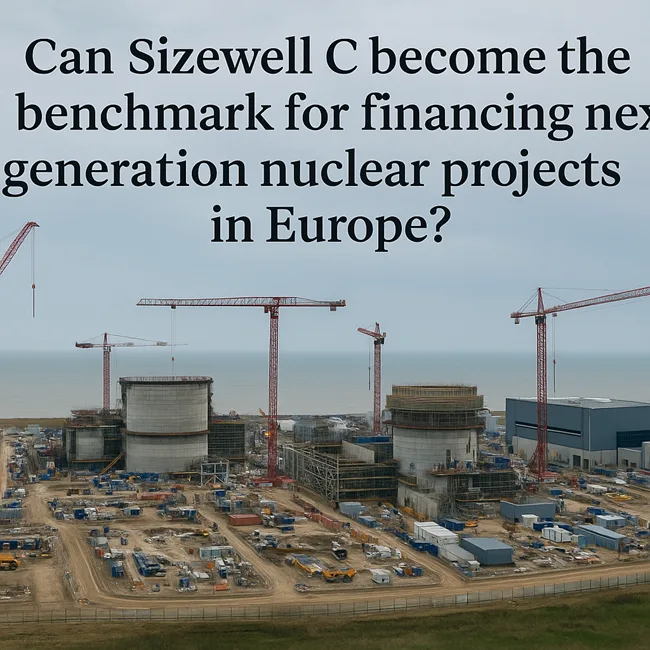
Why is the RAB model for Sizewell c being viewed as a breakthrough for nuclear financing in Europe?
The RAB model represents a fundamental shift from the Contract for Difference (CfD) mechanisms used for Hinkley Point C and other low-carbon energy projects. Instead of requiring investors to wait until the plant becomes operational to begin recouping their costs, the RAB framework allows regulated, inflation-linked returns to flow during construction. This lowers the cost of capital by reducing investor risk, making it easier to attract pension funds and infrastructure-focused institutional investors.
Institutional sentiment suggests the potential for 10–12 per cent inflation-adjusted returns over the project’s lifespan. Analysts also highlight that household bill impacts—capped at around £1 per month during construction—are politically palatable when compared with the price volatility of fossil fuel imports. By mitigating upfront risks and spreading cost recovery across decades, the RAB model could make nuclear development more attractive for governments struggling to balance energy security needs with public spending constraints.
How does Sizewell C’s equity structure balance public accountability with private investor confidence?
The equity split at Sizewell C is considered unusually public-heavy for a European nuclear project, which has raised both optimism and caution among institutional observers. The UK Government’s 44.9 per cent share ensures that taxpayers retain significant control and potential upside, while also signalling political commitment that reassures private investors.
Private backers are incentivised through contractual guarantees and cost-control mechanisms. For example, EDF, La Caisse, and Amber Infrastructure will lose revenue if project overruns exceed agreed budgets, placing financial discipline at the heart of the construction strategy. This “shared risk” structure has been cited by institutional investors as a critical confidence-building measure, particularly given the legacy of Hinkley Point C’s cost overruns.
Can Sizewell C’s financing approach accelerate SMRs and future large-scale nuclear projects in Europe?
If Sizewell C delivers on time and within budget, analysts believe the RAB model could unlock private financing for both large reactors and modular technologies. The success of this financing framework may influence investment decisions in countries like France, Finland, and Eastern European states exploring new nuclear builds.
The UK has already signalled that the RAB approach could be extended to Rolls-Royce’s small modular reactor programme, which is moving through early licensing stages. A proven track record at Sizewell C could reduce financing costs for SMRs, making them viable not only in the UK but also as an exportable technology and financial model for countries with constrained public budgets.
What risks remain for taxpayers and could they affect the RAB model’s credibility?
Despite the structured risk-sharing, Sizewell C’s £47 billion contingency ceiling remains a focal point of concern. If the project exceeds this threshold, critics argue taxpayers and consumers may still face unexpected cost burdens. Institutional investors, while insulated through contractual guarantees, could also see their returns diluted by construction delays or regulatory changes.
Analysts have stressed that the success of the RAB model depends heavily on maintaining cost discipline and transparent reporting. Any perception of mismanagement could undermine investor trust and weaken appetite for future nuclear deals across Europe.
How might Sizewell C redefine Europe’s nuclear policy and energy transition strategy?
Sizewell C’s financing decision has implications beyond the UK. A successful execution could inspire similar public-private partnerships in countries seeking to decarbonise while ensuring baseload stability. Analysts suggest that nations such as Poland and the Czech Republic, which are exploring SMR deployment, could look to replicate the RAB framework if it demonstrates lower financing costs and manageable political risk.
Moreover, a well-executed Sizewell C project would strengthen the UK’s position as a global nuclear hub. By combining engineering expertise with a scalable financial model, the UK could become a leading exporter of nuclear project structuring and SMR technology to Europe, North America, and Asia.
What is the institutional outlook on Sizewell C’s ability to set a European standard?
Institutional investors view Sizewell C as a bold experiment rather than a guaranteed template. Many have expressed cautious optimism, noting that the blend of public capital and regulated returns could redefine how Europe approaches large-scale nuclear funding.
If the project meets its cost and delivery targets, the RAB model could become the default financing strategy for nuclear infrastructure, helping to close the investment gap that has slowed new builds across the continent. Conversely, significant overruns would likely reinforce scepticism and push governments back toward publicly funded models, limiting private sector participation in Europe’s clean energy transition.
For now, Sizewell C represents the most ambitious attempt in decades to combine private capital with strong public oversight in nuclear development, making it a pivotal case study for energy infrastructure financing. Unlike earlier nuclear projects that relied almost exclusively on government-backed debt or full public ownership, Sizewell C’s blended equity structure and use of the Regulated Asset Base (RAB) model mark a significant departure from conventional funding approaches.
If executed successfully, this hybrid framework could transform Europe’s energy financing landscape by proving that large-scale, capital-intensive nuclear plants can attract long-term institutional investors without placing excessive strain on public budgets. It would also demonstrate how governments can leverage public equity stakes to de-risk private participation while maintaining direct accountability for consumer protection and cost control.
Analysts believe such a model could become the blueprint for financing not only future European Pressurised Reactors (EPRs) but also emerging small modular reactor (SMR) programmes, which require investor confidence in predictable revenue streams. A well-managed Sizewell C project could therefore establish the United Kingdom as a reference point for nuclear project structuring, influencing energy transition strategies across Europe and potentially reshaping global nuclear investment norms.
Discover more from Business-News-Today.com
Subscribe to get the latest posts sent to your email.