
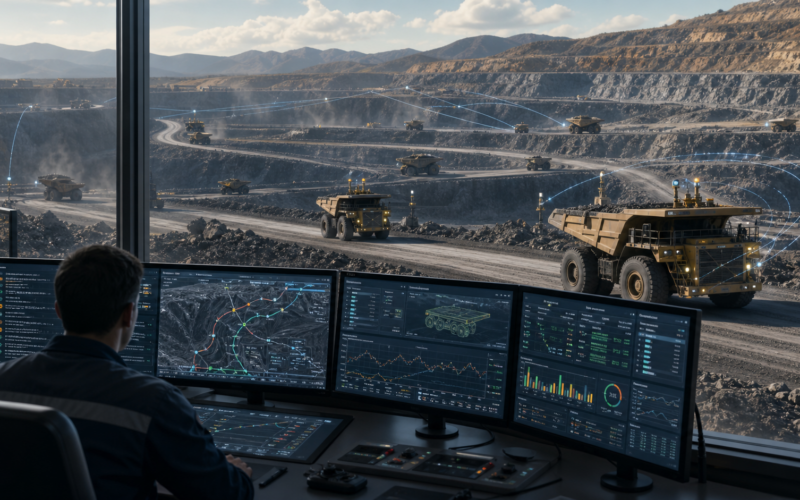
The mining fleet management software market is consolidating into a two-tier structure dominated by original equipment manufacturers on one side and specialist software vendors on the other, with the original equipment manufacturer tier capturing the largest share of new deployments through autonomous haulage commitments tied to long-cycle truck purchases. According to Caterpillar Incorporated (NYSE: CAT) Investor Day disclosures, Caterpillar had 690 autonomous trucks running its Cat MineStar Command for hauling solution at the end of 2024 and is targeting more than 2,000 by 2030. Komatsu Limited (TYO: 6301) confirmed in April 2026 that it had commissioned its 1,000th autonomous ultra-class haul truck on its FrontRunner Autonomous Haulage System, with cumulative material moved on the platform exceeding 11.5 billion metric tonnes since commercial launch in 2008. The competitive consequence is that mining fleet management software is no longer a peripheral procurement category. It is becoming the control layer that determines which equipment original equipment manufacturer a mine effectively marries for the next decade.
The market itself is large and growing. Public market research published by Dataintelo values the global mining fleet management software market at approximately 7.2 billion United States dollars in 2024, with a projected compound annual growth rate of 13.4 percent through 2033 to reach roughly 22.5 billion United States dollars. Asia Pacific accounts for around 38 percent of total value, driven by mining capital expenditure in China, Australia and India. North America follows at roughly 25 percent. The segmentation that matters strategically is not geographic, however, but architectural. Hexagon AB (STO: HEXA-B), Caterpillar Incorporated, Komatsu Limited, Wenco International Mining Systems, Trimble Incorporated (NASDAQ: TRMB) and Hitachi Construction Machinery Company Limited dominate the top of the market alongside specialist vendors including Modular Mining Systems, owned by Komatsu, Sandvik AB through its Deswik and OptiMine subsidiaries, Epiroc AB through MineRP, and Datamine.
What is driving the shift in mining fleet management software providers in 2026
Three structural forces are tightening the link between fleet management software and equipment original equipment manufacturers. The first is autonomous haulage scale. The Caterpillar autonomous fleet has now moved more than 11 billion tonnes of material and travelled more than 380 million kilometres, according to the company’s January 2026 disclosures. Komatsu customers running FrontRunner have collectively moved more than 11.5 billion metric tonnes since 2008 across mine sites in North America, South America, Australia and Europe. These are not pilot programmes. They are now the dominant productivity benchmark in iron ore, copper, gold and oil sands, and they require the original equipment manufacturer’s fleet management software as a tightly integrated dependency rather than an interchangeable layer. A mine operator who commits to Cat MineStar Command for hauling on Cat 793F or Cat 797F trucks is locked into a software, firmware, sensor and service relationship measured in 15 to 20-year truck life cycles.
The second force is original equipment manufacturer roll-up of independent software firms. Sandvik AB acquired Deswik, the Brisbane-based mine planning specialist, and now positions Deswik as the integration point between geological models and physical AutoMine autonomous loading systems. Sandvik AB also owns OptiMine, its underground productivity platform. Epiroc AB acquired MineRP in 2021 from Dundee Precious Metals, paying approximately 40 million United States dollars in cash for the controlling stake plus an earn-out of up to 28.7 million United States dollars contingent on revenue targets. MineRP brought platform capabilities to integrate technical mining data with enterprise resource planning systems. Komatsu Limited owns Modular Mining Systems, the publisher of DISPATCH, which trade press reviews continue to rank as the leading real-time fleet dispatch platform for surface mining. Hitachi Construction Machinery Company Limited owns Wenco International Mining Systems. The independent fleet management software vendor of meaningful scale is now an exception rather than the norm.
The third force is the integration of fleet management software with mine planning, geological modelling and resource scheduling. Hexagon AB’s HxGN MinePlan suite leverages the company’s own high-precision sensors and global navigation satellite system hardware to feed real-time data back into resource allocation. Hexagon AB acquired Mine Design Solutions, a Canadian engineering software company founded in 1995, in June 2025, extending its mine planning portfolio. RPMGlobal, the Brisbane-listed technical mining software firm acquired by Caterpillar Incorporated, develops the XPAC Revolution platform used by mining planners to model unit cost per truckload and per blast in real time. The competitive logic across all three OEM-aligned ecosystems is the same. Fleet management is no longer the product. The product is the integrated planning, execution and optimisation stack with fleet management as one node.
Which companies lead the mining fleet management software market today
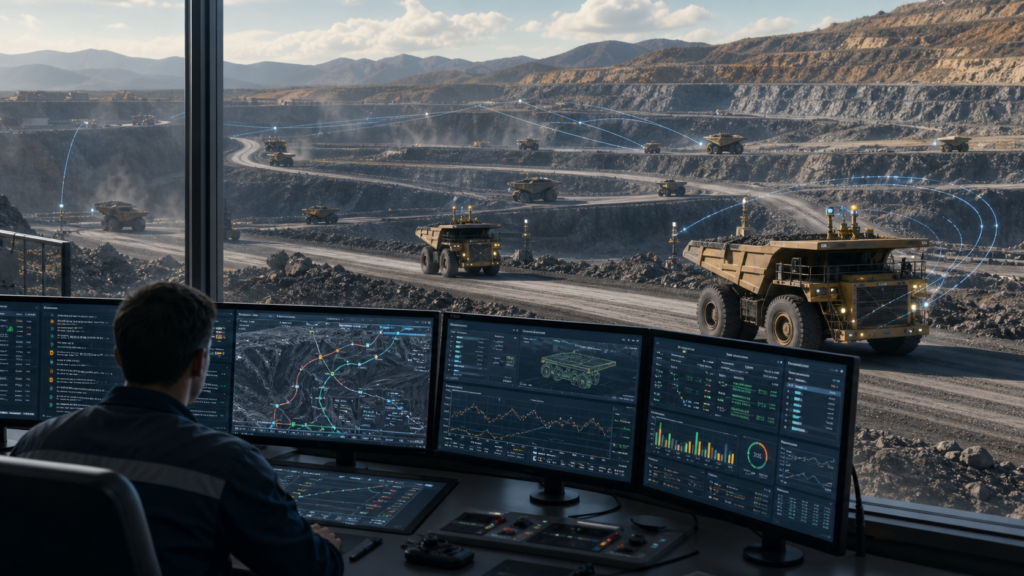
In surface mining, three platforms continue to attract the most independent industry coverage and active deployment commentary. DISPATCH from Modular Mining Systems retains its position as the most widely deployed real-time fleet dispatch and haulage optimisation system across large open-pit operations. Cat MineStar from Caterpillar Incorporated is the dominant suite at sites running Caterpillar trucks, particularly where Command for hauling autonomous capability is in scope. HxGN MineFleet from Hexagon AB is the most cited mixed-fleet alternative, providing original equipment manufacturer-agnostic dispatch, collision avoidance and analytics for operators who refuse to lock into a single truck supplier.
Beyond the top three, the next tier is sharply differentiated by application. Wenco FleetCS from Wenco International Mining Systems, owned by Hitachi Construction Machinery Company Limited, is preferred at Hitachi-equipped sites and at mixed-fleet operations seeking deeper open-pit telematics. Sandvik AB markets OptiMine and AutoMine for underground productivity and autonomous loading. Pitram from Micromine remains the underground production reporting and short-interval control standard in deep hard-rock mines. Datamine, the dedicated mining technology firm, supplies the MineMarket and Studio range used heavily across iron ore and bulk commodities for reconciliation and grade control. Trimble Incorporated’s connected mine and machine guidance systems anchor the precision agriculture-style geospatial layer at sites where Trimble hardware is already embedded. RPMGlobal, now operating under the Caterpillar Incorporated umbrella, supplies XPAC Revolution for financial optimisation of the resource allocation plan.
Underneath this, the autonomous haulage benchmark is being set by two highly specific operating relationships. Fortescue Limited (ASX: FMG) renewed its Cat MineStar Command for hauling agreement in March 2026 across three of its Western Australian iron ore operations, extending a deployment that began in 2012 when Fortescue Limited became the first commercial-scale customer for Caterpillar’s autonomous haulage system. Vale SA (NYSE: VALE) signed an agreement with Caterpillar Incorporated and Sotreq in late 2025 to expand its autonomous fleet in the Carajas region of Para state, Brazil, to approximately 90 autonomous trucks by 2028, including units capable of carrying up to 400 tonnes. On the Komatsu Limited side, Barrick Mining Corporation (NYSE: GOLD) launched the United States’ first major gold-mining FrontRunner deployment at Nevada Gold Mines in 2025, automating a fleet of 230-tonne and 300-tonne haul trucks across surface operations.
How autonomous haulage is reshaping the mining fleet management software competitive landscape
The autonomous haulage market is no longer a research project. The Komatsu Limited FrontRunner installed base alone passed 875 trucks in May 2025 and 1,000 trucks by April 2026. Caterpillar Incorporated’s deployment is somewhat smaller in unit terms at around 690 trucks at end-2024 but has hauled more cumulative material by some measures, with the company citing more than 11 billion tonnes hauled across its installed base. Both companies are now operating at a scale where fleet management software is no longer marketed as a productivity tool. It is marketed as the basis for entire site operating models. Caterpillar Incorporated has begun extending Command for hauling into the aggregates segment through its Luck Stone deployment at Bull Run Plant in Chantilly, Virginia, where four Cat 777 trucks went live in November 2024 and surpassed two million tonnes hauled within the first year. Caterpillar Incorporated has also signalled it will extend autonomous capability to the smaller Cat 785 class, opening the technology to a broader middle market of mines and quarries that previously could not justify the implementation cost.
The strategic risk for non-original-equipment-manufacturer fleet management software vendors is structural. As the autonomous haulage layer becomes the most valuable function of fleet management software, the original equipment manufacturers controlling the autonomous truck designs, the firmware, the safety certifications and the spare parts supply chain hold a near-decisive advantage in selling the fleet management software stack alongside. Independent vendors retain a position in mixed-fleet sites, in regional mid-tier operations and in segments where mine operators are unwilling to commit fully to a single original equipment manufacturer. Hexagon AB has positioned HxGN MineFleet aggressively in this niche. The medium-term question is whether mid-market mining and quarrying operators move toward original equipment manufacturer-bundled autonomy contracts as the technology cost comes down, or whether they preserve the optionality of mixed fleets and pay the integration tax of running an independent fleet management software layer.
What mining companies should consider when selecting fleet management software providers
The procurement framework has changed. A decade ago, fleet management software was selected primarily on dispatch optimisation and fuel efficiency metrics. In 2026, the selection criteria materially extend to autonomous haulage roadmap, integration with the geological model and short-term mine plan, energy management and grid integration capability, and data interoperability with original equipment manufacturer telematics. The Asia Pacific region’s 38 percent market share is being driven in large part by Australian iron ore majors including Rio Tinto Limited (ASX: RIO), BHP Group Limited (ASX: BHP) and Fortescue Limited running multi-thousand-truck autonomous fleets at scale. North American adoption is concentrated in Wyoming Powder River Basin coal, Nevada gold, Alberta oil sands and large open-pit copper, all of which lean toward Caterpillar Incorporated or Komatsu Limited bundled stacks. South American adoption is being led by Vale SA in iron ore and the Chilean copper supermajors, with Caterpillar Incorporated dominant at the major brownfield expansions.
Mid-tier operators face a sharper choice. The cost of implementing autonomous haulage from scratch remains material, with industry coverage citing high upfront costs for hardware integration including global navigation satellite system, communications and sensor infrastructure as the principal barrier outside the largest mines. The trade-off for these operators is between accepting original equipment manufacturer lock-in to access the most advanced autonomous capability and preserving fleet flexibility through mixed-fleet platforms such as HxGN MineFleet or Wenco FleetCS at the cost of a less integrated autonomy roadmap. Quarrying and aggregates operators, historically too small for autonomous haulage, are now in the early window of a Caterpillar Incorporated-led market expansion that could reset the economics over the next three to five years.
What are the key takeaways from the mining fleet management software providers consolidation in 2026
- The global mining fleet management software market is valued at approximately 7.2 billion United States dollars in 2024 and is projected to reach 22.5 billion United States dollars by 2033 at a compound annual growth rate of 13.4 percent.
- Asia Pacific accounts for around 38 percent of the market by value, with North America at approximately 25 percent, driven by autonomous haulage adoption in Australia and the United States.
- Caterpillar Incorporated had 690 autonomous trucks deployed under Cat MineStar Command for hauling at the end of 2024 and is targeting more than 2,000 trucks by 2030, alongside an internal projection of 50 percent growth in mining capital expenditure by 2030.
- Komatsu Limited reached the milestone of 1,000 commissioned autonomous ultra-class haul trucks running its FrontRunner Autonomous Haulage System in April 2026, with the installed base having moved more than 11.5 billion metric tonnes of material since 2008.
- Original equipment manufacturer consolidation has captured most of the leading specialist vendors, with Sandvik AB owning Deswik and OptiMine, Komatsu Limited owning Modular Mining Systems and DISPATCH, Caterpillar Incorporated owning RPMGlobal, Epiroc AB owning MineRP and Hitachi Construction Machinery Company Limited owning Wenco International Mining Systems.
- Hexagon AB remains the leading mixed-fleet, original equipment manufacturer-agnostic fleet management software provider through HxGN MineFleet and HxGN MinePlan, augmented by its June 2025 acquisition of Mine Design Solutions.
- Fortescue Limited renewed its decade-long Cat MineStar Command for hauling deployment in March 2026 across three Western Australian operations, while Vale SA committed to approximately 90 autonomous trucks in the Carajas region of Para state, Brazil, by 2028.
- Barrick Mining Corporation launched the United States’ first major gold-mining FrontRunner Autonomous Haulage System deployment at Nevada Gold Mines in 2025, automating 230-tonne and 300-tonne haul trucks across the surface fleet.
- Caterpillar Incorporated’s Luck Stone deployment at Bull Run Plant in Chantilly, Virginia, marked the first commercial autonomous haulage operation in the aggregates segment, surpassing two million tonnes hauled within the first year of operation.
- The strategic question for mid-tier mining and quarrying operators is whether to accept original equipment manufacturer lock-in to access frontier autonomous haulage capability or to preserve mixed-fleet optionality at the cost of a less integrated autonomy roadmap over the next decade.
Discover more from Business-News-Today.com
Subscribe to get the latest posts sent to your email.