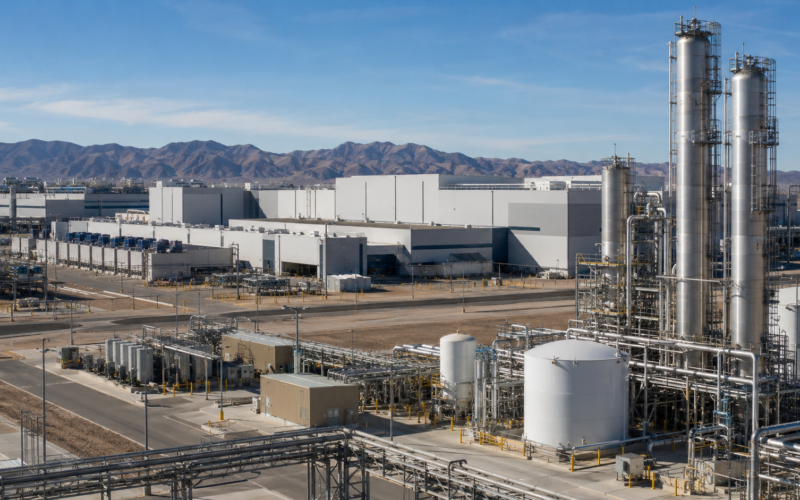
Linde plc (NASDAQ: LIN) is investing $1 billion to expand its on-site industrial gases complex in Phoenix, Arizona, after securing a new long-term supply agreement with one of the world’s largest semiconductor manufacturers. The project will add two air separation units to the three already operating at the location, increasing supplies of ultra-high-purity nitrogen, oxygen and argon for two new semiconductor fabrication facilities. The announcement coincided with Linde reporting record second-quarter sales and lifting the lower end of its 2026 earnings guidance. The strategic opportunity is considerable because advanced chip manufacturing creates long-duration demand for gases that are difficult to replace or interrupt. The central investor question is whether Linde can convert its rapidly expanding electronics backlog into earnings growth without allowing project costs and inflation to weaken returns.
The Phoenix agreement represents one of Linde’s largest investments for an electronics customer anywhere in the world. Linde will build, own and operate the two new SPECTRA air separation units and their associated infrastructure, embedding the company directly within the customer’s manufacturing expansion rather than merely supplying gases from a distant merchant network.
That distinction matters. Semiconductor fabs require gases at exceptional purity levels, delivered continuously and under highly controlled conditions. A supply interruption can affect manufacturing yields, damage production schedules and expose the customer to significant financial losses. Gas infrastructure therefore becomes part of the fabrication facility’s operating backbone, giving established suppliers with engineering scale, reliability records and local infrastructure a substantial competitive advantage.
Why does Linde’s $1 billion Phoenix investment matter beyond additional industrial-gas capacity?
The immediate interpretation is that Linde is adding production capacity to serve two semiconductor fabs. The deeper significance is that the project strengthens a long-term contracted business model in one of the industrial-gas sector’s most attractive growth markets.
Under on-site supply arrangements, Linde normally commits capital to plants built around a customer’s facility and recovers that investment through long-term gas contracts. These agreements can create predictable revenue, contractual protections and relatively stable cash flows once plants begin operating. The plants are also difficult for customers to replace because changing suppliers would involve technical, operational and construction risks.
Linde has not disclosed the agreement’s duration, expected start-up date, production capacity, annual revenue contribution or expected return on capital. Those omissions mean the $1 billion headline should not automatically be treated as near-term earnings growth. Construction expenditure will precede revenue, and the economics will depend on timely fab development, plant commissioning, energy costs and the customer’s manufacturing ramp.
However, the scale of the commitment indicates that Linde expects substantial and durable gas consumption. Adding two units to three existing air separation units also suggests that the Phoenix location is evolving into a dense industrial-gas network rather than a standalone project.
Network density can improve economics because engineering resources, maintenance capabilities, storage, pipelines, backup systems and operating personnel may be shared across several units. It can also improve supply resilience, an important consideration when serving fabrication plants that cannot tolerate extended interruptions.
How does the Phoenix agreement strengthen Linde’s position in advanced chip manufacturing?
Linde’s competitive position in semiconductor gases rests on more than its ability to separate atmospheric gases. It combines plant engineering, purification technology, specialty-gas expertise and operating reliability across major chip-manufacturing regions.
The Phoenix units will supply nitrogen, oxygen and argon. Nitrogen is widely used to maintain controlled environments, prevent oxidation and purge manufacturing equipment. Oxygen supports oxidation and deposition processes, while argon is used in applications including plasma processing and sputtering. Advanced fabs also consume specialty and process gases that must satisfy increasingly demanding purity specifications as chip geometries become smaller and production complexity increases.
Linde Gases US President Armando Botello said the investment reflected the importance of purity, reliability and scale as global advanced-semiconductor demand grows. His comments position the project as evidence of Linde’s capability to support both manufacturing expansion and increasingly stringent process requirements, rather than as a simple volume contract.
The strategic value becomes clearer when viewed against Linde’s second-quarter results. Electronics was among the end markets supporting underlying growth in both the Americas and Asia-Pacific regions. Americas sales rose 7% to $4.08 billion, with underlying sales increasing 4% as electronics and manufacturing volumes improved. Asia-Pacific sales climbed 13% to $1.87 billion, while underlying sales rose 8%, helped by electronics volumes, chemicals and energy demand, and project start-ups.
This indicates that electronics is already contributing to reported growth before the new Phoenix units enter operation. The project therefore adds to an established earnings stream rather than asking investors to underwrite an entirely new market entry.
Does the unnamed Phoenix customer appear connected to the wider TSMC expansion?
Linde did not identify the semiconductor manufacturer, and the customer’s identity should not be presented as confirmed. Nevertheless, the disclosed footprint closely resembles the global expansion being pursued by Taiwan Semiconductor Manufacturing Company.
Linde said the Phoenix agreement supports two new fabs and that Linde LienHwa, its Taiwanese joint-venture operation, had been selected by the same customer to supply gases to semiconductor and advanced-packaging facilities at multiple sites in Taiwan. Linde LienHwa expects to invest approximately $800 million in several air separation units and hydrogen-production facilities.
Taiwan Semiconductor Manufacturing Company has publicly outlined an extensive Phoenix development programme involving semiconductor fabs, advanced-packaging facilities and a research and development centre. Its current Arizona plans have expanded into one of the largest foreign direct investment programmes in United States manufacturing.

The geographic overlap and the combination of Phoenix fabs with Taiwanese advanced-packaging facilities make Taiwan Semiconductor Manufacturing Company a logical market inference. However, Linde has not named the counterparty, and the identification remains unconfirmed.
Even without naming the customer, the combined investment reveals the scale of the relationship. Linde’s direct Phoenix commitment and Linde LienHwa’s planned Taiwan expenditure represent approximately $1.8 billion of industrial-gas infrastructure supporting one customer’s international semiconductor network.
That creates an opportunity for deeper commercial integration across the United States and Taiwan. It also introduces customer-concentration considerations. Large, long-term customers can improve project visibility, but the supplier’s growth timing may become linked to the customer’s construction schedules, technology transitions and capital-spending decisions.
Can Linde fund its expanding semiconductor backlog while preserving capital discipline?
Linde enters the Phoenix investment cycle with substantial operating cash flow, but its capital requirements are also rising.
The company generated $2.27 billion of operating cash flow during the second quarter. After $1.44 billion of capital expenditure, free cash flow was $833 million. Linde nevertheless returned $1.59 billion to shareholders through dividends and net share repurchases during the period.
Management now expects full-year capital expenditure of between $5.5 billion and $6 billion, compared with the previous expectation of $5 billion to $5.5 billion. The revised range includes spending needed to support Linde’s contractual sale-of-gas project backlog, which reached a record $8.1 billion.
Including the Linde Engineering equipment backlog of $3 billion, the group’s total project backlog stood at approximately $11 billion at the end of the quarter. The Phoenix agreement was a major contributor to that expansion.
Linde’s financial scale makes the $1 billion commitment manageable, particularly because the expenditure is likely to be deployed over several construction periods rather than immediately. The group generated $10.4 billion of operating cash flow in 2025, reinvested $5.3 billion in the business and returned $7.4 billion through dividends and repurchases.
The more important capital-allocation test is therefore not whether Linde can finance the project. It is whether the company can earn returns that justify allocating more capital to customer-backed infrastructure while continuing its shareholder-distribution programme.
Linde reported a 23.5% return on capital in the second quarter. Maintaining a return near that level while the backlog moves through construction would support the argument that higher capital expenditure is disciplined growth investment rather than a threat to cash generation.
Why are margins the main execution test as Linde’s electronics volumes accelerate?
Linde’s second-quarter performance demonstrated the strength of its operating model, but it also showed why investors should monitor project costs and margins.
Sales increased 9% to $9.29 billion, while underlying sales rose 4%. Adjusted operating profit advanced 7% to $2.74 billion, and adjusted earnings per share increased 10% to $4.50. The company raised its full-year adjusted earnings guidance to between $17.70 and $17.90 per share, representing expected growth of 8% to 9%.
However, adjusted operating margin declined by 60 basis points to 29.5%. Linde said pricing and productivity improvements were offset by cost inflation.
The Americas operating margin declined by 50 basis points to 31.2%, while the Asia-Pacific margin fell by 120 basis points to 28.4%. Some Asia-Pacific pressure reflected cost pass-through effects, but the results still illustrate the tension between strong electronics growth and the cost of supporting new capacity.
New semiconductor projects can eventually create attractive contracted revenue, yet their construction and start-up phases may involve engineering expenditure, labour requirements, energy infrastructure and commissioning risk. A growing backlog is valuable only when projects enter service on schedule and produce the expected return.
Linde has historically used pricing, productivity programmes and network optimisation to defend profitability through uneven industrial cycles. The Phoenix project will test whether that discipline can be maintained as electronics becomes an increasingly important destination for capital.
How should investors interpret Linde stock after the earnings and semiconductor announcements?
Linde shares were trading around $508.64 during the July 31 session, down approximately 0.6% from the previous close. The company had a market capitalisation of about $237.2 billion and traded at roughly 33.7 times trailing earnings at the time of the market check.
The stock was approximately 0.7% below its July 24 close of $512.28 and about 4.7% below its July 1 close of $533.55. It remained roughly 7.2% below its 52-week high of $548.20 while standing around 31.2% above its 52-week low of $387.78.
The subdued initial reaction should not be interpreted as a rejection of the Phoenix investment. Linde released quarterly earnings and the project announcement on the same day, making it difficult to isolate the market response to either development. Broader volatility in technology and semiconductor shares also affected investor sentiment during the final week of July.
The valuation suggests that investors already assign a premium to Linde’s earnings resilience, project discipline and ability to expand margins over time. A new $1 billion contract supports the long-term growth case, but it does not remove the need for operating evidence.
At this valuation, backlog growth alone may be insufficient to drive a sustained rerating. Investors are likely to look for timely project execution, continued electronics volume growth, stable returns on capital and evidence that inflation is not creating prolonged margin pressure.
What milestones will demonstrate that Linde’s Phoenix investment is creating durable value?
The first measurable development will be greater disclosure about construction and commissioning schedules. Linde has not provided a start-up date for the two new air separation units, leaving uncertainty over when expenditure will begin contributing to revenue.
Future quarterly reports should also show whether the record $8.1 billion sale-of-gas backlog continues to expand and how quickly completed projects convert backlog into reported volume growth. The relationship between capital expenditure, operating cash flow and free cash flow will become increasingly important as several large projects move forward simultaneously.
Americas electronics volumes will provide another indicator. The region already reported higher electronics demand in the second quarter. Continued volume growth without further material margin deterioration would suggest that network density and operating productivity are offsetting inflationary pressure.
The Taiwan programme adds a second proof point. Successful execution by Linde LienHwa would demonstrate that Linde can serve the same advanced-semiconductor customer across multiple manufacturing regions and technology platforms.
The Phoenix award has improved Linde’s contracted growth visibility and reinforced its position within advanced semiconductor infrastructure. What remains unresolved is the timing and profitability of that growth. The strongest confirmation will come when the new units enter service, electronics volumes rise and return on capital remains resilient despite the elevated investment cycle.
What are the key takeaways from Linde’s $1 billion Phoenix semiconductor investment?
- Linde will invest $1 billion to expand its existing industrial-gas complex in Phoenix, Arizona.
- The company will build, own and operate two new air separation units alongside three existing units.
- The expansion will supply ultra-high-purity nitrogen, oxygen and argon to two semiconductor fabrication facilities.
- Linde did not name the customer or disclose the contract duration, project capacity, start-up date or expected revenue.
- Linde LienHwa plans a separate investment of approximately $800 million to serve the same customer in Taiwan.
- The combined disclosures point to a global customer relationship spanning United States fabrication and Taiwanese manufacturing and packaging capacity.
- Linde’s contractual sale-of-gas project backlog reached a record $8.1 billion, while total project backlog reached approximately $11 billion.
- Second-quarter sales increased 9% to $9.29 billion and adjusted earnings per share rose 10% to $4.50.
- Adjusted operating margin declined by 60 basis points, making cost control and project execution important investor tests.
- Future value creation will depend on timely commissioning, electronics volume growth and the preservation of Linde’s return on capital.
Discover more from Business-News-Today.com
Subscribe to get the latest posts sent to your email.