




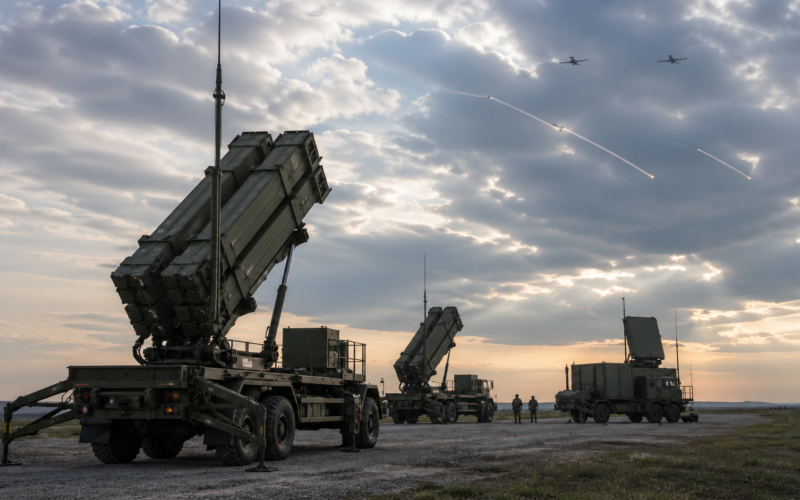
Leidos Holdings Inc. (NYSE: LDOS) has turned a single U.S. Army launcher award into a larger signal about where American defense procurement is heading. The company’s latest $617 million award for additional Indirect Fire Protection Capability Increment 2 launchers lifts its IFPC Inc 2 production contract base to nearly $1.2 billion when combined with earlier 2025 awards. The timing matters because the U.S. Army is moving from episodic air defense purchases toward a more sustained requirement for mobile, layered protection against drones, cruise missiles, rockets, artillery and mortar threats. For investors, the contract also lands while LDOS trades well below its 52-week high, suggesting the market has not yet fully rerated the company’s expanding role in air and missile defense production.
Why is Leidos’ IFPC Inc 2 contract more than a routine U.S. Army procurement award?
The $617 million award to Leidos Holdings Inc. looks, at first glance, like another large defense production contract. In reality, it sits inside a much more important procurement shift. The U.S. Army is no longer treating short- and medium-range air defense as a narrow battlefield support function. It is becoming a core protection layer for bases, logistics nodes, critical infrastructure, forward operating positions and command sites that can now be threatened by relatively inexpensive drones and cruise missiles.
That is the bigger signal behind IFPC Inc 2. The system is designed as a mobile, ground-based air defense capability that can be integrated into the Army’s layered air and missile defense architecture. Leidos Holdings Inc. has said it has more than 100 launchers committed for delivery, while the latest funding also supports continued research, development and testing tied to future orders through 2029. That makes this a production story, a technology-integration story and a backlog story rolled into one. Not bad for a launcher contract, frankly.
For Leidos Holdings Inc., the contract also strengthens a strategic transition. The company is widely known as a government technology, mission systems and services contractor. IFPC Inc 2 gives it a sharper position in hardware-enabled defense modernization, where systems integration, manufacturing discipline, open architecture and battlefield adaptability all matter. That gives Leidos Holdings Inc. a more visible role in a segment that investors increasingly associate with long-cycle demand rather than one-off services revenue.
The key point is that the U.S. Army is buying more than metal launchers. It is buying optionality. A mobile launcher that can support current and future effectors gives the Army a better chance of adapting to threats that are changing faster than traditional procurement cycles. That matters because drones and cruise missiles are not waiting politely for Pentagon paperwork to catch up.
Why are drones and cruise missiles forcing a new air defense investment cycle?
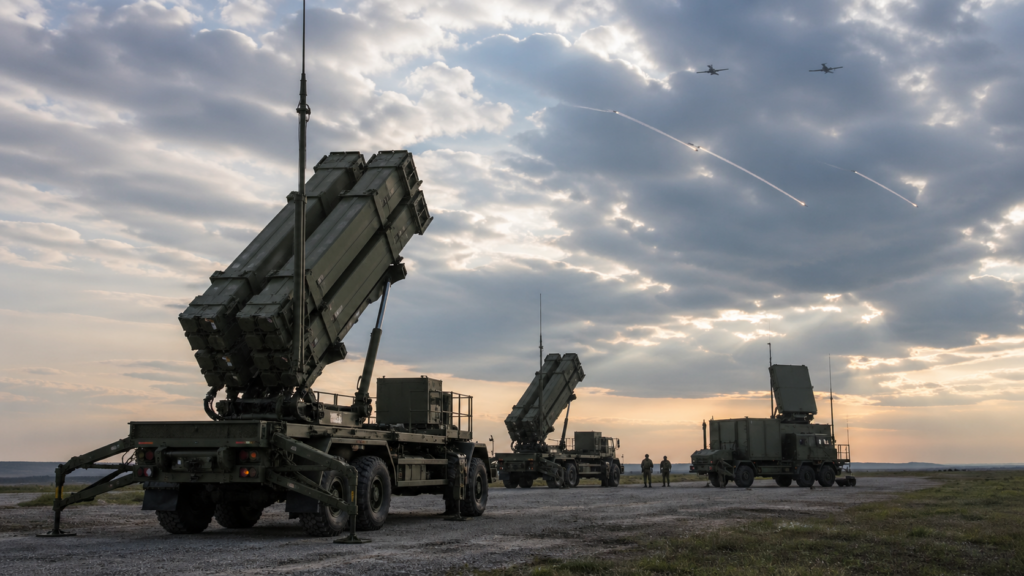
The air defense investment cycle is being pulled forward by a hard battlefield lesson: offensive aerial threats have become cheaper, more flexible and more numerous. Drones, loitering munitions and cruise missiles can pressure expensive military assets, fixed sites and civilian infrastructure without requiring the attacker to deploy a conventional air force. That changes the economics of defense because the side defending the target must intercept repeatedly, often at a much higher cost per engagement.
This is why systems such as IFPC Inc 2 are gaining strategic relevance. The Army needs layered defense options that sit between high-end missile defense systems and lower-cost counter-drone tools. A single defensive layer cannot solve the problem because the threat spectrum is too wide. Small drones, larger unmanned aircraft, cruise missiles and rocket-artillery-mortar threats require different sensors, effectors and engagement logic. Mobile launchers give commanders more flexibility to protect assets as the threat map changes.
The Leidos Holdings Inc. award also comes as the Pentagon is sharpening its focus on replenishment, missile defense, unmanned systems and counter-drone capabilities. Recent U.S. defense budget reporting has pointed to large proposed increases in unmanned weapons systems, drone countermeasures and missile defense priorities, while Reuters reported that the Leidos award fits into broader replenishment and readiness efforts.
The strategic consequence is clear. Air defense is no longer only about intercepting expensive aircraft or ballistic missiles. It is now about protecting the everyday operating fabric of modern militaries from swarms, saturation attacks and cheaper precision threats. That is a structural demand driver, not a temporary procurement fashion.
How does the Leidos contract fit into the Pentagon’s wider industrial base challenge?
The Leidos Holdings Inc. award also exposes a wider industrial base issue. The Pentagon can identify new threats faster than the defense industrial base can always scale production. That gap matters because air defense requires launchers, interceptors, sensors, command-and-control systems, software integration, testing capacity, spare parts, trained personnel and sustainment networks. A launcher contract is only one link in a much longer chain.
This is where IFPC Inc 2 becomes strategically interesting. Leidos Holdings Inc. has already delivered the first Initial Operational Test and Evaluation launcher two months ahead of schedule, which is a useful credibility marker. However, delivering a test asset ahead of schedule and scaling production across more than 100 launchers are different challenges. Production programs test supplier resilience, engineering maturity, quality control and cost discipline in ways that early milestones do not.
The broader defense sector is facing the same problem. Demand for air defense, counter-drone systems, precision munitions and missile replenishment is rising at the same time that governments want faster delivery and more domestic production capacity. That creates opportunity for defense contractors, but it also creates execution risk. Contractors that can show repeatable production performance may gain pricing credibility, follow-on awards and stronger strategic positioning. Contractors that cannot scale smoothly may find that record demand does not automatically translate into clean margins.
For Leidos Holdings Inc., the IFPC Inc 2 program is therefore a test of whether the company can convert defense urgency into durable revenue. The award improves backlog visibility, but the market will eventually ask harder questions. Can Leidos Holdings Inc. deliver at scale? Can it protect margins? Can the supply chain keep pace? Can the Army integrate the system fast enough for the contract value to become operational value?
Why could open architecture become the hidden value driver in air defense procurement?
One of the most important parts of the IFPC Inc 2 story is the system’s open architecture design. Leidos Holdings Inc. has emphasized that IFPC Inc 2 is intended to integrate current and future effectors while connecting with existing command-and-control systems. That matters because the Army does not want to lock itself into a rigid system at a time when threats and interceptors are evolving quickly.
Open architecture is becoming a procurement advantage because militaries increasingly need systems that can evolve after fielding. In older procurement models, a platform could remain largely fixed for years. In the drone and cruise missile era, that approach looks risky. Software, sensors, battle management tools and effectors may all need rapid upgrades as adversaries adapt. A launcher that can support plug-and-play upgrades gives the Army more procurement flexibility and reduces the risk of technological dead ends.
This is also where Leidos Holdings Inc. may benefit from its broader mission systems background. The company’s value proposition is not only physical launcher production. It is the ability to sit at the intersection of hardware, integration, software and mission architecture. That positioning could become more valuable if the Army expands IFPC Inc 2 procurement and continues to prioritize systems that can integrate with existing and future networks.
The competitive implication is important. Defense contractors that sell closed, narrowly configured systems may face more pressure as the Pentagon looks for adaptable platforms. Contractors that can support modularity, interoperability and future upgrades may have a stronger chance of staying embedded in long-term modernization programs.
What does this mean for Leidos stock and investor sentiment around LDOS?
The stock market has not treated the Leidos Holdings Inc. contract as an immediate breakout catalyst. LDOS recently traded at $146.06, with a market capitalization of about $18.67 billion and a price-to-earnings ratio of about 13.65. MarketWatch reported that LDOS closed on April 24, 2026, about 29 percent below its 52-week high of $205.77, even though it outperformed several major defense peers on that session.
That tells us something useful. Investors appear to be recognizing the contract as strategically positive, but not yet enough to override broader concerns around valuation, growth durability, margins or sector positioning. A $617 million award is meaningful, especially when it lifts IFPC Inc 2 production contracts to nearly $1.2 billion, but Leidos Holdings Inc. is still a large diversified contractor. One program can strengthen the narrative, but it does not fully define the valuation.
The more interesting investor question is whether IFPC Inc 2 helps Leidos Holdings Inc. earn a stronger defense modernization multiple over time. If the company shows consistent execution, secures follow-on orders, protects margins and expands its role in air and missile defense architecture, the market may begin to view the program as more than a contract win. It could become evidence that Leidos Holdings Inc. is building a stronger position in a high-priority defense segment.
For now, sentiment looks cautiously constructive rather than euphoric. The contract supports the long-term story. The stock price suggests investors still want proof. That is a healthy tension for a defense stock article because it keeps us away from cheerleading and closer to the real question: can strategic relevance become financial acceleration?
How could a broader air defense spending cycle reshape competition among U.S. defense contractors?
If the Leidos Holdings Inc. award is part of a broader air defense spending cycle, the competitive implications extend well beyond one company. Lockheed Martin Corporation, RTX Corporation, Northrop Grumman Corporation, L3Harris Technologies Inc., Boeing Company, General Dynamics Corporation, Anduril Industries and other defense technology players all have potential exposure to different parts of the layered defense stack.
The future air defense market will not be won by a single product category. It will involve launchers, interceptors, radars, passive sensors, electronic warfare, command-and-control software, counter-drone systems, directed energy, autonomous detection and artificial intelligence-enabled targeting support. That makes the market both attractive and fragmented. Large incumbents may benefit from scale and program history. Newer defense technology companies may benefit from speed, software-first architecture and lower-cost counter-drone approaches.
Leidos Holdings Inc. sits in an interesting middle position. It has incumbent credibility with the U.S. government, but it is not as narrowly associated with traditional missile systems as some larger primes. IFPC Inc 2 gives the company a chance to become more visible in a defense segment where the Army needs both reliability and adaptability. If the program scales cleanly, Leidos Holdings Inc. could strengthen its competitive identity in air defense without needing to compete head-on across every missile category.
The broader lesson for the sector is that air defense spending is moving from prestige platforms to protection capacity. The companies that can help militaries defend more sites, against more threat types, with faster integration and better production economics may be the ones that benefit most from the next spending cycle.
What happens next if the U.S. Army expands IFPC Inc 2 production through 2029?
The next phase is about proof, not promise. Leidos Holdings Inc. already has a stronger contract base, more than 100 committed launchers and a program connected to future orders through 2029. The company now has to show that it can move IFPC Inc 2 toward full-rate production while maintaining schedule discipline and supply chain resilience.
If the program succeeds, Leidos Holdings Inc. could gain more than revenue. It could gain strategic credibility as a production-scale air defense integrator. That could support follow-on work, strengthen customer confidence and improve investor perception of the company’s defense modernization exposure. It may also reinforce the broader idea that mobile, modular air defense is becoming a durable procurement lane rather than a temporary response to current conflicts.
If the program struggles, the downside would not be limited to Leidos Holdings Inc. Delays or cost pressures could reinforce concerns about whether the U.S. defense industrial base can scale fast enough for the drone and missile era. That would matter for the Army, for suppliers and for other contractors chasing similar modernization dollars. Defense demand is rising, but execution remains the gatekeeper.
The cleanest takeaway is this: Leidos Holdings Inc. has secured a strategically meaningful seat in the next air defense cycle. The contract is already large, but the real story is whether IFPC Inc 2 becomes part of a broader shift in how the Army buys protection against modern aerial threats. If it does, this $617 million award may look less like a standalone announcement and more like an early marker of where the next defense spending wave is forming.
Key takeaways on what Leidos’ IFPC Inc 2 contract means for the defense sector
- Leidos Holdings Inc.’s $617 million award strengthens its position in mobile air defense at a time when drones and cruise missiles are reshaping military procurement.
- The nearly $1.2 billion IFPC Inc 2 production contract base gives Leidos Holdings Inc. stronger visibility into a high-priority Army modernization program.
- The contract suggests the U.S. Army is moving toward sustained layered air defense investment rather than isolated launcher purchases.
- IFPC Inc 2 matters because it is designed to protect fixed and semi-fixed sites from drones, cruise missiles, rockets, artillery and mortar threats.
- The open architecture design could become a strategic advantage if the Army integrates new effectors and command-and-control upgrades over time.
- The biggest execution risk is whether Leidos Holdings Inc. can scale launcher production while maintaining schedule, cost and quality discipline.
- LDOS stock has not fully rerated around the contract, suggesting investors want proof that backlog can translate into stronger earnings momentum.
- The broader defense industry opportunity is shifting toward systems that combine mobility, interoperability, production capacity and lower-cost defensive economics.
- Competitors including Lockheed Martin Corporation, RTX Corporation, Northrop Grumman Corporation, L3Harris Technologies Inc. and Anduril Industries are likely to benefit from adjacent demand across the layered defense stack.
- The Leidos Holdings Inc. award may become an early marker of a larger U.S. air defense spending cycle driven by drone warfare, missile threats and industrial base urgency.
Discover more from Business-News-Today.com
Subscribe to get the latest posts sent to your email.
