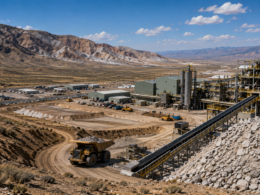



Denarius Metals Corp. (Cboe CA: DMET) has moved to position itself at the center of one of Europe’s most strategically significant mining corridors after proposing an all-share acquisition of Emerita Resources Corp. at a 15% premium. More than a straightforward takeover approach, the proposal signals an attempt to build a scaled Iberian platform spanning precious metals, base metals, and critical minerals, while potentially unlocking major capital efficiencies through shared processing infrastructure and downstream refining access. For executives, investors, and sector specialists, the immediate significance lies in what this could mean for the future shape of the Iberian Pyrite Belt. If completed, the transaction would not simply combine two asset portfolios; it could materially alter how Spain’s mining sector is financed, processed, and valued in a market increasingly focused on strategic resource security and capital discipline.
Why Denarius Metals Corp. may be accelerating consolidation in the Iberian Pyrite Belt at this point in the cycle
Timing is central to the strategic logic of this proposal, and that timing appears far from accidental. The Iberian Pyrite Belt has long been recognized as one of Europe’s most prolific polymetallic mining regions, but the commercial relevance of the district has become materially stronger as Europe intensifies its focus on supply-chain resilience, electrification infrastructure, and reduced dependence on imported strategic raw materials. Against that backdrop, Denarius Metals Corp. appears to be moving ahead of a potentially broader consolidation trend rather than reacting to it.
Emerita Resources Corp.’s IBW project sits near Denarius Metals Corp.’s Aguablanca and Lomero assets in Spain, creating an industrial overlap that is strategically far more important than headline reserve growth alone. In mining-sector mergers and acquisitions, geographic adjacency is often where value creation begins because it can materially improve project economics through shared haulage, centralized processing, infrastructure reuse, and better capital efficiency. This proposal therefore reads less like a simple premium-based acquisition and more like an attempt to create operational density in a high-value corridor. If Denarius Metals Corp. can cluster assets within the same region and move multiple ore streams through shared infrastructure, the result could be materially lower development costs and faster cash-flow conversion.
For the broader sector, this may also signal that the Iberian Pyrite Belt is entering a phase where scale and infrastructure reuse begin to matter more than standalone asset ownership. That is often the point at which regional roll-up strategies begin to accelerate.
How shared processing economics could become the real value driver behind this proposed transaction
The most compelling part of the transaction thesis lies in processing economics rather than simple resource aggregation. Denarius Metals Corp. has explicitly highlighted the possibility of routing Emerita Resources Corp.’s IBW material through the Aguablanca processing facility, and that may ultimately prove to be the core investment case behind the proposal. Processing infrastructure is one of the largest capital burdens in mine development, particularly for companies pursuing standalone buildouts. If Emerita Resources Corp. were to advance independently, the capital required to construct dedicated processing infrastructure could materially affect development timelines, financing flexibility, and dilution risk.
By contrast, Denarius Metals Corp. is presenting a pathway in which that capital burden may be deferred, reduced, or potentially avoided altogether. That immediately changes how investors should frame the transaction. This is not simply about adding ounces, grades, or tonnage. It is about improving the return profile of those resources through infrastructure leverage.
For Denarius Metals Corp. shareholders, the benefit lies in improved utilization of an existing asset base. For Emerita Resources Corp. shareholders, the argument is that value may be unlocked more quickly within an integrated platform than through a slower standalone route that depends on external capital markets. In the current financing environment, where mining developers continue to face selective capital access and cost inflation pressure, that argument may resonate strongly with institutional investors focused on capital discipline.
Could this transaction materially strengthen Denarius Metals Corp.’s multi-metal and critical minerals valuation story?
Beyond the immediate processing and capital-efficiency rationale, the proposed acquisition could strengthen Denarius Metals Corp.’s broader valuation narrative by expanding both commodity exposure and strategic relevance. Denarius Metals Corp. already operates projects across Colombia and Spain, including producing exposure through the Zancudo gold-silver project and development-stage assets spanning nickel, copper, zinc, lead, and silver. The addition of Emerita Resources Corp.’s Spanish resource base would deepen that exposure across both precious metals and industrial commodities, making the combined platform increasingly relevant in the current market environment.
This diversification matters because investor capital is increasingly flowing toward companies with exposure to both defensive precious metals and industrial commodities linked to electrification, infrastructure, and supply-chain resilience. Gold and silver continue to attract macro-sensitive capital, while copper, nickel, zinc, and related polymetallic assets increasingly sit within the critical-minerals narrative.
For Denarius Metals Corp., this could gradually shift the equity story from a project-led mining company toward a broader strategic materials platform. If the combined Spanish portfolio supports both near-term production visibility and long-term resource scalability, the market may increasingly begin to price the business on platform potential rather than asset-by-asset development milestones.
Why the Saudi Arabian refining and trading platform may be the underappreciated long-term upside lever
One of the more strategically interesting aspects of the proposal is Denarius Metals Corp.’s existing joint venture with ProGrowth in Saudi Arabia, intended to create a refining and trading platform for concentrates from the combined Spanish portfolio. This matters because it extends the investment case beyond extraction and processing into downstream value capture.
Mining companies that demonstrate some degree of refining access, offtake optionality, or trading control often attract stronger long-term valuation support because they are positioned to capture more margin across the chain. The Saudi Arabian component potentially strengthens Denarius Metals Corp.’s ability to diversify market access while reducing reliance on third-party concentrate channels.
If executed successfully, this could improve realized margins and add strategic exposure to a region that is becoming increasingly active in global metals investment. Over time, that may support a broader platform narrative rather than a single-region mining thesis.
Which integration, valuation, and execution risks could still materially constrain the upside case?
Despite the industrial logic, several material risks remain. The most immediate risk remains whether the proposed transaction progresses beyond the current non-binding stage. At this stage, this remains a proposal letter rather than a definitive agreement, and there is no assurance that Emerita Resources Corp.’s board will accept the terms or enter into negotiations on a mutually acceptable structure.
The valuation debate may prove just as important. While a 15% premium appears reasonable in headline terms, the board of Emerita Resources Corp. may still conclude that the long-term value of IBW as a standalone development project exceeds the implied exchange ratio.
Even if the transaction advances, the investment case will still hinge heavily on execution. Metallurgical compatibility, processing throughput assumptions, permitting alignment, production sequencing, and capital allocation discipline all need to translate from strategic logic into operational reality. Mining acquisitions often appear highly coherent in presentation materials but encounter friction once engineering, permitting, and production assumptions are stress-tested.
Jurisdictional exposure could also continue to influence how the market values the combined platform. Denarius Metals Corp.’s portfolio spans Spain and Colombia, introducing multiple regulatory and political frameworks into the investment case. While diversification can be beneficial, it can also widen the discount applied by investors who prefer more focused jurisdictional exposure.
How should executives and investors interpret what comes next if this proposal moves forward?
The next phase will be less about the headline premium and more about economic validation. Investors should closely watch Emerita Resources Corp.’s board response, any revisions to the implied valuation framework, and further detail around projected cost savings associated with Aguablanca processing.
If negotiations advance, the market will increasingly focus on capital expenditure deferral, integration timelines, and expected production sequencing across the combined Spanish portfolio. The broader signal may be that the Iberian Pyrite Belt is entering a new phase of strategic consolidation as companies seek scale, infrastructure reuse, and stronger alignment with Europe’s critical-minerals agenda. If that trend accelerates, Denarius Metals Corp.’s move may increasingly be viewed as an early positioning step in a wider regional roll-up cycle.
Key takeaways on what this development means for Denarius Metals Corp., its competitors, and the mining industry
- The proposal is fundamentally a capital-efficiency and infrastructure-reuse transaction rather than a simple reserve expansion move.
- Shared processing at Aguablanca could materially improve economics and reduce the need for standalone capital expenditure at IBW.
- The deal strengthens Denarius Metals Corp.’s exposure to both precious metals and critical-minerals investment themes.
- Multi-metal diversification may support broader institutional investor interest and stronger valuation optionality.
- The Saudi Arabian refining and trading platform may become a major long-term margin and market-access differentiator.
- Transaction certainty remains the most immediate risk, with board acceptance still unresolved.
- Integration assumptions around metallurgy, throughput, and permitting will be critical to the investment case.
- This proposal may signal the beginning of a broader consolidation cycle in the Iberian Pyrite Belt.
- If successfully executed, the transaction could support a structural re-rating from project operator to strategic materials platform.
Discover more from Business-News-Today.com
Subscribe to get the latest posts sent to your email.