


Anduril Industries has secured a $65 million production delivery order under the United States Army’s Tactical Intelligence Targeting Access Node programme as TITAN moves beyond prototyping and into its first production phase.
The Anduril award forms part of $192 million in delivery orders announced by the Army, alongside a $127 million order for Palantir Technologies Inc. (NASDAQ: PLTR). Together, the contracts cover procurement and integration of eight initial production systems comprising four TITAN Advanced units and four TITAN Basic units, with delivery planned over the next 18 months.
Palantir will lead overall TITAN production, supported by L3Harris Technologies, Sierra Nevada Corporation, Strategic Technology Consulting and World Wide Technology. Anduril’s specific role covers critical hardware and shelter integration, making the private defence technology company responsible for a physical layer of a system whose central purpose is to fuse data and accelerate battlefield targeting.
The programme is significant because the Army is no longer buying experimental prototypes alone. The eight new systems will join nine prototypes that the service plans to retain for operational use, creating a combined pool of 17 TITAN systems once the production units are delivered. The Army also expects another production order for additional systems in fiscal 2027.
What does TITAN actually do and why is the US Army moving the system into production now?
TITAN is designed as an artificial intelligence-enabled, expeditionary intelligence ground station that can collect and process information from multiple sensors, build a common intelligence picture and accelerate the process of identifying and geolocating targets.
Its strategic importance comes from the increasingly compressed time available between sensing a battlefield target and acting against it. The Army says TITAN can automate target nominations and shorten sensor-to-shooter timelines by fusing information from multiple sources rather than forcing operators to manually reconcile separate intelligence feeds.
That function is central to the Army’s Multi-Domain Operations and long-range precision fires strategy. Weapons able to engage targets at greater distances have limited utility if intelligence networks cannot locate, classify and transmit targeting information quickly enough. TITAN is intended to sit between those sensors and weapon systems, turning distributed information into actionable targeting data.
The move into production follows roughly four years of prototyping and feedback from soldiers who used TITAN prototypes in different configurations and operating environments. That development history matters because the Army is moving into production after field exposure rather than taking a purely laboratory-developed system directly into deployment.
Why is Anduril receiving $65 million when Palantir leads the larger TITAN production effort?
The division of work illustrates how modern defence technology programmes can combine software-centric companies with specialist hardware and integration providers.
Palantir received approximately two-thirds of the initial $192 million production orders and has responsibility for leading overall production. Anduril’s $65 million represents roughly one-third of the combined value, although the Army has not presented the awards as directly comparable unit prices because the companies are delivering different elements of the programme.
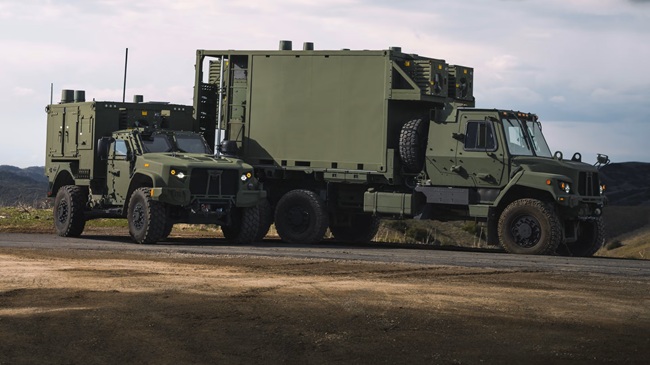
Anduril will supply hardware components and perform shelter integration for the eight systems. In practical terms, that means converting TITAN’s intelligence and software architecture into deployable physical systems that Army units can transport and operate in expeditionary conditions.
The programme therefore reflects a broader shift in defence procurement where newer technology companies are moving from prototype demonstrations into recurring production roles. Anduril has built its reputation around autonomous systems, sensors, command-and-control software and rapidly developed military hardware, while Palantir has become increasingly embedded in government data and artificial-intelligence programmes.
TITAN gives the two companies different but complementary positions inside the same battlefield architecture. The commercial question is whether the initial eight systems become the first tranche of a much larger production programme rather than a limited transition from prototyping.
Could the eight-system production order become a substantially larger Anduril opportunity?
The clearest indication of follow-on potential comes from the Army itself. It expects to award another production order for additional TITAN systems in fiscal 2027, although it has not yet disclosed the quantity or value of that future procurement.
That means Anduril’s current $65 million delivery order should not automatically be extrapolated into a future contract pipeline. The company would still need to retain its role in later production phases, and requirements could change as the first production systems enter service.
However, the programme has already crossed an important threshold. Defence companies often spend years demonstrating prototypes without obtaining meaningful production revenue. TITAN has now progressed to funded initial production after operational use of prototypes, making it a more mature opportunity than an early-stage experimentation contract.
The Army’s decision to retain nine prototypes alongside the eight new production units also suggests that demand for the capability is not limited to a single test fleet. Once the initial production tranche is complete, the Army will have 17 systems available across the prototype and production pool.
If the technology proves effective in reducing targeting timelines under operational conditions, expanding deployment across formations could create additional opportunities for hardware, software, maintenance, upgrades and integration.
What does the TITAN award mean for publicly traded Palantir investors?
Palantir Technologies Inc. is receiving the larger $127 million order and will lead production, making TITAN another example of its growing role in United States government and defence artificial intelligence.
Yet Palantir’s shares have recently been driven by much larger valuation and technology-sector forces. The stock fell 3.47% on September 1 and another 5.81% on September 2, closing at about $169.46, before rebounding sharply during September 3 trading. The September 2 decline formed part of a wider selloff in richly valued software shares rather than an obvious negative reaction to TITAN.
That distinction matters because a $127 million delivery order is material industrially but still relatively modest compared with the valuation investors have assigned to Palantir’s expected long-term artificial-intelligence growth. The stock had also enjoyed a powerful August rally following strong second-quarter results, leaving sentiment sensitive to interest rates, valuation concerns and expectations for continued rapid expansion.
For Anduril, which remains privately held, the significance is different. The company does not need to produce an immediate public-market reaction. Instead, every programme moving from prototype to production adds evidence that its model can win repeatable Pentagon procurement rather than remain concentrated in demonstrations and experimental contracts.
What should investors and defence suppliers watch during the next 18 months?
Delivery performance will be the first test. The Army expects all eight production systems during the next 18 months, and those units will have to demonstrate that software, sensors, hardware, communications and shelter integration can operate as a coherent expeditionary system.
The second milestone will be the anticipated fiscal 2027 production decision. A materially larger follow-on order would indicate that TITAN is beginning to scale across the force, while a small or delayed order would suggest the Army still has integration, budget or operational questions to resolve.
The programme is therefore more consequential than the $65 million Anduril headline alone suggests. It sits at the intersection of artificial intelligence, intelligence fusion, long-range weapons and battlefield automation, areas receiving substantial military investment.
Anduril has secured a clear role in the first production tranche. The bigger commercial prize depends on whether the Army decides eight production systems are the beginning of a fleet rather than the end of a technology transition.
Discover more from Business-News-Today.com
Subscribe to get the latest posts sent to your email.
