The rare-earth supply-chain debate is often reduced to a question of where minerals are mined. That framing misses the more difficult industrial problem because a tonne of rare-earth-bearing ore has little strategic value until the material has been separated, refined, converted into metals and alloys, manufactured into magnets and qualified by demanding customers.
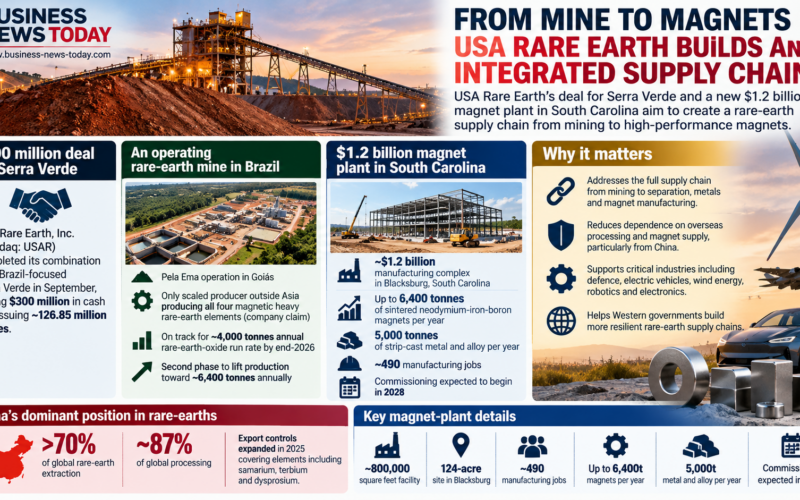
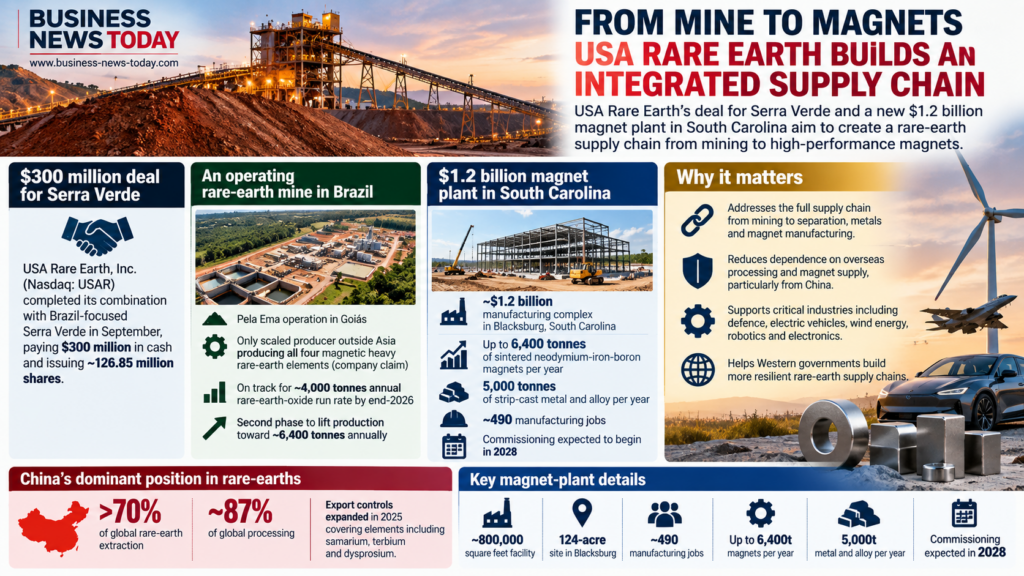
USA Rare Earth, Inc. (Nasdaq: USAR) is attempting to assemble those stages inside one group. The company completed its combination with Brazil-focused Serra Verde in September, paying $300 million in cash and issuing approximately 126.85 million shares. Serra Verde brings an operating heavy-rare-earth resource in Goiás, while USA Rare Earth is developing downstream separation, metallurgy and permanent-magnet manufacturing capabilities.
Five days after the transaction closed, USA Rare Earth broke ground on an approximately $1.2 billion manufacturing complex in Blacksburg, South Carolina. The planned facility targets annual capacity of up to 6,400 tonnes of sintered neodymium-iron-boron permanent magnets and 5,000 tonnes of strip-cast metal and alloy, with commissioning expected to begin in 2028.
The project is therefore testing a larger thesis. Western governments may not materially reduce rare-earth vulnerability by financing isolated mines unless they also recreate the sophisticated processing and manufacturing ecosystem that converts those minerals into components used in defence systems, electric motors, robotics, electronics and energy technologies.
Why does mining rare earths solve only one part of the supply-chain problem?
Rare-earth elements pass through several industrial stages before becoming commercially useful magnets. Ore must first be mined and concentrated, individual rare-earth elements then need to be separated, and the resulting oxides can require conversion into metals and alloys before magnet manufacturing begins.
Each stage demands different technology, capital and customer qualification. A country could therefore possess abundant geological resources while remaining dependent on overseas processing or magnet factories for the products its manufacturers actually consume.
The United States Geological Survey said China accounted for more than 70% of global rare-earth extraction and approximately 87% of processing in the data cited in its 2026 analysis of China’s mineral industries. The concentration becomes more pronounced for certain heavy rare earths, with the agency describing Chinese processing dominance in dysprosium and terbium, elements particularly important in high-performance magnetic applications.
China’s 2025 expansion of export controls across several rare-earth elements further reinforced the strategic importance of the processing stage. The 2026 U.S. Geological Survey Mineral Commodity Summaries noted controls covering materials including samarium, terbium and dysprosium, followed later by additional rare-earth elements.
That experience explains why Western policy has increasingly shifted from simply finding alternative mines toward creating complete industrial chains.
Why does Serra Verde matter to a mine-to-magnet strategy?
Serra Verde’s Pela Ema operation gives USA Rare Earth something many Western critical-mineral developers do not yet possess: commercial-scale upstream production. The company describes Serra Verde as the only scaled producer outside Asia currently producing all four magnetic heavy rare-earth elements, although that characterisation comes from USA Rare Earth and should be understood as a company claim.
The mine began commercial production before the combination and is progressing toward an approximately 4,000-tonne annual total rare-earth-oxide run rate by the end of 2026. A second expansion phase is intended to lift average production toward roughly 6,400 tonnes annually, creating a potential upstream feedstock base for the group’s downstream ambitions.
Heavy rare earths matter because small quantities can materially improve magnet performance in demanding operating environments. Dysprosium and terbium, for example, can help permanent magnets retain performance at higher temperatures, making secure access relevant to applications ranging from aerospace and defence systems to high-performance motors.
Ownership of Serra Verde does not automatically make the supply chain self-sufficient. Material still needs to pass efficiently through separation, refining, metal-making and magnet fabrication, but controlling an operating resource reduces one of the largest uncertainties facing a downstream manufacturer.
Why is the South Carolina magnet plant potentially more important than another rare-earth mine?
Permanent magnets are where much of the economic and strategic value of the chain becomes visible. Neodymium-iron-boron magnets provide high magnetic strength relative to their size and are used in numerous applications where weight, efficiency and power density matter.
USA Rare Earth’s Blacksburg plant is planned as an approximately 800,000-square-foot facility on a 124-acre site. The company expects about 490 manufacturing jobs and selected South Carolina after evaluating nearly 275 potential locations, citing factors including workforce, electricity, logistics and proximity to customers.
The scale is meaningful because an operating magnet factory creates a domestic customer for upstream material while also supplying industries that currently depend heavily on imported components. That can help stabilise both ends of the investment equation: the mine gains a higher-value downstream route, while the factory gains a more controlled source of feedstock.
This is what makes vertical integration strategically attractive in rare earths. The economic weakness of one stage can sometimes be offset by value captured elsewhere in the chain, while internal coordination can make it easier to qualify material specifications across mining, separation, metallurgy and manufacturing.
How much government support is behind USA Rare Earth’s integrated model?
The private market is not carrying the entire financing burden. In August, USA Rare Earth announced completion of a $1.55 billion capitalisation of a government-backed special-purpose vehicle designed around Serra Verde offtake.
The structure includes a $750 million investment from the U.S. Department of War, a commitment for a $500 million senior debt facility from an institutional bank and a government forward-purchase commitment covering at least $300 million of rare-earth products over five years.
That arrangement illustrates how critical-mineral policy increasingly blends industrial strategy with commercial financing. Instead of relying only on grants, governments can provide demand visibility, capital and financing structures intended to make projects bankable before conventional markets would necessarily accept the risk.
The approach is not without controversy or financial risk. Government support can reduce market uncertainty, but it cannot guarantee that operating costs, processing recoveries, construction schedules or customer qualification will meet expectations.
The relevant test is therefore whether public support catalyses a competitive supply chain rather than permanently subsidising one that cannot stand on its own.
Why is the “missing middle” of rare-earth processing so difficult to rebuild?
Mining projects are highly visible because they involve large resources and clearly defined geological assets, while magnet factories are understandable because they make physical products. The stages between them can be less visible even though they often contain some of the most technically demanding chemistry and metallurgy.
Rare-earth separation is complex because the elements possess similar chemical properties. Producing high-purity separated materials at scale requires specialised processing knowledge, environmental management and years of operating experience.
Metallisation and alloy production add another set of technical requirements, while magnet manufacturing depends on precise composition, powder handling, pressing, sintering, machining, coating and quality control. Manufacturers also need customer certification, particularly in defence, aerospace and automotive markets where a material substitution cannot be made casually.
This is why Western supply diversification cannot be measured simply by counting mines. The more useful metric is how much qualified material can move from ore into a finished component without passing through a strategically concentrated processing jurisdiction.
Could the integrated model create new commercial risks for USA Rare Earth?
Vertical integration can solve coordination problems while simultaneously increasing execution complexity. USA Rare Earth now has to manage mining, expansion, processing development, metallurgy and construction of a $1.2 billion magnet facility across multiple jurisdictions.
Capital allocation becomes particularly important. The company must decide where each incremental dollar produces the greatest reduction in supply-chain risk and the strongest commercial return, while avoiding the temptation to build downstream capacity faster than upstream volumes or customer demand can support.
The Serra Verde transaction also introduced substantial new equity. Approximately 126.85 million USA Rare Earth shares formed part of the acquisition consideration, materially expanding the ownership base and creating potential selling pressure as transaction-related securities become tradeable.
Commodity pricing adds another complication. Strategic scarcity can encourage governments to support new capacity, yet additional production can eventually depress prices, creating tension between national-security objectives and shareholder returns.
What is USA Rare Earth’s stock performance saying about investor expectations?
USA Rare Earth closed at $15.37 on September 18, down 1.66% for the session. The shares had closed at $17.66 on September 8 and $17.06 on September 9, meaning the stock weakened after the Serra Verde closing and South Carolina groundbreaking despite the strategic significance of those developments.
The stock remains far below its 52-week high near $43.98, highlighting how aggressively investors have already repriced expectations around the company. That volatility reflects the unusual combination of a strategic-growth narrative, government support, substantial capital requirements and limited operating history for the fully integrated structure.
The market is therefore unlikely to be satisfied simply by additional announcements carrying the words rare earth, defence or supply security. Investors can increasingly measure physical milestones: Serra Verde production, separation performance, South Carolina construction, customer qualification, magnet output, cash requirements and the economics of each stage.
The broader policy lesson is equally measurable. The United States does not achieve rare-earth independence when another mine opens, and it does not achieve it when another factory is announced.
A resilient supply chain emerges only when ore can reliably travel through separation, metals, alloys and magnet manufacturing into qualified products at competitive cost. USA Rare Earth is attempting to build that entire bridge, which makes its execution one of the more revealing tests of whether Western mine-to-magnet industrial policy can work commercially.
Discover more from Business-News-Today.com
Subscribe to get the latest posts sent to your email.