




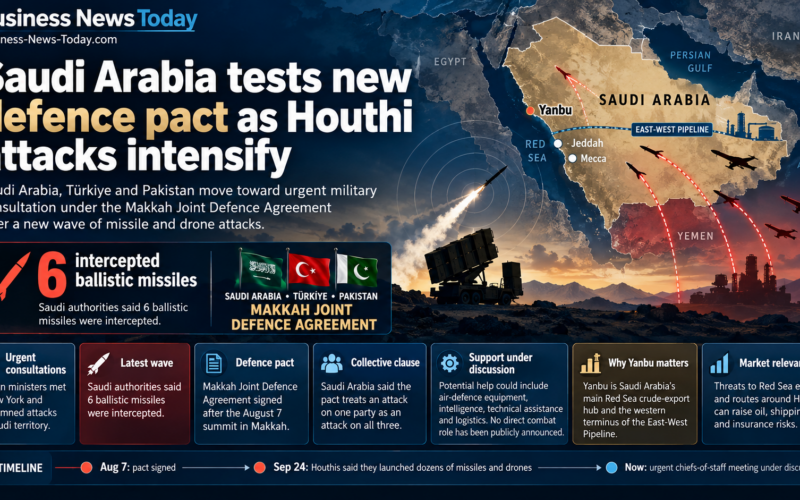
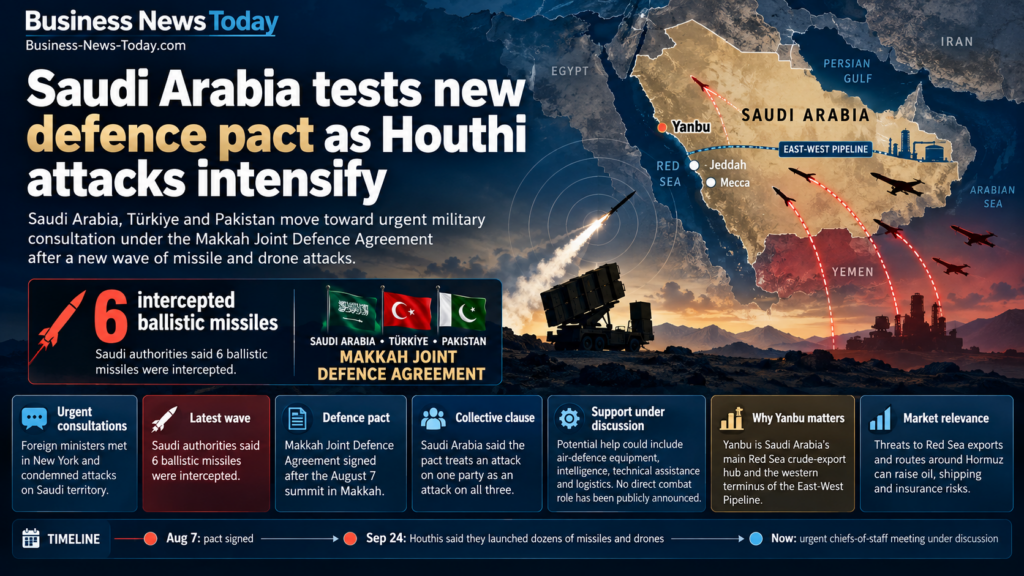
Saudi Arabia, Türkiye and Pakistan are moving toward an urgent meeting of their military chiefs under the Makkah Joint Defence Agreement as the kingdom confronts an escalating series of missile and drone attacks from Yemen’s Houthi movement. Reuters reported that the three countries’ foreign ministers met in New York and condemned attacks targeting Saudi territory, while Saudi authorities said six ballistic missiles had been intercepted during the latest wave.
The consultations represent one of the first significant tests of the defence pact signed by the three countries in August. Saudi Arabia’s Foreign Ministry said the agreement provides that an attack against one of the parties constitutes an attack against all three, although the precise military support to be provided in the current crisis has not yet been publicly defined.
What does the Makkah Joint Defence Agreement require from the three countries?
Saudi Arabia, Türkiye and Pakistan signed the agreement following an August 7 summit in Makkah attended by Saudi Crown Prince Mohammed bin Salman, Turkish President Recep Tayyip Erdoğan and Pakistani Prime Minister Shehbaz Sharif. The pact was framed around closer defence coordination and collective security, adding a formal structure to already deep bilateral military relationships among the three countries.
Reuters reported that current consultations are intended to determine practical support for Saudi Arabia following the Houthi attacks. The foreign ministers have discussed holding an urgent meeting of the three countries’ chiefs of staff, moving the process from diplomatic condemnation toward military planning.
That does not mean Türkiye or Pakistan has announced direct participation in combat. Support can take many forms, including air defence equipment, intelligence, technical assistance, logistics or broader military coordination.
Türkiye had already said earlier in September that it could help meet Saudi technical military requirements under the pact. Pakistan has strong defence ties with Saudi Arabia but has not publicly announced a decision to enter combat operations against the Houthis.
Why have Houthi attacks on Saudi Arabia intensified during the Iran conflict?
The Houthis control much of northern Yemen and have developed significant ballistic-missile and drone capabilities during years of conflict. Reuters described the group as Iran-aligned, while the precise extent of direct Iranian operational control remains contested and varies across specific events.
The current escalation is occurring during a broader Middle East war that began after U.S. and Israeli strikes on Iran in February. Although direct U.S.-Iran fighting has eased intermittently, Iranian-aligned armed groups elsewhere in the region have remained active.
The Houthis said they fired dozens of missiles and drones toward Saudi targets on September 24. Saudi authorities reported intercepting six ballistic missiles and issued alerts affecting locations including Mecca, Jeddah and Yanbu. Those competing accounts describe the claimed scale of the attacks and Saudi defensive response; independent verification of every projectile has not been publicly established.
The escalation also intersects with developments inside Yemen, where Houthi forces have been advancing against the internationally recognized government backed by Saudi Arabia.
Why is Yanbu strategically important to Saudi Arabia and global oil markets?
Yanbu is Saudi Arabia’s principal Red Sea crude-export hub and the western terminus of the East-West Pipeline. That pipeline allows the kingdom to move oil from production regions near the Persian Gulf toward the Red Sea without relying on the Strait of Hormuz.
Its importance has increased dramatically during the Iran conflict because traffic through Hormuz has been disrupted, reducing access to the maritime route that historically handled a large share of global oil exports.
Saudi energy infrastructure has already been under pressure. Attacks temporarily disrupted the East-West Pipeline earlier in September, forcing Saudi Aramco to experiment with alternative arrangements including crude transfers through Oman while restoring export flexibility.
Threats involving Yanbu therefore affect more than domestic Saudi security. Damage severe enough to restrict Red Sea exports could remove one of the principal alternative pathways protecting global oil supply from disruption around Hormuz.
How is Iran responding to the latest Houthi escalation against Saudi Arabia?
Iranian President Masoud Pezeshkian sought publicly to distance Tehran from Houthi decisions during a U.S. television interview, saying the movement was responsible for its own actions. Reuters reported those comments alongside regional and Yemeni sources that have alleged varying degrees of Iranian Revolutionary Guard support for Houthi operations.
The distinction remains important because political alignment, weapons support and direct operational command are different levels of involvement. Iranian support for the Houthis has been widely documented over time, but assigning Tehran direct responsibility for a specific attack requires evidence relating to that operation.
Iran has simultaneously been involved in indirect diplomacy with the United States over the wider conflict. Foreign Minister Abbas Araqchi said Tehran had transmitted proposals through intermediaries that could eventually include reopening the Strait of Hormuz under specified conditions.
Those negotiations create an unusual environment in which diplomacy aimed at easing one part of the regional conflict is occurring while fighting involving aligned groups intensifies elsewhere.
Could Türkiye and Pakistan materially strengthen Saudi air and missile defence?
Both countries possess substantial defence industries and military capabilities. Türkiye has developed drones, missiles, electronic-warfare technologies and increasingly sophisticated air-defence systems, while Pakistan maintains a large military with significant air and missile capabilities.
Technical assistance could therefore strengthen Saudi defensive capacity even without direct combat involvement. Training, intelligence sharing, spare parts, air-defence coordination or deployment of supporting systems could all potentially fall within a collective-defence relationship, depending on decisions made by the three governments.
Saudi Arabia itself already operates advanced Western air-defence systems and maintains one of the region’s largest defence budgets. The current challenge is partly one of saturation: repeated barrages of relatively inexpensive drones and missiles can impose large defensive costs even when most incoming threats are intercepted.
An expanded trilateral arrangement could help distribute technical and logistical requirements, but any concrete military deployment would represent a materially greater development than the diplomatic consultations announced so far.
Why does the Saudi-Houthi escalation matter for global markets beyond oil prices?
Energy remains the most immediate transmission channel because Saudi Arabia is one of the world’s largest oil exporters. Repeated threats to pipelines, ports and shipping lanes can increase crude prices, tanker insurance and freight costs even when physical production remains available.
Shipping provides another channel. Houthi activity around the Red Sea has already complicated commercial vessel movements, while disruption around Hormuz on the other side of the Arabian Peninsula has simultaneously reduced flexibility for exporters.
A broader Saudi military operation inside Yemen could add another layer of regional uncertainty. Reuters reported that observers have questioned whether the kingdom and the Yemeni government forces it supports could widen military operations, but Saudi Arabia has not announced such a campaign in the current reporting.
The immediate verified development is more limited but still consequential: Saudi Arabia, Türkiye and Pakistan are moving their new defence pact into urgent military consultation while attacks on Saudi territory intensify.
Discover more from Business-News-Today.com
Subscribe to get the latest posts sent to your email.


