





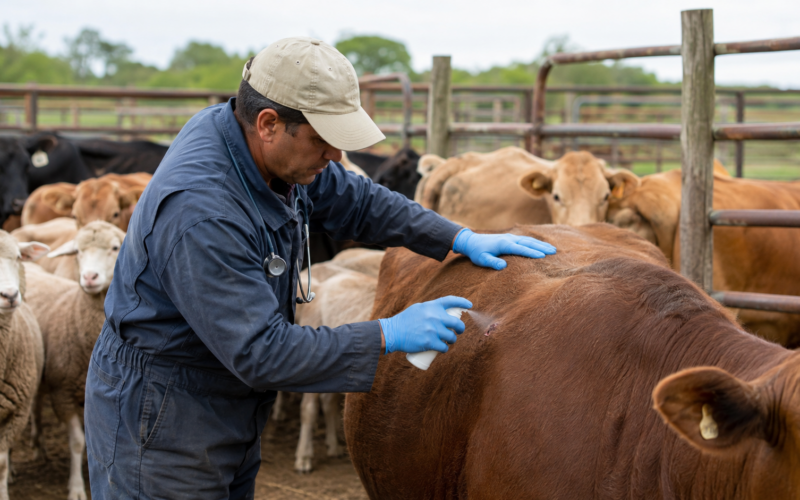
Elanco Animal Health Incorporated has secured a United States Food and Drug Administration Emergency Use Authorization for CLiK Extra, a dicyclanil topical suspension wound spray, for application on or around wounds to prevent New World screwworm infestations in a broad range of livestock and selected captive and captured wildlife species. The August 7, 2026 authorization covers sheep, cattle, goats, swine and camelids, along with cervids, American bison, bighorn sheep and Sonoran pronghorn.
The regulatory distinction is important. CLiK Extra has been authorized for emergency use, not FDA approved, and the authorization applies to prevention rather than treatment of an established New World screwworm infestation. FDA’s authorization letter explicitly says the product is not FDA approved for any indication, while the accompanying fact sheet states that animals with an existing infestation, or an infestation that develops after administration, require another treatment approach.
That limitation does not make the authorization minor. New World screwworm, Cochliomyia hominivorax, returned to the United States in June 2026, when the United States Department of Agriculture confirmed the parasite in a calf in Zavala County, Texas. Additional detections followed, while federal and state authorities expanded surveillance, sterile fly releases and other containment measures. USDA’s current screwworm response remains active, although the agency describes the present risk to animals and people across the United States as very low.
For Elanco, the significance lies less in adding another conventional commercial product than in filling a specific operational gap. CLiK Extra provides a topical, wound-focused preventive option that can be used through standard product channels, according to the company, potentially making it more accessible than emergency products distributed primarily through government stockpile mechanisms. Elanco said the spray would be available to animal health professionals, livestock producers and those managing eligible captive and captured wildlife.
Why does the FDA authorization of CLiK Extra matter during the US New World screwworm response?
New World screwworm is unusually destructive because female flies deposit eggs near wounds or other vulnerable body openings, and the larvae subsequently feed on living tissue. Infestation can enlarge wounds rapidly and can become severe or fatal if it is not recognized and treated. USDA has therefore placed surveillance, wound inspection, reporting and rapid intervention at the centre of its response.
CLiK Extra is designed to intervene before that process becomes established. FDA authorized its use on or around wounds, including wounds that can arise around birth and from livestock procedures. The FDA fact sheet specifically discusses application when wounds appear or are created during procedures such as dehorning, ear tagging, castration, tail docking and shearing.
The active ingredient, dicyclanil, is an insect growth regulator and ectoparasiticide. CLiK Extra contains dicyclanil at 65 mg/mL. Unlike a systemic product intended to eliminate larvae after infestation has occurred, the regulatory rationale here centres on exposing the parasite to the topical drug around a potential entry site and preventing myiasis from developing.
That gives the product a defined place within the broader response rather than turning it into a stand-alone screwworm solution. Eradication and outbreak control continue to depend on surveillance, animal movement controls, case detection, treatment of affected animals and large-scale sterile insect releases. USDA has also been operating thousands of traps across affected and high-risk states and expanding wildlife surveillance as part of the federal response.

How strong is the evidence supporting CLiK Extra for New World screwworm prevention?
The evidence package behind the EUA deserves careful interpretation because an Emergency Use Authorization uses a different regulatory threshold from a conventional animal drug approval. FDA concluded that, based on the totality of available scientific evidence, it was reasonable to believe that CLiK Extra may be effective and that the known and potential benefits outweighed the known and potential risks under the authorized conditions.
Some of the most directly relevant evidence comes from relatively small studies in sheep and cattle conducted outside the United States. A study in Uruguay evaluated 15 treated lambs and 15 untreated controls after tail docking. No treated lambs developed myiasis during the reported observation period, while eight of 15 controls had developed myiasis by Day 13. The study used a 50 mg/mL dicyclanil formulation rather than the 65 mg/mL concentration in the authorized product.
FDA also reviewed cattle studies conducted in Brazil and Argentina. In one Brazilian dose study, none of 10 animals given 20 mL of 50 mg/mL dicyclanil developed myiasis through Day 10, while control animals became infested. Another study recorded infestation in one of 15 cattle receiving a 16 mL dose by Day 8, with three treated animals affected by Day 30. An Argentine study following castration reported myiasis in one of 20 treated cattle compared with 16 of 20 untreated controls by the end of the observation period.
The evidence is therefore supportive, but it is not equivalent to a large contemporary US field programme built specifically around the commercial 65 mg/mL product across every species named in the authorization.
That distinction becomes particularly important for goats, swine, camelids, cervids, American bison, bighorn sheep and Sonoran pronghorn. FDA’s fact sheet states that there are no direct effectiveness or safety data for dicyclanil topical suspension in those species. The agency instead relied on the product’s topical mode of administration, local action, pharmacological and toxicological information, and extrapolation from other species in reaching its emergency-use conclusion.
This is exactly where EUA terminology matters. The decision means FDA determined that the emergency-use statutory criteria were satisfied. It should not be interpreted as evidence that CLiK Extra has completed the conventional FDA approval pathway or that identical levels of clinical evidence exist across all authorized species.
Why is prevention rather than treatment the most important limitation of CLiK Extra?
The practical dividing line for veterinarians and livestock operations is whether New World screwworm larvae are already present.
FDA’s fact sheet states explicitly that CLiK Extra will not treat an active New World screwworm infestation. Its authorized role is prevention around wounds. This means the product can add another layer to wound-management protocols during an outbreak, but it does not remove the need to identify infestations quickly or provide appropriate treatment once myiasis has developed.
That distinction also separates CLiK Extra from some other products in the rapidly expanding emergency screwworm armamentarium.
FDA has already authorized several animal drugs for New World screwworm under the emergency framework. These include products intended for prevention, products intended for treatment, and some covering both uses. The regulator’s current list includes Ivomec, Dectomax and Dectomax-CA1, Negasunt Powder, F10 topical products, ivermectin liquid for horses and companion-animal medicines including NexGard and NexGard COMBO, alongside other authorized or conditionally approved options.
Elanco itself therefore has more than one position in the response. Its Negasunt Powder received an EUA for both prevention and treatment of New World screwworm in several species. FDA said Elanco intended to limit Negasunt distribution through the United States Department of Agriculture for onward distribution to authorized users, creating a different access model from CLiK Extra’s planned availability through standard channels.
The commercial and operational relevance of CLiK Extra may consequently depend as much on availability and ease of deployment as on the existence of the authorization itself.
What food-animal restrictions could shape the real-world use of CLiK Extra?
The broad species authorization comes with substantial food-residue and handling restrictions that livestock operations will need to incorporate into treatment decisions.
Sheep, cattle, goats, swine, cervids, American bison and bighorn sheep treated with CLiK Extra must not be slaughtered or harvested for human consumption within 86 days after treatment. For captured cervids, American bison and bighorn sheep, use is restricted to circumstances where there is reasonable certainty that the animal will not enter the human food chain during that 86-day period.
Treated camelids and Sonoran pronghorn may not be used for human consumption. FDA has also not established a milk discard period, so the product must not be used in animals producing milk for human consumption. A withdrawal period has not been established for pre-ruminating calves, and treated calves, as well as calves born to treated cows, must not be processed for veal.
These restrictions are commercially important. A product can be straightforward to apply yet still require careful integration into herd management, slaughter scheduling and food-chain controls. That is especially relevant during an emergency in which preventive treatment could be considered across large populations of animals exposed to wound-related risk.
The fact sheet also includes user and environmental precautions. FDA directs users to wear appropriate protection during application, and residues can remain on fleece and fibre for up to three months, with specific handling and shearing precautions during that period.
How does CLiK Extra change Elanco’s position in the expanding screwworm product market?
For Elanco Animal Health Incorporated, CLiK Extra adds a differentiated preventive tool to a broader screwworm portfolio at a time when government agencies are deliberately expanding the number of available animal-health countermeasures.
That diversification matters because FDA itself noted that there are no approved products to treat or prevent New World screwworm in several species covered by this EUA. Even in cattle, where conditionally approved products exist, the agency said CLiK Extra provides an additional option involving a different drug class and topical application. FDA specifically pointed to the need for a diverse and sufficient product supply to address an incursion.
The company also has Negasunt Powder within the FDA emergency framework, while Elanco said Tanidil had received emergency authorization earlier in 2026 and highlighted Catron IV as an Environmental Protection Agency registered product labelled for screwworm treatment in several livestock species. Those products occupy different regulatory, access and use positions, which gives Elanco multiple ways to participate in the animal-health response without making the products interchangeable.
The more consequential question now is how frequently wound-based prevention becomes necessary as the United States manages the outbreak. USDA confirmed the first 2026 US detection on June 3 and has since maintained active surveillance and control programmes. Southern livestock ports remained closed as of early August, with a phased reopening process tied to risk conditions and progress in the response.
CLiK Extra therefore enters the market during an unusual convergence of veterinary medicine, agricultural biosecurity and emergency regulation.
What will determine whether the CLiK Extra EUA becomes operationally significant?
The authorization removes an immediate regulatory barrier to emergency use, but its real significance will be determined outside the authorization letter.
Availability through ordinary animal-health channels could make CLiK Extra particularly useful when producers need a preventive product around wounds without waiting for access through a government-controlled stockpile. The range of authorized livestock and wildlife species also gives the product relevance beyond conventional cattle operations.
At the same time, adoption must remain aligned with what the evidence and authorization actually support. CLiK Extra prevents rather than treats active infestations, direct New World screwworm evidence is concentrated mainly in sheep and cattle, several authorized species rely on extrapolated evidence, and food-animal withdrawal restrictions could limit use in some production settings.
That makes CLiK Extra neither a marginal addition nor a singular answer to New World screwworm. It is better understood as another specialized layer in an increasingly diversified emergency toolkit.
The next meaningful test will be operational: whether producers and animal-health authorities can use that additional preventive layer effectively alongside wound surveillance, rapid diagnosis, active-infestation treatment and USDA’s broader eradication programme. If the US outbreak continues to generate detections, the value of having multiple drug classes, formulations and distribution routes available could become increasingly clear.
Discover more from Business-News-Today.com
Subscribe to get the latest posts sent to your email.


