


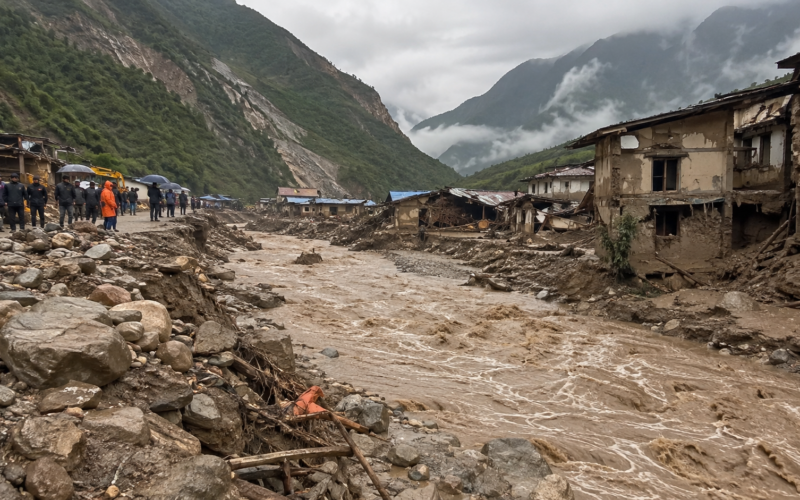
The confirmed death toll from the catastrophic Nepal–Tibet flood disaster has risen to at least 586, while 2,482 people remain missing after a Himalayan glacier collapse unleashed a destructive mixture of water, ice, rock and mud through mountain valleys on August 26. Nepal has reported at least 579 deaths and 1,924 missing people, while seven deaths and 558 missing people have been reported on the Tibetan side of the border. At least 540 of those missing are foreigners, including pilgrims travelling through the region.
More than 90,000 people are estimated to have been affected, and the emergency remains active rather than shifting cleanly into recovery. Rescue operations were temporarily halted on Friday after a newly formed lake began overflowing upstream, forcing teams in both Nepal and Tibet to withdraw before returning when officials judged the immediate danger manageable.
Authorities are now monitoring multiple barrier lakes above the flood zone because debris carried by the original disaster blocked waterways and created unstable reservoirs. One satellite assessment showed another lake increasing in size without a visible outlet, raising concern that pressure could build behind the natural barrier even as rescuers continue searching downstream.
What caused the catastrophic Nepal–Tibet flood that destroyed communities within minutes?
Initial assessments indicate that the disaster began with a major collapse involving bedrock and glacier ice high in the Himalayas. Satellite imagery reviewed by scientists showed part of the mountain and glacier system failing and sending an enormous mass of material downslope, which then entered river valleys and generated destructive flooding.
The result was not a conventional monsoon flood moving gradually through a river basin. A fast-moving surge of water, mud, boulders, sediment and ice travelled through steep terrain with immense force, destroying settlements and changing river channels as it moved toward lower elevations. The Gyirong border crossing between Tibet and Nepal was among the areas virtually obliterated.
Scientists will need more time before determining how individual factors contributed to the collapse. Warming temperatures, glacier retreat and degradation of frozen mountain terrain can increase instability across high-altitude landscapes, but directly attributing one specific slope or glacier failure to climate change requires detailed geological and climatic analysis. The disaster nevertheless exposes the growing vulnerability of heavily populated Himalayan valleys to cascading hazards in which one collapse can trigger landslides, floods and secondary lake failures.

Why are barrier lakes creating another danger even after the main flood has passed?
The initial torrent rearranged the landscape and deposited enormous quantities of rock and debris across mountain rivers. When that material blocks a river, water accumulates behind it and forms a barrier lake that can remain unstable until it drains gradually or breaks suddenly. In this disaster, one such lake began overflowing into waterways feeding the Lhende Khola and Trishuli river systems, prompting authorities to temporarily suspend rescue work.
Nepal is monitoring two barrier lakes upstream, while Chinese specialists have warned that numerous glacial lakes across the wider region require observation. The concern is not that every lake will fail, but that even one sudden release could send another high-energy surge into valleys already stripped of roads, bridges and protective infrastructure.
That risk complicates rescue decisions. Teams searching buildings, riverbanks and buried settlements need to operate close to the same waterways that could carry another flood, while damaged communications can reduce warning times for remote communities.
How badly have roads, hydropower projects, schools and health facilities been damaged?
The flood destroyed or damaged roads, bridges, power infrastructure and settlements along the corridor connecting Kathmandu with Tibet. Helicopters have consequently become essential for moving survivors and supplies into communities where ground access has disappeared. Bodies have been carried far downstream, with Indian police reporting recoveries from rivers in Uttar Pradesh linked to waterways flowing out of Nepal.
The humanitarian impact extends well beyond the casualty figures. UNICEF says at least 17,000 children have been affected, 18 schools have been completely destroyed and another 20 have suffered damage. At least four health facilities were severely damaged, while an estimated 10,000 school-age children require emergency education support.
The World Health Organization has deployed emergency medicines, tents and other medical supplies while working with Nepalese authorities to maintain health services and disease surveillance. That work becomes increasingly important as displaced communities spend longer periods in temporary accommodation with damaged sanitation and water infrastructure.
Why are foreign pilgrims and workers among those missing in such large numbers?
The Nepal–Tibet border region is not only home to remote mountain communities. It is also a major route for international trekking, tourism, cross-border trade and religious travel, including pilgrimages toward Mount Kailash and the wider Himalayan region. That helps explain why hundreds of foreigners were caught in the disaster when the flood struck.
Hydropower development created another concentration of workers in vulnerable valleys. Floodwaters damaged project infrastructure and trapped personnel in areas where heavy mud made access extremely difficult. Rescue crews have therefore been searching both residential settlements and industrial sites, including tunnels and hydropower facilities.
The geographic reach of the missing-person crisis is likely to keep the disaster internationally prominent. Families across several countries are waiting for identification and survivor information, while Nepalese and Chinese authorities face the additional challenge of reconciling passenger, worker and pilgrimage records with people evacuated independently.
What are the key takeaways from the Nepal–Tibet glacier collapse and flood disaster?
- At least 579 people have been confirmed dead in Nepal and seven in Tibet, bringing the reported toll to at least 586.
- Nepal has listed 1,924 people as missing, while 558 remain missing in Tibet, for a combined 2,482.
- At least 540 missing people are foreigners, including international pilgrims and travellers.
- More than 90,000 people are estimated to have been affected by the disaster.
- Rescue operations were briefly suspended after an upstream barrier lake began overflowing.
- Authorities are continuing to monitor additional barrier lakes because the risk of secondary flooding has not disappeared.
- Roads, bridges, hydropower assets, schools and health facilities have suffered extensive damage.
- UNICEF says at least 17,000 children have been affected and is seeking additional funding for emergency response and early recovery.
Why could the Nepal–Tibet disaster reshape how Himalayan flood risks are assessed?
The scale of this catastrophe shows why mountain disasters increasingly need to be treated as connected systems rather than isolated events. A slope or glacier collapse at high altitude can turn rapidly into a debris flow, destroy river infrastructure, create artificial lakes and then generate additional flood threats long after the original surge has passed. Communities far downstream may face danger even though they are many kilometres from the initial collapse.
The immediate priority remains finding survivors and stabilising basic services, but reconstruction will require more than rebuilding roads in the same places. Monitoring unstable slopes and lakes, redesigning critical transport and hydropower infrastructure, improving transboundary warning systems between Nepal and China and identifying communities that cannot safely rebuild in previous locations are likely to become central questions. With thousands still missing, however, the full scale of both the human loss and the reconstruction challenge is not yet known.
Discover more from Business-News-Today.com
Subscribe to get the latest posts sent to your email.