


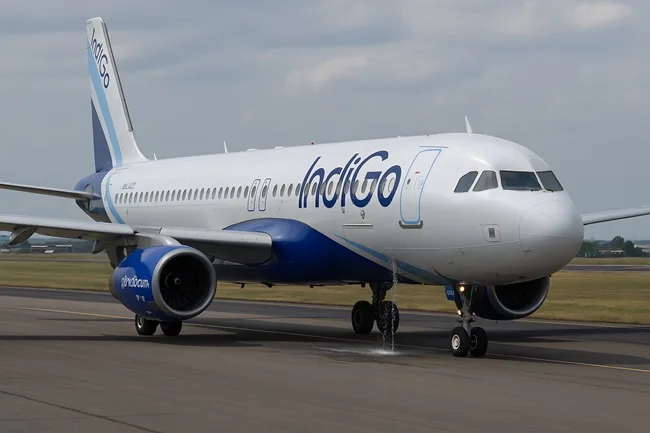
An IndiGo Airlines flight enroute from Kolkata to Srinagar made an unscheduled emergency landing in Varanasi on Tuesday afternoon after the flight crew detected a suspected fuel leak mid-air. The aircraft, operating as Flight 6E-6961, was carrying 166 passengers and crew members. According to preliminary updates, all individuals onboard were safely evacuated and no injuries were reported.
The incident occurred shortly after the Airbus A320 aircraft departed from Netaji Subhas Chandra Bose International Airport in Kolkata. Midway through the journey, flight personnel received an alert from the onboard system that indicated a possible fuel leak. The pilot immediately initiated standard emergency protocols and contacted air traffic control at Lal Bahadur Shastri International Airport in Varanasi to request a priority landing.
Authorities at Varanasi confirmed that the flight landed without further complication at approximately 4:10 PM IST. Emergency response units, including fire safety teams and aviation security personnel, were deployed to the runway as a precautionary measure.
What triggered the emergency landing of IndiGo Airlines Flight 6E-6961?
According to a statement issued by IndiGo Airlines, the flight diversion was precautionary in nature and aligned with the airline’s commitment to passenger safety. The carrier clarified that the emergency was declared following a suspected fuel leak notification. After landing, the aircraft was subjected to a thorough inspection by IndiGo’s ground technical team and airport engineers. Initial reports suggest that the alert may have stemmed from a faulty sensor rather than an actual fuel system malfunction.
The official statement read that “as a precautionary measure and in compliance with safety procedures, the pilot diverted the aircraft to Varanasi. All 166 passengers were accommodated on an alternate aircraft that operated with minimal delay following technical clearance.”
Airport director Puneet Gupta also confirmed that a Mayday alert was not issued, but priority landing was requested and granted in accordance with protocol. He noted that all safety mechanisms, including deployment of emergency ground crew and passenger disembarkation assistance, were activated immediately upon landing.
How did authorities in Varanasi respond to the emergency situation?
The response from airport officials at Lal Bahadur Shastri International Airport was swift and comprehensive. Upon receiving the distress communication from the IndiGo cockpit, the Air Traffic Control unit cleared the runway for priority landing and mobilized all necessary emergency services.
Fire engines, ambulance units, and emergency response personnel were stationed at the tarmac as a precautionary standby. Varanasi airport management confirmed that runway operations were halted temporarily to ensure a smooth and isolated landing environment for the aircraft. Passengers were deplaned safely, with IndiGo ground staff and airport personnel facilitating immediate assistance and refreshments.
According to media reports citing on-ground sources, there was no panic among passengers, thanks to the calm handling by the flight crew and the absence of any visible incident inside the cabin. Passenger luggage was also offloaded carefully and reloaded onto the standby replacement aircraft arranged by IndiGo.
What are the likely causes behind the fuel leak alert and how is it being investigated?
While no definitive cause has been confirmed as of this writing, technical experts have pointed toward a sensor-related fault that may have triggered the fuel leak alarm in the cockpit. This is not uncommon in modern commercial aircraft, where sensor systems are designed to be highly sensitive to even the smallest anomalies.
IndiGo Airlines has launched an internal investigation into the matter, and the Directorate General of Civil Aviation (DGCA) is expected to be notified per standard reporting protocol for in-flight emergencies. The maintenance logs, recent inspections, and flight data recorder from the affected aircraft will be analyzed to determine whether the alert was a genuine leak or a sensor malfunction.
According to experts familiar with Airbus aircraft systems, false positives from sensors can occur due to calibration drift, wiring issues, or moisture ingress. However, any alert linked to fuel system integrity must be treated with the highest level of seriousness due to the potential risks involved. Further clarity is expected once the full post-flight technical diagnostic is completed by IndiGo’s engineering team.
How does this incident reflect on IndiGo Airlines’ operational safety and response preparedness?
From an operational and reputational standpoint, the incident underscores the robustness of IndiGo Airlines’ safety systems and pilot training. The fact that the crew opted for a diversion rather than continuing to the destination speaks to a conservative, safety-first approach—which is in line with best practices endorsed by the International Civil Aviation Organization and domestic regulatory agencies.
Passenger confidence in IndiGo Airlines, which is India’s largest commercial carrier by market share, is unlikely to take a significant hit as long as the incident remains an isolated one. However, repeated in-flight alerts—even if precautionary—can erode brand trust over time if not addressed with transparency.
IndiGo Airlines has steadily built a reputation for on-time performance and operational efficiency, but maintaining technical reliability, especially as its fleet size and utilization rates continue to grow, remains a critical focus area.
How did passengers react and what support was extended post-landing?
Passenger reaction to the incident was generally calm, according to initial media accounts and statements from those onboard. IndiGo Airlines staff at the airport assisted travelers with refreshments, rebooking, and onward journey arrangements. The replacement aircraft was deployed promptly, limiting delay to a few hours.
While no passenger complaints were formally lodged at the time of reporting, a few flyers expressed concern on social media over the anxiety caused by the mid-air alert. IndiGo’s prompt communication and handling of the situation appear to have averted any major backlash, at least in the short term.
The airline has not yet released a public customer advisory beyond its media statement but is expected to follow up with individual communications and compensation procedures as per its passenger charter.
What is the broader industry context and safety implications of such alerts?
This episode reflects a broader challenge facing global aviation: balancing technological sensitivity with operational predictability. As aircraft systems become increasingly reliant on digital sensors and automated alerts, the risk of false alarms—while low—is not negligible. Carriers must invest in predictive maintenance technologies that can flag potential sensor faults before they result in mid-air diversions.
For regional airports like Varanasi, the incident also highlights the importance of maintaining readiness for unscheduled landings. As air traffic density rises across India’s tier-2 and tier-3 cities, emergency response capacity will become a more integral part of airport modernization.
IndiGo Airlines’ proactive approach in this situation is commendable, but the incident will likely spark internal reviews across other Indian carriers regarding sensor diagnostics, alert thresholds, and pilot response training.
Why even a safe landing doesn’t close the case: the technical review IndiGo Airlines now faces
While all 166 passengers onboard IndiGo Airlines Flight 6E-6961 are safe and the aircraft landed without incident, the suspected fuel leak alert cannot be dismissed lightly—even if it turns out to be a false alarm. For a carrier of IndiGo’s scale, maintaining its safety record requires not only procedural correctness in the moment but also post-event accountability and transparency.
The airline’s technical teams, in coordination with the Directorate General of Civil Aviation, are now tasked with investigating the root cause and implementing any required corrective action. For the traveling public, the episode serves as a reminder that air safety is a layered system—one that occasionally raises alarms as a necessary safeguard, even when no immediate danger exists.
If anything, this incident proves that such alarms are working exactly as they should: detecting possible threats and prompting swift, professional responses that keep everyone safe.
Key takeaways from the IndiGo Airlines emergency landing in Varanasi
- 166 passengers and crew were safely evacuated after IndiGo Flight 6E-6961 made an emergency landing in Varanasi due to a suspected fuel leak.
- Initial inspection suggests the alert may have been caused by a sensor malfunction, not an actual leak.
- IndiGo Airlines arranged a replacement aircraft and resumed the journey with minimal delay.
- The Varanasi airport team, led by director Puneet Gupta, activated emergency protocols swiftly, ensuring a smooth and safe landing.
- The Directorate General of Civil Aviation is expected to review the incident under standard in-flight emergency reporting norms.
- This incident brings renewed focus on sensor reliability, predictive maintenance, and airport preparedness in India’s growing aviation network.
Discover more from Business-News-Today.com
Subscribe to get the latest posts sent to your email.