

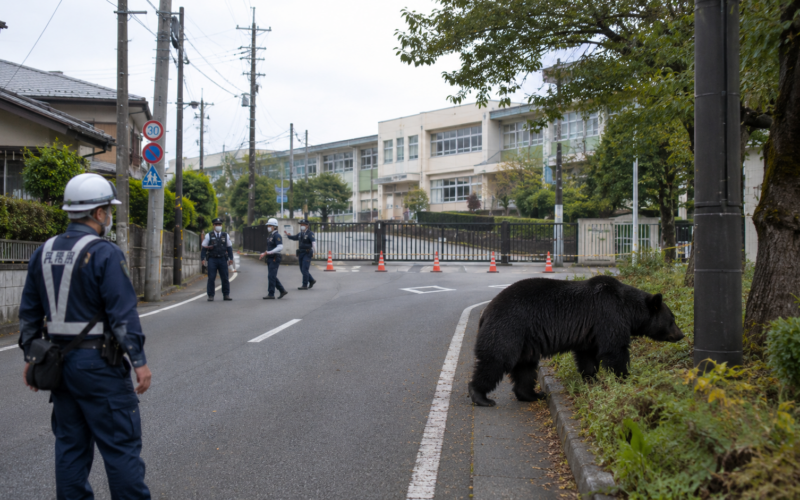
A wild black bear that triggered the closure of all 94 municipal primary and junior high schools in Utsunomiya, Japan, was captured on Tuesday, June 9, 2026, after repeated sightings across the city raised public safety concerns for children, residents and emergency authorities.
The bear was first seen near a residential park in Utsunomiya on Saturday, June 6, 2026, before additional sightings were reported near schools, a library, a university campus, a community centre and other urban locations. Utsunomiya authorities closed all city-run primary and junior high schools on Monday, June 8, 2026, and Tuesday, June 9, 2026, as police, hunters and local officials searched for the animal.
The bear was eventually located on private property and tranquilised by a veterinarian. No injuries were reported in Utsunomiya, but the incident caused widespread disruption in a city of about half a million people located north of Tokyo. Residents were urged to stay indoors, lock doors and windows, secure rubbish and avoid confronting the animal.
The Utsunomiya school closures have drawn national attention because the city had no previous record of a bear sighting, making the incident both unusual and alarming for local authorities. The episode also comes during a broader increase in bear encounters across Japan as bears emerge from hibernation and move closer to human settlements.
Japan has seen a rise in bear attacks, sightings and emergency responses in recent years. Public safety officials have linked the trend to multiple pressures, including reduced natural food sources, changing climate patterns, rural depopulation, shrinking human activity in mountain villages and a decline in hunting. The Utsunomiya case shows how the problem is no longer limited to remote mountain communities, because bear encounters are increasingly affecting schools, residential districts and city planning.
Why did Utsunomiya close all 94 municipal primary and junior high schools after bear sightings?
Utsunomiya closed all 94 municipal primary and junior high schools because authorities could not immediately determine where the bear would move next after repeated sightings across populated areas. The decision affected children, parents, teachers and school staff across the city on Monday, June 8, 2026, and Tuesday, June 9, 2026.
The closure was a precautionary public safety measure. A bear moving through residential and school-adjacent areas creates unpredictable risk because children may walk to school, wait at bus stops, use playgrounds or travel through streets where visibility is limited. Even a single bear can cause serious injury if startled or cornered.
Authorities also had to consider the possibility of multiple sightings in different locations. When a bear is reported near schools, parks, public buildings and residential streets, officials must assume the risk zone is wider than one neighbourhood. Closing schools reduced movement by children during the search and gave police and wildlife teams more room to operate.
The broader consequence is that a wildlife sighting became a citywide education and emergency management issue. The closure of nearly 100 schools shows that urban bear encounters can disrupt essential public services even when no injuries occur. For Utsunomiya, the priority was to prevent contact between the animal and children before the situation turned into an attack.

How did the bear move through Utsunomiya before being captured on June 9?
The bear was first spotted near a park in Utsunomiya on Saturday, June 6, 2026. Further sightings were reported through the weekend and into the start of the school week, including areas near educational and public facilities. The pattern of movement made the animal difficult to contain quickly.
Authorities used public warnings, patrols and search teams to track the animal. Police, hunters and local officials were involved, while residents received instructions to avoid the bear, stay indoors where possible and secure doors, windows and rubbish. A drone was also used after the bear was seen on a university campus, prompting additional class disruptions.
The bear was captured on Tuesday, June 9, 2026, on private property after being tranquilised by a veterinarian. Officials then had to decide how to handle the animal after capture, including whether relocation, temporary holding or another management step would follow.
The movement pattern matters because it shows how a bear can cross between green spaces, residential areas, schools and public facilities in a modern city. Utsunomiya is not a remote mountain village. The incident demonstrated that wildlife corridors, urban edges and food-seeking behaviour can bring large animals into places where residents and institutions are not prepared for direct encounters.
Why are bear encounters increasing across Japan after hibernation season?
Bear encounters are increasing across Japan after hibernation season because bears emerge hungry and begin searching for food across wider areas. When natural food sources are poor, bears may move closer to farms, rubbish collection points, residential districts and urban fringes.
Japan’s changing environment has made this pattern more serious. Poor harvests of nuts and other forest foods can push bears into human settlements. Climate-related shifts may also affect food availability and hibernation patterns, increasing the chance that bears appear in unusual locations.
Rural depopulation is another factor. As Japan’s countryside ages and shrinks, abandoned fields, quiet roads and less active mountain communities can make it easier for bears to move through areas that once had stronger human presence. Fewer hunters also mean bear populations may grow in some regions or become harder to manage.
The Utsunomiya case fits that wider pattern. The bear appeared in a city that had not previously recorded such a sighting, suggesting that the boundary between bear habitat and human settlement is becoming less predictable. For Japanese authorities, the policy challenge is to protect residents without reducing wildlife management to panic-driven emergency response.
What does the Utsunomiya case reveal about Japan’s school safety planning?
The Utsunomiya case reveals that school safety planning in Japan now has to account for wildlife risk as well as earthquakes, fires, traffic hazards and crime. Closing all 94 municipal primary and junior high schools was a major intervention, but authorities judged that keeping children at home was safer than allowing normal school movement while the bear remained at large.
Schools are especially sensitive because children are less able to assess wildlife danger and may behave unpredictably if they see a bear. A child may run, scream, approach from curiosity or become trapped in a narrow street. Those behaviours can increase the risk of an animal reacting defensively.
The case also shows why communication systems matter. Parents needed clear information on closures, reopening decisions and safety instructions. Teachers and school administrators needed guidance on whether to cancel classes, shift online, remain closed or coordinate with police patrols.
The broader lesson is that school safety cannot depend only on physical campuses. Routes to school, nearby parks, rubbish points, community centres and residential streets are all part of the risk environment. Utsunomiya’s response showed that authorities treated child movement across the city as a single safety issue rather than limiting concern to school buildings.
How are Japanese authorities balancing public safety and bear conservation concerns?
Japanese authorities are balancing public safety and bear conservation concerns by expanding management efforts while recognising that some bear species remain ecologically important and legally sensitive. Asiatic black bears are globally listed as vulnerable, but some bear populations inside Japan have increased as hunting activity has declined.
This creates a policy tension. Residents want quick protection when bears enter towns or cities. Conservation experts warn that indiscriminate killing can damage ecosystems and may not solve the underlying causes of bear movement. Authorities therefore need case-by-case responses that consider immediate threat, public location, animal behaviour and available capture options.
In Utsunomiya, the bear was captured alive after being tranquilised. That outcome reduced immediate public safety risk without a fatal response at the scene. However, officials still had to decide what would happen to the bear after capture, which can involve difficult judgments about relocation, release risk or other management actions.
The national policy challenge is larger than one animal. Japan has created task force and management responses as bear incidents have risen. The harder issue is building a system that includes warning technology, rubbish management, school protocols, trained hunters, veterinary support, habitat monitoring and public education before emergencies reach city streets.
Why does rural depopulation make urban bear sightings harder to prevent in Japan?
Rural depopulation makes urban bear sightings harder to prevent because shrinking human activity in mountain and agricultural communities can allow bears to move more freely toward towns. When fields are abandoned, forests expand, footpaths are less used and hunters decline, bears may encounter fewer human deterrents along the way.
Japan’s ageing population has changed many rural areas. Some villages have fewer residents, fewer farmers and fewer people regularly maintaining land near forests. That can blur the line between wildlife habitat and human settlement. Bears may then follow food sources, rivers, green corridors or rubbish smells into more populated areas.
Utsunomiya’s experience shows the urban end of that chain. A bear can appear suddenly in a city where residents and schools are not used to such threats. Once that happens, local authorities must respond quickly even if the underlying drivers are regional and long term.
The broader consequence is that bear safety is not only a wildlife issue. It is also connected to demographic change, land use, rural policy and municipal planning. Japan’s bear problem cannot be solved only by emergency capture teams if the conditions drawing bears toward people continue to expand.
What should residents do when a bear is spotted near schools or homes in Japan?
Residents should avoid approaching the animal, stay indoors where possible, secure doors and windows, and follow instructions from local authorities. In Utsunomiya, residents were also advised not to leave rubbish outside at night because food smells can attract bears into residential areas.
Public safety guidance usually warns people not to run toward or chase a bear. Bears may react aggressively if cornered, startled or separated from an escape route. Children and elderly residents are especially vulnerable because they may have less ability to move away quickly or respond calmly.
Schools, community centres and businesses need clear procedures when a bear is reported nearby. Those procedures may include suspending outdoor activity, keeping children inside, notifying parents, locking external doors and coordinating with police before dismissing students.
The Utsunomiya incident showed that public compliance can help prevent injuries. No injuries were reported before the bear was captured, even though the animal moved through multiple public and residential areas. That outcome suggests that rapid warnings, school closures and controlled movement helped reduce the chance of direct contact.
What happens next after the bear capture and school closures in Utsunomiya?
After the bear capture on Tuesday, June 9, 2026, Utsunomiya authorities were expected to assess whether schools could resume normal operations and whether any further sightings suggested the presence of another animal. Officials had to confirm that the immediate public risk had been removed before reopening affected facilities.
Wildlife officials also needed to decide the bear’s next destination. That decision may involve veterinary assessment, public safety concerns, relocation options and national or local wildlife management rules. The choice can be controversial because releasing a bear too close to populated areas may create renewed risk, while killing captured animals raises conservation and ethical concerns.
The incident is likely to feed into Japan’s broader bear management debate. Authorities across the country are already dealing with more sightings, more attacks and growing public concern. Utsunomiya’s closure of 94 schools shows how disruptive one roaming bear can be in an urban setting.
For residents, the immediate crisis ended with the animal’s capture. For policymakers, the case remains a warning that Japan’s wildlife safety problem is moving closer to schools, homes and city streets.
What are the key takeaways from the Utsunomiya bear sightings and school closures?
- A wild black bear was captured in Utsunomiya, Japan, on Tuesday, June 9, 2026, after repeated sightings across the city triggered a major public safety response.
- The bear was first seen near a residential park in Utsunomiya on Saturday, June 6, 2026, before additional sightings were reported near schools, public facilities and urban neighbourhoods.
- Utsunomiya closed all 94 municipal primary and junior high schools on Monday, June 8, 2026, and Tuesday, June 9, 2026, while police, hunters and local officials searched for the animal.
- No injuries were reported in Utsunomiya, but residents were urged to stay indoors, secure doors and windows, avoid confronting the bear and keep rubbish from attracting wildlife.
- The bear was located on private property and tranquilised by a veterinarian, ending the immediate threat but leaving officials to decide how the animal should be managed after capture.
- The incident was unusual because Utsunomiya had no previous record of a bear sighting, making the closure of nearly 100 schools a significant citywide emergency measure.
- Japan has seen more bear sightings and attacks in recent years, with officials linking the trend to food shortages, climate pressures, rural depopulation and reduced hunting activity.
- The Utsunomiya case shows that Japan’s bear safety challenge is no longer limited to remote mountain areas because schools, homes and urban facilities are increasingly exposed.
Discover more from Business-News-Today.com
Subscribe to get the latest posts sent to your email.