
The United Nations General Assembly has approved a second four-yeaner for Human Rights Volker Türk, overcoming opposition from the United States, Russia and Israel in a vote that exposed deep divisions over the independence and authority of global human rights oversight.
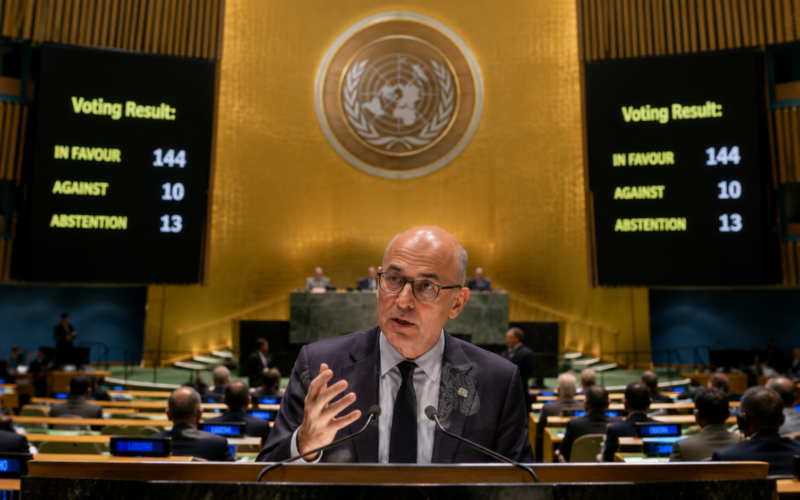
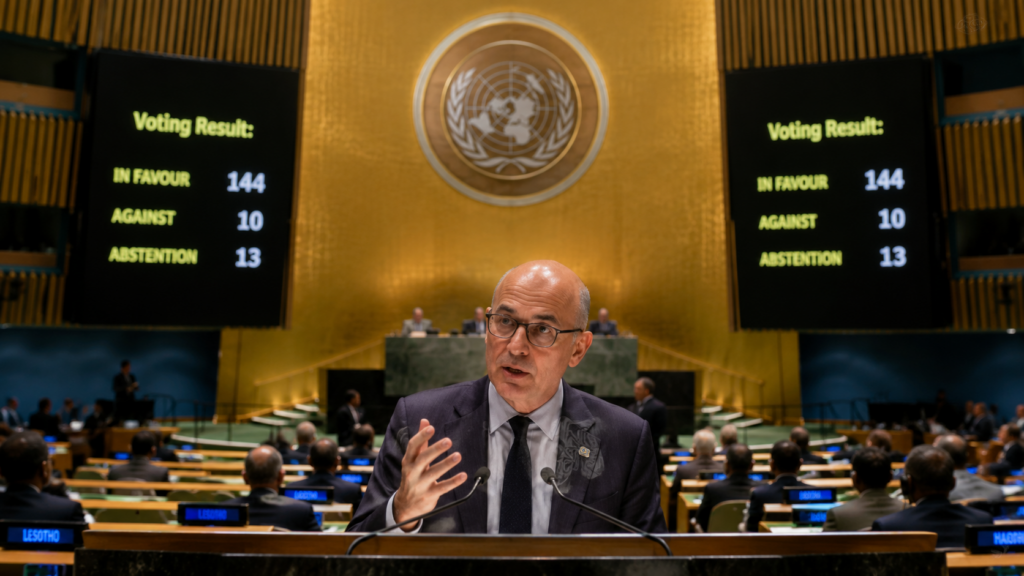
The vote on July 24, 2026, delivered 144 votes in favour of the extension, with 10 countries voting against and 13 abstaining. The result allows Volker Türk to continue leading the Office of the United Nations High Commissioner for Human Rights after his existing mandate expires in October 2026.
The United Nations General Assembly also rejected a Russian proposal that would have extended Volker Türk’s mandate only until the end of December 2026. That arrangement would have allowed the next United Nations Secretary-General to reconsider the appointment shortly after taking office in January 2027.
United Nations Secretary-General António Guterres had proposed renewing Volker Türk for the maximum second term permitted under the mandate of the Office of the United Nations High Commissioner for Human Rights. The decision effectively gives Volker Türk continuity through 2030, even as the United Nations prepares for a leadership transition following the conclusion of António Guterres’s second term on December 31, 2026.
Why did the United Nations General Assembly extend Volker Türk’s mandate despite major-power resistance?
The scale of support for Volker Türk indicated that most United Nations member states were unwilling to reopen the leadership of the Office of the United Nations High Commissioner for Human Rights during a period of expanding wars, political repression and humanitarian emergencies. Support came from countries across Europe, Africa and Latin America, as well as China, creating a coalition that crossed several traditional geopolitical divisions.
Many supporting governments treated continuity as an institutional priority. Volker Türk has led the United Nations human rights system since October 17, 2022, and his reappointment avoids a potentially prolonged search for a successor while conflicts in Ukraine, Gaza, Sudan and other regions continue to generate allegations of violations of international humanitarian and human rights law.
The vote also reflected concern that objections from individual powerful states could weaken the independence of the United Nations human rights office. Governments supporting the extension appeared to distinguish between disagreements with particular findings and the broader requirement for the high commissioner to scrutinise the conduct of all states, including permanent members of the United Nations Security Council and close allies of major powers.
The United Nations General Assembly established the Office of the United Nations High Commissioner for Human Rights in 1993. Under the institutional framework, the United Nations Secretary-General nominates the high commissioner and the United Nations General Assembly approves the appointment for a fixed four-year term that can be renewed once.
That structure gives member states a direct role in approving the appointment while preventing any single permanent member of the United Nations Security Council from using a veto. The July 24 vote therefore became a broader test of whether opposition from several influential governments could prevent the continuation of a human rights chief supported by a large majority of the United Nations membership.
What objections did the United States, Russia and Israel raise against Volker Türk’s reappointment process?
The United States, Russia and Israel opposed the extension for overlapping but distinct reasons. Their objections combined criticism of Volker Türk’s public positions with procedural concerns about António Guterres proposing a full four-year renewal only months before the end of his own mandate.
Russia argued that Volker Türk had applied human rights standards selectively and had allowed the Office of the United Nations High Commissioner for Human Rights to become politically aligned against Moscow. Volker Türk has repeatedly criticised Russia’s war in Ukraine and the consequences of Russian military operations for civilians, prisoners and communities living in occupied territories.
Russia’s counterproposal would have kept Volker Türk in office only until December 31, 2026. Russia maintained that the next United Nations Secretary-General should be able to participate in deciding who leads the human rights office during the next United Nations leadership cycle.
The United States focused heavily on the timing and process of the nomination. The United States argued that the decision was being accelerated without sufficient consultation, scrutiny or opportunity for alternative candidates to be considered. The United States also warned that the handling of the appointment could influence its future funding and participation in parts of the United Nations system.
Volker Türk has criticised conditions within the United States immigration system and has called for investigations into deaths involving people held in immigration custody. Those interventions placed the United States among the major powers directly challenged by the United Nations human rights chief during his first term.
Israel opposed the extension after repeated criticism from Volker Türk over Israeli military operations in Gaza, the treatment of Palestinian civilians and compliance with international law. Israel has frequently argued that United Nations human rights institutions apply disproportionate scrutiny to Israeli conduct while giving insufficient attention to abuses committed by armed groups and governments elsewhere.
The three governments therefore approached the vote from different geopolitical positions but shared a concern about the authority exercised by the high commissioner. Their opposition demonstrated how the human rights mandate can become politically contentious when investigations and public statements involve governments with substantial diplomatic, military or financial influence.
How does the 144 to 10 vote reshape the debate over independence at the United Nations human rights office?
The 144 to 10 result gave Volker Türk a clear institutional mandate, but it did not resolve the underlying conflict over how the Office of the United Nations High Commissioner for Human Rights should operate. The vote reinforced the principle that the high commissioner must be capable of challenging governments regardless of their influence, alliances or position within the United Nations system.
At the same time, the opposition of the United States, Russia and Israel carries practical consequences. The Office of the United Nations High Commissioner for Human Rights depends on financial resources, access to countries, cooperation from national authorities and political support from member states to conduct investigations, deploy monitoring missions and publish findings.
A government can reject a report, deny investigators access or withhold cooperation without formally removing the high commissioner. Major donors can also use funding decisions to influence the operational capacity of the wider United Nations system, even when they cannot overturn an appointment approved by the General Assembly.
The United States warning that it could reassess its funding and engagement consequently introduces uncertainty beyond the personnel decision. The United Nations human rights system is already operating under financial pressure, with funding shortages affecting investigations, field operations and monitoring activities in several regions.
The reappointment therefore strengthens Volker Türk’s political authority while leaving operational vulnerabilities unresolved. A large vote in the United Nations General Assembly can protect the leadership of the office, but it cannot guarantee the cooperation, access and resources required to translate that leadership into effective investigations and accountability mechanisms.
The participation of China among the governments supporting the extension also illustrates the complexity of the vote. China has faced sustained criticism over human rights conditions, particularly concerning the treatment of Uyghurs and other Muslim minorities in Xinjiang, but supported continuity in the high commissioner’s office despite those tensions.
That cross-regional support prevents the decision from being presented simply as a division between Western democracies and non-Western governments. Instead, the result revealed a broader institutional calculation that preserving the office’s leadership was preferable to creating a vacancy or allowing the transition to become dominated by disputes among major powers.
Why does the timing of Volker Türk’s second term matter as António Guterres prepares to leave office?
The timing of the extension was one of the most contested elements of the vote because António Guterres is approaching the end of his second and final term as United Nations Secretary-General. António Guterres will leave office on December 31, 2026, while the next United Nations Secretary-General is expected to begin a five-year term on January 1, 2027.
By securing approval for Volker Türk before that transition, António Guterres has ensured continuity in one of the United Nations system’s most politically sensitive roles. Volker Türk’s second mandate will extend well beyond António Guterres’s departure and into the tenure of the next secretary-general.
Supporters viewed that continuity as consistent with the institutional rules established for the high commissioner. The mandate allows one renewal, and the authority to nominate the high commissioner remains with the serving secretary-general until the end of the secretary-general’s term.
Opponents viewed the same decision as an attempt to bind the next United Nations leadership to a significant personnel choice made during the final months of the current administration. Russia’s proposed short extension was designed to postpone the long-term decision until after the new secretary-general assumed office.
The General Assembly’s rejection of the Russian proposal established that member states did not consider the approaching leadership transition sufficient reason to delay the appointment. The vote affirmed that the timetable of the Office of the United Nations High Commissioner for Human Rights does not have to align with the timetable of the United Nations Secretary-General.
That institutional separation can protect the human rights office from abrupt political changes. It can also generate friction when a new secretary-general inherits a high commissioner selected by a predecessor and approved under a different balance of diplomatic relationships.
Volker Türk’s second term will consequently overlap with a new era of United Nations leadership. The working relationship between Volker Türk and the next United Nations Secretary-General could shape how strongly the organisation responds to violations involving major powers, armed conflicts and politically sensitive domestic policies.
What challenges will Volker Türk face as global conflicts deepen pressure on United Nations human rights oversight?
Volker Türk begins the path toward a second term at a time when the international human rights system is confronting simultaneous crises. Armed conflicts, mass displacement, restrictions on political opposition, attacks on journalists and pressure on civil society organisations have increased the workload of the Office of the United Nations High Commissioner for Human Rights.
The war in Ukraine will remain a central challenge. The human rights office continues to document civilian casualties, detention practices, attacks on infrastructure and alleged violations in territories affected by Russian military operations and Ukrainian responses.
The conflict involving Israel and the Palestinian territories presents another major test. Volker Türk must continue assessing allegations involving civilian protection, humanitarian access, detention conditions and the conduct of both state forces and armed groups while facing intense diplomatic pressure from opposing sides.
Sudan and other underfunded crises will also require sustained attention. Monitoring abuses in fragmented conflict zones is difficult when investigators lack physical access, reliable local partners, adequate security and sufficient financial resources.
Domestic human rights issues in powerful countries will remain equally sensitive. Volker Türk’s willingness to address immigration detention in the United States demonstrates that the mandate is not limited to conflicts in developing countries or governments outside Western alliances.
The challenge is not only to identify violations but to maintain consistent standards. Governments frequently support United Nations investigations involving rivals while rejecting scrutiny of their own policies or those of strategic partners.
Volker Türk’s second term will therefore be judged partly on whether the Office of the United Nations High Commissioner for Human Rights applies comparable legal and evidentiary standards across different countries. Perceptions of selectivity can weaken trust even when individual findings are supported by substantial documentation.
Financial pressure could become the most immediate operational constraint. Without adequate funding, the human rights office may be forced to reduce field monitoring, delay reports or limit support for independent investigations, weakening its ability to respond to the expanding number of crises.
What does Volker Türk’s reappointment reveal about the balance between sovereignty and multilateral scrutiny?
The vote demonstrated that most United Nations member states continue to support an international mechanism capable of examining domestic and wartime conduct. At the same time, the opposition showed that governments remain highly protective of sovereignty when external scrutiny affects national security, immigration policy or military operations.
The Office of the United Nations High Commissioner for Human Rights has no independent enforcement force. Its influence depends on documentation, public reporting, diplomatic engagement, technical assistance and cooperation with other United Nations institutions and international legal mechanisms.
That limited enforcement authority makes credibility especially important. When governments accept the office’s findings, the reports can influence sanctions debates, judicial proceedings, peace negotiations and domestic reforms. When governments reject the office entirely, its ability to influence events depends on whether other states and institutions continue to use its evidence.
The vote preserved the leadership of the office but also highlighted the political limits surrounding it. Volker Türk has received a strong mandate from the United Nations General Assembly, yet several of the governments most capable of affecting global human rights outcomes remain openly critical of his approach.
The second term will therefore test whether institutional independence can coexist with the diplomatic cooperation required to conduct effective human rights work. Volker Türk must engage governments whose actions he may simultaneously be required to investigate or condemn.
The July 24 decision represents more than a personnel extension. It is a declaration by a large majority of United Nations member states that disagreement with the high commissioner should not automatically result in the high commissioner’s removal.
Whether that mandate produces stronger accountability will depend on access, funding, consistent legal standards and the willingness of governments to respond to findings they may find politically inconvenient. The vote protected the office’s continuity. The larger struggle over the authority of international human rights oversight remains unresolved.
What are the key takeaways from the United Nations vote extending Volker Türk’s human rights mandate?
- The United Nations General Assembly voted on July 24, 2026, to approve a second four-year term for United Nations High Commissioner for Human Rights Volker Türk, with 144 countries supporting the extension, 10 voting against and 13 abstaining.
- The United States, Russia and Israel opposed the reappointment after disputes involving Volker Türk’s criticism of Russia’s war in Ukraine, Israeli military operations in Gaza and conditions affecting people held in United States immigration custody.
- The United Nations General Assembly rejected a Russian proposal that would have extended Volker Türk’s current mandate only until December 31, 2026, allowing the next United Nations Secretary-General to revisit the leadership appointment after taking office.
- United Nations Secretary-General António Guterres nominated Volker Türk for the second term before António Guterres’s own mandate ends on December 31, 2026, creating continuity in the human rights office during the coming United Nations leadership transition.
- The Office of the United Nations High Commissioner for Human Rights was established under a 1993 General Assembly resolution that provides for a four-year appointment, approved by the General Assembly, with the possibility of one additional four-year term.
- Support for Volker Türk extended across European, African and Latin American states and included China, demonstrating that the coalition favouring continuity was broader than a conventional division between Western and non-Western governments.
- The United States warned that concerns about the appointment process could affect its future engagement and funding, raising operational questions because United Nations human rights investigations and monitoring programmes are already facing significant financial pressure.
- Volker Türk’s second term will be shaped by wars in Ukraine, Gaza and Sudan, disputes over national sovereignty, restrictions on investigators and the challenge of applying consistent human rights standards to both powerful governments and smaller states.
Discover more from Business-News-Today.com
Subscribe to get the latest posts sent to your email.