

The Umm Shaif Gas Cap project is strategically important because it shows how Abu Dhabi National Oil Company is trying to extract more gas value from mature offshore infrastructure while expanding the United Arab Emirates’ long-term gas supply base. Rather than relying only on greenfield fields, ADNOC is advancing a gas cap development above existing oil reservoirs at Umm Shaif, one of Abu Dhabi’s oldest and most important offshore assets.
ADNOC approved a $6.2 billion final investment decision for the Umm Shaif Gas Cap development on July 21, 2026, alongside TotalEnergies SE, Eni S.p.A. and China National Petroleum Corporation. The project is designed to unlock more than 600 million standard cubic feet per day of natural gas and associated gas liquids by 2030, equal to almost 10% of the United Arab Emirates’ current daily gas consumption.
The Umm Shaif Gas Cap project matters because natural gas has become central to ADNOC’s upstream, industrial and LNG growth strategy. The company is seeking to expand domestic gas supply, support rising industrial and power demand, and strengthen its future liquefied natural gas platform. Umm Shaif Gas Cap fits directly into that strategy because it adds production from an existing offshore concession while leveraging established infrastructure, long-life reservoir knowledge and international partner expertise.
The timing is also important. The final investment decision comes as the United Arab Emirates is pursuing gas self-sufficiency and a larger role in global LNG markets. ADNOC is also advancing the Bab Gas Cap project and the Ruwais LNG project, making Umm Shaif Gas Cap part of a broader national gas expansion cycle rather than a standalone offshore development.
Where is the Umm Shaif Gas Cap project located and what is being developed?
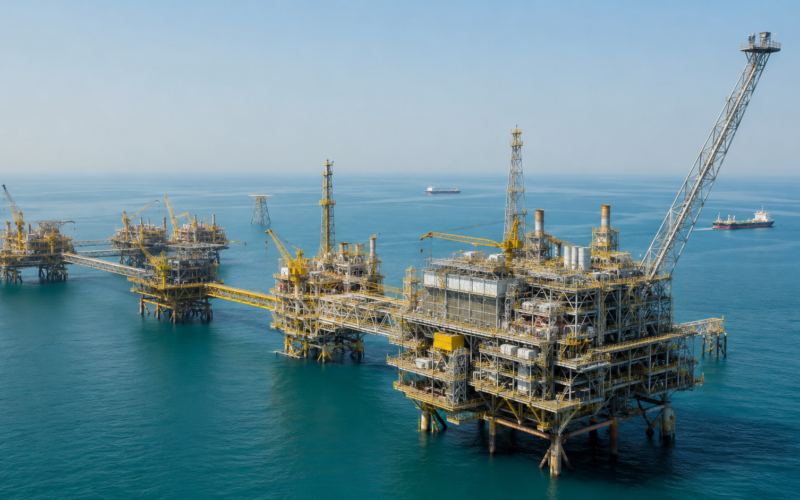
The Umm Shaif Gas Cap project is located offshore Abu Dhabi within the Umm Shaif and Nasr hydrocarbons concession. Umm Shaif is Abu Dhabi’s oldest offshore field and has been producing since 1962. The field already has extensive offshore infrastructure, production systems, export facilities and operational knowledge built over more than six decades.
A gas cap is a natural accumulation of gas that sits above an oil column in a reservoir. In the case of Umm Shaif, ADNOC and its partners are developing gas cap resources located above the field’s oil reservoirs while also aiming to maximise recovery of associated gas liquids and condensate. This makes the project technically different from a conventional standalone gas field because the new development must be integrated with existing oil production, reservoir management plans and offshore facilities.
The project is intended to produce natural gas and associated liquids, with production expected by 2030. TotalEnergies has also indicated that the wider Umm Shaif gas cap has potential to increase gas production to as much as 1.5 billion cubic feet per day in the future. That larger figure should be treated as longer-term potential rather than the immediate output target covered by the sanctioned 2026 final investment decision.
This distinction matters for project readers, contractors and policy analysts. The currently approved Umm Shaif Gas Cap development is a major 600 million standard cubic feet per day-plus project. The larger 1.5 billion cubic feet per day figure represents additional potential that would depend on future phases, reservoir performance, engineering design, market demand and further investment approvals.
Who operates the Umm Shaif Gas Cap project and how is ownership structured?
The Umm Shaif Gas Cap project is part of the Umm Shaif and Nasr offshore concession. ADNOC holds a 60% interest, TotalEnergies SE holds 20%, Eni S.p.A. holds 10% and China National Petroleum Corporation holds 10%. ADNOC Offshore is the operator.
The current partnership structure reflects the concession awarded in 2018 for a 40-year term. That agreement gave international energy companies long-term exposure to one of Abu Dhabi’s key offshore production areas while keeping ADNOC as the majority stakeholder and ADNOC Offshore as the operating company.
TotalEnergies has described itself as an asset lead in the development, working alongside ADNOC and the other concession partners to unlock additional value from the field. That role is important because the Umm Shaif Gas Cap project requires reservoir expertise, offshore engineering, drilling execution, brownfield integration and gas processing knowledge.
For TotalEnergies SE and Eni S.p.A., the project adds long-cycle upstream gas exposure beyond 2030. For China National Petroleum Corporation, it maintains participation in one of the Gulf’s major offshore concessions. For ADNOC, the ownership structure keeps Abu Dhabi in majority control while sharing technical and capital commitments with international partners.
What is the capacity of the Umm Shaif Gas Cap project?
The approved Umm Shaif Gas Cap development is expected to unlock more than 600 million standard cubic feet per day of natural gas and associated gas liquids by 2030. ADNOC has said this volume is equivalent to almost 10% of the United Arab Emirates’ current daily gas consumption.
The project also targets condensate and gas liquids recovery. These liquids can improve project economics because they provide additional value beyond dry gas production. In an offshore gas cap project, maximising liquids recovery while managing reservoir pressure and maintaining existing field operations is central to the development plan.
The production profile should be understood in the context of a mature offshore field. Umm Shaif has been producing oil for decades, so the gas cap development is not a frontier discovery story. It is a reservoir-management and infrastructure-expansion project designed to recover gas resources that sit within an existing offshore system.
The future potential of up to 1.5 billion cubic feet per day gives the Umm Shaif Gas Cap project additional long-term relevance. However, that upside depends on future development phases, engineering outcomes, reservoir performance, economics, demand, processing capacity and partner approvals. The present base case remains the sanctioned development that aims to deliver more than 600 million standard cubic feet per day by 2030.
What infrastructure will ADNOC build for the Umm Shaif Gas Cap project?
The Umm Shaif Gas Cap final investment decision includes major offshore infrastructure, drilling and integrated services. ADNOC said the investment includes three engineering, procurement and construction packages totalling $5.1 billion for large-scale offshore infrastructure.
The project also includes a $365 million 14-well drilling and integrated drilling services programme to be delivered by ADNOC Drilling over 18 months using three existing rigs. This drilling programme is central to converting the approved investment into production because the wells will provide the physical connection between the gas cap reservoir and the offshore production system.
The offshore infrastructure is expected to support gas collection, handling, compression, liquids recovery and integration with existing field facilities. Because Umm Shaif is a mature offshore development, the project must tie new systems into an operating asset rather than build entirely isolated infrastructure.
That integration can reduce development risk by using established field infrastructure, but it also creates execution complexity. Contractors must work around existing production, maintain safety standards, coordinate tie-ins and ensure that new gas facilities do not disrupt oil production from the wider field.
Which companies won contracts for the Umm Shaif Gas Cap project?
The officially disclosed contract picture is clear at the package level but not fully transparent at the named-contractor level. ADNOC has said the final investment decision includes three EPC packages worth a combined $5.1 billion for large-scale offshore infrastructure. It said the awards went to consortiums including major United Arab Emirates and international contractors, but the primary company release did not publicly list every winning consortium member.
This means the safest project-page wording is to describe the contract value, number of packages and broad contractor composition without naming specific EPC winners unless separately confirmed by ADNOC or the contractors themselves. Industry reports may discuss bidders, shortlisted companies or likely consortiums, but those should not be treated as confirmed award recipients unless official award disclosures are available.
The one contractor role that is clearly named in the official announcement is ADNOC Drilling. The company will deliver the $365 million drilling and integrated drilling services programme over 18 months using three existing rigs. This is material because it gives ADNOC Drilling a direct operational-services role in one of ADNOC’s most important gas investments of 2026.
From a supply-chain perspective, the project is important even without full public disclosure of the EPC consortium members. The three EPC packages imply substantial demand for offshore fabrication, compression systems, process modules, pipelines, offshore tie-ins, electrical systems, controls, installation vessels, project management and commissioning services.
How did the Umm Shaif Gas Cap project evolve before the 2026 final investment decision?
The history of Umm Shaif Gas Cap is tied to the long life of the Umm Shaif field itself. Umm Shaif has been producing since 1962, making it one of Abu Dhabi’s longest-operating offshore fields. Over time, the concession has evolved from an oil-led offshore development into a broader hydrocarbon asset with significant gas potential.
The modern commercial framework was reshaped in 2018 when ADNOC awarded participating interests in the Umm Shaif and Nasr concession for a 40-year term. The concession structure placed ADNOC at 60%, TotalEnergies at 20%, Eni at 10% and China National Petroleum Corporation at 10%, with ADNOC Offshore as operator.
At the time of the 2018 concession award, TotalEnergies highlighted the gas cap potential at Umm Shaif, referring to a possible gas production level of around 500 million standard cubic feet per day. The 2026 final investment decision has raised the sanctioned output target to more than 600 million standard cubic feet per day, while also indicating larger long-term potential if further development phases are approved.
The Umm Shaif Gas Cap project had been under evaluation for several years before the 2026 final investment decision. The project required technical work around reservoir behaviour, pressure management, offshore infrastructure, processing needs, drilling design and integration with existing facilities. The final investment decision therefore represents the conversion of long-identified gas potential into an approved capital programme.
What are the latest Umm Shaif Gas Cap developments and operational updates in 2026?
The most important 2026 development is the July 21 final investment decision. ADNOC and its partners approved a $6.2 billion investment to develop the gas cap resources at Umm Shaif, with production expected by 2030.
The final investment decision includes $5.1 billion of EPC packages and a $365 million drilling and integrated drilling services programme. These figures indicate that the project has moved beyond technical evaluation and tendering into execution planning, contractor mobilisation and drilling preparation.
The project also follows the Supreme Council for Financial and Economic Affairs’ award of the Bab Gas Cap concession, which is expected to unlock an additional 1.5 billion standard cubic feet per day of natural gas and associated liquids. That timing suggests Abu Dhabi is accelerating a broader gas cap development cycle across both offshore and onshore assets.
ADNOC has also launched a global LNG marketing and trading platform in Abu Dhabi Global Market, targeting 47 million tonnes per annum of combined marketable LNG capacity by 2035. Umm Shaif Gas Cap is therefore connected to a wider gas strategy that spans domestic supply, upstream development, LNG production, trading and international customer relationships.
What regulatory, geopolitical and environmental factors affect the Umm Shaif Gas Cap project?
The Umm Shaif Gas Cap project is governed by Abu Dhabi’s concession framework and the regulatory oversight of the United Arab Emirates’ energy authorities. The 2018 concession award established the long-term ownership and operating framework, while the 2026 final investment decision approves the next major phase of capital spending.
Geopolitically, the project strengthens the United Arab Emirates’ gas security at a time when the Gulf region is seeking to balance domestic demand, LNG growth and long-term export positioning. Gas demand is rising because of power generation, industrial expansion, desalination, petrochemicals, artificial intelligence infrastructure and broader economic growth.
The project also sits within a region where energy infrastructure has strategic significance beyond the balance sheet. Offshore oil and gas assets in the Gulf are important to global energy markets, and new gas investments are increasingly assessed through both security-of-supply and energy-transition lenses.
From an environmental perspective, ADNOC and TotalEnergies have said the project will use synergies with existing offshore facilities and clean power from the United Arab Emirates grid to minimise costs and emissions. That claim should be interpreted carefully. Leveraging existing infrastructure and grid power can reduce project-level emissions intensity compared with a less integrated development, but the project will still add hydrocarbon production and associated downstream emissions.
The key environmental question is therefore not whether Umm Shaif Gas Cap is a zero-emissions project. It is whether ADNOC can develop incremental gas with lower operational emissions intensity while meeting rising demand and maintaining credibility around its broader decarbonisation commitments.
How does Umm Shaif Gas Cap affect operators, national strategy and global gas supply?
For ADNOC, the Umm Shaif Gas Cap project strengthens domestic gas supply while extending the value of an established offshore concession. The project increases recoverable value from an existing field, supports ADNOC Offshore’s long-term production base and gives ADNOC Drilling a material drilling and integrated services role.
For TotalEnergies SE, Eni S.p.A. and China National Petroleum Corporation, the project provides long-duration participation in a major Abu Dhabi gas development with a clear production target and a 2030 start-up timeline. Their role is not only financial. The project also draws on international technical experience in offshore development, brownfield integration and reservoir optimisation.
For the United Arab Emirates, the project supports gas self-sufficiency and energy security. A development capable of adding more than 600 million standard cubic feet per day can materially reduce future supply pressure as domestic consumption grows. It also supports power generation, petrochemicals, desalination, heavy industry and future digital infrastructure demand.
For global gas supply, Umm Shaif Gas Cap is not as large as the biggest LNG megaprojects in Qatar or the United States. Its importance lies in the way it supports ADNOC’s broader gas and LNG value chain. Additional domestic gas supply can free up other resources, support industrial growth and complement ADNOC’s expansion into LNG marketing and trading.
The project also reflects a wider trend among national oil companies. Mature offshore fields are being re-evaluated for gas, liquids and enhanced recovery potential, especially where existing infrastructure can shorten development timelines and improve economics. Umm Shaif Gas Cap is a strong example of this strategy because it seeks to generate new gas supply from an old field rather than depend entirely on frontier exploration.
Why does the Umm Shaif Gas Cap project matter to the United Arab Emirates?
The Umm Shaif Gas Cap project matters to the United Arab Emirates because it directly supports national gas supply security. A project capable of adding more than 600 million standard cubic feet per day is material in a country where gas demand is tied to industry, power, water, petrochemicals and future data infrastructure.
The project is also important for Abu Dhabi’s industrial strategy. Natural gas supports energy-intensive sectors and can provide flexible generation capacity as the country expands renewable power and low-carbon industrial initiatives. Gas supply security therefore remains a strategic requirement even as the United Arab Emirates invests in solar, nuclear and lower-carbon energy systems.
Umm Shaif Gas Cap also reinforces Abu Dhabi’s position as a long-term destination for energy investment. The presence of TotalEnergies SE, Eni S.p.A. and China National Petroleum Corporation shows that ADNOC continues to attract international partners into core upstream concessions.
At a regional level, the project demonstrates that Gulf producers are not treating gas as a transition afterthought. They are increasing investment in gas production, LNG capacity, gas trading and lower-emissions upstream operations at the same time. Umm Shaif Gas Cap fits into that regional shift by turning a mature oilfield asset into a future gas supply platform.
What is the future outlook for the Umm Shaif Gas Cap project?
The future outlook for Umm Shaif Gas Cap is positive but execution-sensitive. The project has now secured final investment approval, a clear production target and major EPC and drilling commitments. The main challenge is converting that capital programme into reliable output by 2030.
The development must manage several operational risks. These include reservoir behaviour in a mature offshore field, drilling performance, offshore construction complexity, compression and processing requirements, tie-ins with existing infrastructure and coordination between multiple contractors.
The project’s use of existing offshore facilities should help reduce cost and execution risk, but brownfield integration can also create schedule constraints because work must be coordinated around active operations. Safe tie-ins, shutdown planning and commissioning discipline will be central to delivery.
Longer term, the upside case depends on whether the project can move beyond the initial more than 600 million standard cubic feet per day target toward the larger potential identified by TotalEnergies. Any future expansion would require additional technical validation, investment approval and alignment with ADNOC’s gas processing and marketing strategy.
Umm Shaif Gas Cap is therefore best understood as a strategic brownfield gas expansion with greenfield-level importance. It does not open a new basin, but it materially changes how much gas Abu Dhabi can recover from one of its most established offshore assets.
If ADNOC and its partners deliver production by 2030, the project will strengthen the United Arab Emirates’ gas security, support ADNOC’s LNG growth strategy and provide a reference model for extracting more gas from mature oil-led offshore concessions. If execution slips, it will underline the complexity of turning gas cap potential into commercial supply at scale.
Discover more from Business-News-Today.com
Subscribe to get the latest posts sent to your email.