
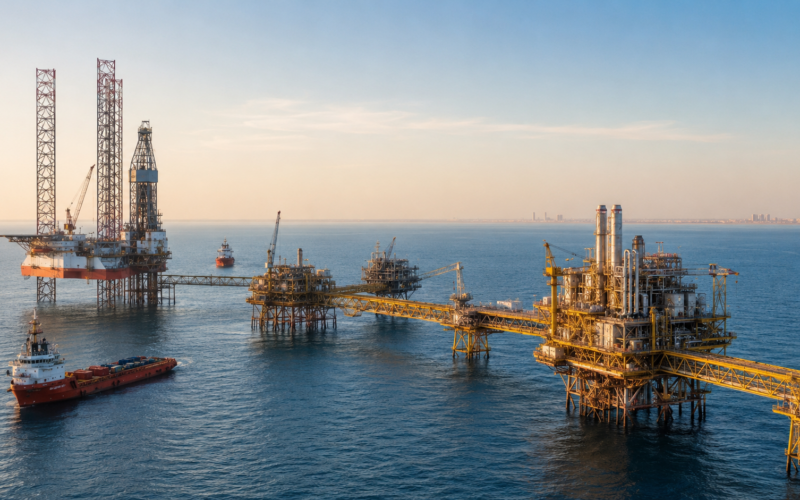
Abu Dhabi National Oil Company (ADNOC) has taken a $6.2 billion final investment decision to develop the Umm Shaif Gas Cap offshore Abu Dhabi, alongside partners TotalEnergies SE (Euronext Paris: TTE; NYSE: TTE), Eni S.p.A. (BIT: ENI; NYSE: E) and China National Petroleum Corporation.
The development sits within the 40-year Umm Shaif and Nasr concession, held 60 percent by ADNOC, 20 percent by TotalEnergies SE and 10 percent each by Eni S.p.A. and China National Petroleum Corporation, and targets more than 600 million standard cubic feet per day of natural gas and associated liquids from 2030.
Three engineering, procurement and construction packages totalling $5.1 billion have been awarded to consortiums of UAE and international contractors, with ADNOC Drilling Company P.J.S.C. (ADX: ADNOCDRILL) securing a separate $365 million 14-well drilling programme over 18 months.
The FID follows the Supreme Council for Financial and Economic Affairs’ award of the Bab Gas Cap concession, which is expected to unlock an additional 1.5 billion scfd, and reinforces ADNOC’s target of 47 million tonnes per annum of combined marketable LNG capacity by 2035.
The central question for institutional readers is whether the coordinated Umm Shaif, Bab, Ruwais LNG and marketing-platform build is timed correctly to convert into contracted LNG volume before global gas markets rebalance later in the decade.
What does the $6.2 billion Umm Shaif Gas Cap FID actually unlock for the UAE’s gas balance and LNG ambitions?
The headline output is 600 million standard cubic feet per day of natural gas and associated gas liquids from 2030, an increment equivalent to almost 10 percent of the UAE’s current daily gas consumption. That single number carries three separate strategic messages. First, it materially strengthens UAE domestic energy security at a moment when the country is scaling power demand for industrial expansion and artificial intelligence infrastructure. Second, it frees up incremental gas volumes that can flow through the ADNOC gas processing system to serve export markets, either directly or via the Ruwais LNG project. Third, it demonstrates that the Umm Shaif and Nasr concession, historically valued primarily for its 275,000 barrels per day crude oil production capacity, can be repositioned as a dual oil-and-gas asset by developing the gas cap sitting above the oil reservoir.
TotalEnergies SE’s own statement adds an important scaling qualifier. The Umm Shaif Gas Cap development has the potential to increase future gas production up to 1.5 billion scfd, supporting the long-term gas growth strategy of the concession partners. The initial FID therefore captures roughly 40 percent of the ultimate technical envelope, leaving material upside for a follow-on investment cycle. That optionality is one of the reasons a project economically dependent on downstream LNG capacity can be sanctioned with a 2030 production start-up: the incremental 600 mmscfd is intended to slot into a system that has already made its LNG capacity commitments.

How is the $6.2 billion capital outlay split between offshore EPC, drilling and residual project costs?
The $6.2 billion FID has a clean disclosed breakdown. Three EPC packages account for $5.1 billion, or roughly 82 percent of the total, and cover large-scale offshore infrastructure. The 14-well drilling and integrated drilling services programme accounts for $365 million, or about 6 percent, and is scheduled to run for 18 months using three existing rigs from ADNOC Drilling Company P.J.S.C.’s fleet. The residual $735 million, or about 12 percent, covers owner’s costs, contingency, project management, tie-in engineering and integration with existing offshore infrastructure that TotalEnergies SE has described as a source of significant synergies.
The split is worth reading closely because it tells investors where the industrial value flows. Offshore EPC work at this scale typically supports platforms and topsides, subsea tie-ins, pipelines and gas processing modifications, and the naming of consortiums including major UAE and international contractors is consistent with the pattern established on the earlier Umm Shaif Long Term Development Plan awarded to National Petroleum Construction Company in 2022. The drilling scope is smaller in dollar terms but is meaningful for the listed contractor’s earnings visibility, and the reliance on existing rigs rather than new-build capacity keeps mobilisation costs down.
What is TotalEnergies SE’s 20 percent stake and Asset Lead role worth in the Umm Shaif Gas Cap development?
TotalEnergies SE is the largest international partner in the Umm Shaif and Nasr concession and continues to act as Asset Lead, meaning it provides the technical leadership of the concession alongside ADNOC. On the announced numbers, the 20 percent stake translates to approximately 120 million scfd of equity gas plus associated liquids from 2030 and an equity share of capital expenditure of roughly $1.24 billion of the $6.2 billion total. In the context of TotalEnergies SE’s group-wide capital expenditure programme, that is a small figure spread across multiple years, but the strategic value is disproportionately larger. Umm Shaif Gas Cap gives TotalEnergies SE incremental low-cost, low-carbon-intensity gas equity in a Middle East hub that is closely tied to its expanding UAE portfolio.
The Asset Lead role also means TotalEnergies SE captures reputational and technical value beyond its equity share, since the technical operator role positions the company for future concession awards and adjacent development phases. The French group’s own statement highlighted synergies with existing offshore installations and the use of clean grid power from the UAE electricity network to minimise both cost and emissions, which is consistent with the low-carbon-intensity narrative TotalEnergies SE has been anchoring across its Middle East upstream programme.
How does the FID fit alongside the Bab Gas Cap concession and ADNOC’s 47 mtpa LNG capacity target for 2035?
Umm Shaif Gas Cap is one of several coordinated moves rather than a standalone development. The Supreme Council for Financial and Economic Affairs recently awarded a separate concession agreement for the Bab Gas Cap, which is expected to unlock an additional 1.5 billion scfd of natural gas and associated liquids. On 6 July 2026, ADNOC launched a global LNG marketing and trading platform in Abu Dhabi Global Market, combining marketing activities of ADNOC Gas and XRG with the trading capabilities of ADNOC Trading. On 7 July 2026, ADNOC signed a 15-year Sales and Purchase Agreement with INPEX Corporation for 1 million tonnes per annum of LNG from the Ruwais LNG project, which is designed to produce 9.6 million tonnes per annum from clean-powered facilities in the Middle East and North Africa region’s first such export terminal.
The connecting logic is straightforward. ADNOC needs new upstream gas to feed the domestic energy system, the Ruwais LNG project and the wider marketing platform if it is to reach 47 million tonnes per annum of combined marketable LNG capacity by 2035. Umm Shaif Gas Cap and the Bab Gas Cap concession are the two most concrete upstream contributions to that supply build, and both have been progressed through the middle of 2026. The Umm Shaif start-up date of 2030 is consistent with the phased ramp-up an LNG platform typically requires between initial production and full contract book coverage.
Why does ADNOC Drilling Company P.J.S.C.’s $365 million 14-well contract matter for the listed rig operator’s 2026 order book?
The $365 million drilling and integrated drilling services programme is delivered by ADNOC Drilling Company P.J.S.C. (ADX: ADNOCDRILL), the listed rig operator, over 18 months using three existing rigs. In the context of ADNOC Drilling Company P.J.S.C.’s 2026 revenue guidance of approximately $5 billion and 2025 reported revenue of $4.90 billion, the Umm Shaif Gas Cap contract is not a step-change on its own, but it fits the pattern of incremental contract wins that have been progressively extending the company’s earnings visibility. Recent examples include the $806 million contract from ADNOC Offshore in early 2026 for three artificial island rigs supporting the offshore Zakum development, which took the total to six next-generation island rigs since July 2024.
For investors modelling ADNOC Drilling Company P.J.S.C., the more consequential read-through is the pipeline signal. The Umm Shaif Gas Cap award confirms that the parent group’s accelerated gas and LNG buildout continues to translate into rig demand, which supports the company’s ambition to expand its rig fleet to more than 151 rigs by 2028 and its target of drilling 300 unconventional wells by 2030. The stock has traded in a 52-week range of AED 4.31 to AED 6.34 and analyst consensus price targets of about AED 6.58 imply meaningful upside on execution of that pipeline.
How does the Umm Shaif Gas Cap slot into Eni S.p.A. and China National Petroleum Corporation’s UAE upstream portfolios and gas equity positions?
Eni S.p.A. (BIT: ENI; NYSE: E) and China National Petroleum Corporation each hold 10 percent in the Umm Shaif and Nasr concession, which translates to approximately 60 million scfd of equity gas apiece from 2030 and an equity capital expenditure share of approximately $620 million each. For Eni S.p.A., the stake sits alongside its 5 percent participation in the Lower Zakum concession and its broader Middle East upstream portfolio, and the gas cap development materially increases Eni S.p.A.’s Middle East gas equity ahead of the LNG capacity build. For China National Petroleum Corporation, the participation is consistent with the parent group’s strategy of securing long-term equity gas supply to Chinese demand centres through a combination of concession stakes and offtake agreements, and its 10 percent stake in Umm Shaif and Nasr complements its 5 percent stake in Lower Zakum.
The presence of all three international partners on a single FID reinforces a diplomatic and commercial point that is increasingly important in Gulf upstream policy. Abu Dhabi’s willingness to award and re-affirm shared concession structures across French, Italian and Chinese state-linked and quasi-state-linked partners provides a multi-pole framework for long-term gas supply that reduces the political concentration risk associated with any single-country partnership. In the current geopolitical setting, that structure carries its own value beyond the operational economics.
What are the execution, permitting and timing risks between now and the 2030 production start-up target?
The Umm Shaif Gas Cap development benefits from several risk-reducing features. It is a tie-in development at an established offshore hub with decades of operating history rather than a greenfield project. The EPC packages have been awarded to consortiums that include major UAE and international contractors with prior experience on the field. The drilling scope uses three existing rigs from ADNOC Drilling Company P.J.S.C. rather than newbuild rig capacity. The gas cap sits above already-producing oil reservoirs, meaning subsurface characterisation is more advanced than for a frontier development.
Even so, four risks are worth monitoring. First, EPC schedule discipline in a Gulf market where major contractor backlogs have been building for the past two years. Second, integration between the Umm Shaif and Nasr concession’s ongoing Long Term Development Plan Phase 1 and Phase 2 activities, the Bab Gas Cap ramp and the Ruwais LNG start-up, which requires careful sequencing to avoid contractor bottlenecks. Third, the interface between upstream production and downstream LNG capacity, since incremental gas is most valuable when there is contracted LNG offtake to monetise it. Fourth, the broader global gas price environment between 2030 and 2035, which will determine the marginal economics of exporting incremental volumes rather than consuming them domestically.
How is TotalEnergies SE positioned on the Paris and NYSE listings heading into Q2 2026 results on 23 July?
TotalEnergies SE shares traded at EUR 70.51 on Euronext Paris on 19 July 2026, from a previous close of EUR 69.59, giving a market capitalisation of approximately EUR 156.61 billion. The 52-week range is EUR 49.24 to EUR 81.34, and the stock trades at a trailing price to earnings ratio of about 11.94 with a dividend yield of approximately 4.89 percent. The average 12-month analyst price target is EUR 83.69, with a range of EUR 74.64 to EUR 93.99, and 14 analysts recommend buying the stock. The next scheduled catalyst is the second-quarter 2026 results release on 23 July 2026, at which management is expected to discuss the group’s UAE portfolio alongside its wider upstream and LNG strategy.
The Umm Shaif Gas Cap FID is unlikely to be a share-price catalyst on its own, given its modest scale relative to group capital expenditure. But it does add a further data point to the story TotalEnergies SE has been building around low-cost, low-carbon-intensity Middle East equity gas. Investors will watch for any commentary on the timing profile of upstream contributions to the Ruwais LNG offtake, the Middle East cost base and the integration of the group’s UAE positions with its broader LNG marketing footprint. For Eni S.p.A. and, indirectly, PetroChina Company Limited (SEHK: 857; SSE: 601857) as the listed downstream vehicle of China National Petroleum Corporation, the same disclosure logic applies, though with correspondingly smaller equity shares.
Key takeaways from the ADNOC $6.2 billion Umm Shaif Gas Cap FID and its downstream value chain
- ADNOC, TotalEnergies SE, Eni S.p.A. and China National Petroleum Corporation have taken a $6.2 billion final investment decision to develop the Umm Shaif Gas Cap, targeting more than 600 million scfd of natural gas and associated liquids from 2030.
- Equity shares within the 40-year Umm Shaif and Nasr concession are ADNOC 60 percent, TotalEnergies SE 20 percent, Eni S.p.A. 10 percent and China National Petroleum Corporation 10 percent, with ADNOC Offshore as operator and TotalEnergies SE as Asset Lead.
- The FID includes three EPC packages worth a combined $5.1 billion for large-scale offshore infrastructure and a $365 million 14-well drilling and integrated drilling services programme delivered by ADNOC Drilling Company P.J.S.C. over 18 months using three existing rigs.
- The initial 600 mmscfd represents about 40 percent of a technical envelope that TotalEnergies SE has described as scalable to up to 1.5 billion scfd, providing meaningful follow-on upside.
- The development supports ADNOC’s target of 47 million tonnes per annum of combined marketable LNG capacity by 2035, alongside the recently awarded Bab Gas Cap concession expected to unlock a further 1.5 billion scfd.
- Recent linked announcements include the 6 July 2026 launch of a global LNG marketing and trading platform in Abu Dhabi Global Market and the 7 July 2026 15-year Sales and Purchase Agreement with INPEX Corporation for 1 million tonnes per annum of LNG from the Ruwais LNG project.
- TotalEnergies SE’s equity gas increment of approximately 120 mmscfd from 2030 and equity capex of roughly $1.24 billion sit within its wider UAE portfolio and support its low-cost, low-carbon-intensity Middle East narrative.
- Eni S.p.A. and China National Petroleum Corporation each pick up approximately 60 mmscfd of equity gas and around $620 million of equity capital expenditure, complementing their existing Lower Zakum positions.
- ADNOC Drilling Company P.J.S.C. secures $365 million of drilling work over 18 months, which extends earnings visibility as the listed rig operator targets more than 151 rigs by 2028 and 300 unconventional wells by 2030.
- The most immediate catalyst for listed partners is the TotalEnergies SE second-quarter 2026 results release on 23 July 2026, at which the market will look for commentary on Middle East equity gas contribution and integration with the group’s LNG marketing platform.
Discover more from Business-News-Today.com
Subscribe to get the latest posts sent to your email.