



Ukraine launched one of its largest drone attacks on Russia overnight, killing at least four people, including three in the Moscow region, as the war between Ukraine and Russia moved deeper into long range aerial escalation.
Russian officials said the assault involved hundreds of drones across Russia, occupied Crimea, and nearby maritime zones, while the Russian Defence Ministry said air defences destroyed 556 drones overnight and more than 1,000 Ukrainian drones over a 24 hour period. The attack marked one of the most significant Ukrainian drone barrages against Russia since Russia launched its full scale invasion of Ukraine on February 24, 2022.
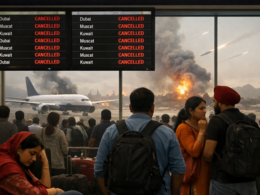
The deadliest reported impact was in the Moscow region, where local officials said a woman was killed in Khimki after a drone hit a home, while two men were killed in the village of Pogorelki in the Mytishchi district. A fourth person was reported killed in the Belgorod region, which borders Ukraine. Several people were wounded, residential buildings were damaged, and Moscow’s Sheremetyevo airport reported that drone debris had fallen on its grounds without causing damage.
Ukrainian President Volodymyr Zelenskyy confirmed the strikes and said Ukraine’s response to Russia’s continued war and attacks on Ukrainian cities was justified. Ukraine said its drones had reached targets more than 500 kilometres from Ukrainian territory, underlining Kyiv’s growing ability to hit sites far beyond the front line.
Russia accused Ukraine of targeting civilians, while Ukraine has repeatedly said its long range strikes are aimed at military, energy, and logistical assets used to support Russia’s war effort. Both Russia and Ukraine deny deliberately targeting civilians.
Why did the Ukraine drone attack on Russia become a major escalation near Moscow?
The latest Ukraine drone attack on Russia became a major escalation because of its scale, its reach, and the concentration of reported damage around the Moscow region. Moscow is not just Russia’s capital. Moscow is the political, administrative, financial, and symbolic centre of the Russian state. Drone activity around Moscow therefore carries significance beyond the immediate battlefield effect.
Russian authorities said 81 drones were destroyed while heading toward Moscow, making the overnight attack one of the largest directed at the capital region in more than a year. Moscow Mayor Sergei Sobyanin said 12 people were wounded, mostly near the entrance to the city’s oil refinery, while local authorities in the Moscow region reported deaths and damage to residential areas.
The Moscow region deaths also changed the political weight of the attack. Previous Ukrainian drone strikes deep inside Russia have often focused on oil refineries, fuel depots, military facilities, airfields, and defence related production sites. In this case, Russian officials reported civilian deaths near Moscow, allowing Moscow to frame the attack as a direct strike on populated areas.
Ukraine’s position is different. Kyiv has argued that Russia’s repeated strikes on Ukrainian cities, including drone and missile attacks on Kyiv and other urban centres, have forced Ukraine to expand its own long range strike campaign. Ukrainian President Volodymyr Zelenskyy said Ukraine’s actions were a response to Russia’s prolongation of the war and its attacks on Ukrainian communities.
The broader consequence is that the Russia Ukraine war is moving further into a contest of endurance between air defence systems, drone production capacity, long range strike planning, and civilian infrastructure resilience. The battlefield is no longer limited to eastern and southern Ukraine. The aerial dimension now extends hundreds of kilometres into Russia.
How did Russia describe the overnight Ukraine drone barrage across Russian territory?
Russia described the overnight assault as a mass aerial attack involving hundreds of Ukrainian drones. The Russian Defence Ministry said 556 drones were destroyed overnight across Russia, occupied Crimea, and the Azov and Black Seas. Shortly after midday local time, Russia said more than 1,000 Ukrainian drones had been shot down or jammed over a 24 hour period.
Russian officials said the attack hit or threatened multiple regions. The Moscow region saw the most politically sensitive impact because of the fatalities near the capital. Belgorod, a Russian border region repeatedly affected by the war, also reported one death after a drone struck a truck.
Moscow regional Governor Andrei Vorobyov said a woman was killed in Khimki when a drone hit a home and that two men died in Pogorelki. He also said several high rise residential buildings and infrastructure facilities were damaged. Moscow Mayor Sergei Sobyanin said the city’s oil refinery technology had not been damaged, even though injuries were reported near the refinery entrance.
Russia’s institutional response focused on civilian harm and national security. The Russian Foreign Ministry accused Kyiv of carrying out a mass attack, while Russian officials presented the drone barrage as evidence that Ukraine was striking civilian areas inside Russia. This messaging fits Moscow’s broader effort to portray Ukrainian long range strikes as terrorism rather than military retaliation.
The wider implication is that Russia now faces a more persistent internal air defence burden. Moscow and surrounding regions must defend against drones while Russia also continues air operations against Ukraine. Every major Ukrainian drone attack forces Russia to spread air defence coverage across front line zones, border regions, energy assets, military production sites, and major cities.
What did Ukraine say about the strikes and why did Kyiv defend the operation?
Ukraine defended the strikes as a response to Russia’s continued attacks on Ukrainian cities and communities. Ukrainian President Volodymyr Zelenskyy said Ukraine’s long distance sanctions had reached the Moscow region and that Russia must end its war.
The wording matters because Ukraine increasingly uses the phrase “long distance sanctions” to describe drone and missile strikes against Russian assets. The phrase frames Ukraine’s campaign as a form of pressure on Russia’s military, industrial, and energy systems rather than as isolated retaliation.
Ukraine’s military also said it had struck targets linked to weapons production and drone operations. Ukrainian officials said one strike triggered a fire at a plant outside Moscow involved in high precision weapons production. Ukraine also said a command point overseeing drone flights had been hit in Russian occupied Donetsk region.
Kyiv’s position is built around deterrence and reciprocity. Russia has launched repeated drone and missile barrages against Ukrainian cities, power infrastructure, residential areas, and industrial sites. Ukraine is signalling that Russia’s own strategic depth will no longer remain insulated from the war.
The global consequence is a further normalization of long range drone warfare in a major interstate conflict. Ukraine’s ability to send drones more than 500 kilometres into Russia shows how cheaper unmanned systems can challenge larger air defence networks. It also shows why both sides are investing heavily in drone manufacturing, electronic warfare, interception systems, and decentralised launch capability.
How does the deadly Moscow region attack fit into the wider Russia Ukraine air war?
The Moscow region attack fits into a broader pattern of intensifying drone and missile warfare between Russia and Ukraine. Russia has continued large scale aerial strikes against Ukraine, while Ukraine has expanded attacks on Russian oil infrastructure, military logistics, command points, weapons plants, and airfields.
The latest Ukrainian attack followed a period of heavy Russian strikes on Kyiv and other Ukrainian cities. Russia’s own drone and missile attacks have caused deaths and injuries in Ukraine, while damaging homes, power systems, and civilian infrastructure. Ukrainian officials said Russian drone strikes overnight into Sunday wounded eight people in Ukraine’s Dnipropetrovsk region, including in Dnipro, Kryvyi Rih, and Synelkove.
The air war has become one of the defining features of the conflict. Russia has relied on missiles and drones to pressure Ukraine’s cities and infrastructure. Ukraine has responded by building a long range drone campaign intended to raise the cost of war inside Russia and disrupt the systems that support Moscow’s invasion.
The Moscow attack shows that the balance of vulnerability is shifting. Russia still possesses far greater missile capacity and air power than Ukraine. But Ukraine has demonstrated that relatively lower cost drones can penetrate or pressure Russian defences when launched at scale.
This creates a difficult strategic cycle. Russia’s attacks on Ukraine are likely to drive further Ukrainian retaliation. Ukrainian strikes inside Russia are likely to trigger stronger Russian accusations and possibly further Russian strikes on Ukrainian cities. The result is a widening aerial conflict in which civilian areas, energy facilities, transport systems, and industrial sites remain exposed.
Why does the reported strike near Moscow’s oil refinery matter for Russia’s war economy?
The reported injuries near the entrance to Moscow’s oil refinery matter because energy infrastructure has become one of the most sensitive targets in the Russia Ukraine war. Even when refinery technology is not damaged, drone activity near such facilities signals vulnerability in Russia’s fuel and industrial network.
Ukraine has increasingly targeted Russian oil refineries, depots, and pipelines. Kyiv’s strategic logic is clear. Russia’s energy sector generates revenue, supports military logistics, and helps sustain the economic base of the war. Any disruption to refining capacity, fuel distribution, or export systems can create costs for Moscow.
Russia said the Moscow refinery’s technology was not damaged in the overnight attack. That detail is important because it limits the immediate operational impact of the strike. However, the proximity of drone activity to the refinery still carries psychological and security consequences. It demonstrates that key infrastructure near Russia’s capital must now be defended against repeated aerial threats.
The broader consequence extends beyond one refinery. Russia must allocate more air defence assets to protect energy sites across a vast territory. That creates pressure on Moscow’s defence planning because the same systems may also be needed near the front line, around military facilities, and across cities exposed to long range drones.
For Ukraine, energy infrastructure remains a way to impose economic pressure without relying only on conventional battlefield advances. For Russia, protecting oil and fuel systems is now part of the wider challenge of sustaining a long war under growing aerial pressure.
What does the attack reveal about drone warfare and air defence pressure in the Russia Ukraine war?
The attack reveals that drone warfare has become a mass scale contest rather than an occasional tactical tool. Russia said it destroyed or jammed more than 1,000 Ukrainian drones in 24 hours. Even if air defences intercept most incoming drones, the sheer number forces defenders to spend ammunition, activate radar networks, disrupt air traffic, and protect multiple regions at once.
Ukraine’s drones reaching more than 500 kilometres from Ukrainian territory also shows how the geography of the war has widened. Long range drones allow Ukraine to hit or threaten targets that would once have been outside the practical reach of its conventional forces.
For Russia, the institutional challenge is defensive saturation. A large drone barrage can overwhelm local systems, force temporary airport restrictions, and create uncertainty even when most drones are destroyed. Moscow’s Sheremetyevo airport said drone debris fell on its territory without causing damage, but the incident still illustrated how civilian aviation can be affected by aerial warfare near major urban centres.
For Ukraine, the challenge is maintaining production, accuracy, and target selection while facing Russian electronic warfare and air defence systems. Kyiv must also manage the diplomatic and reputational risk that comes when strikes inside Russia lead to civilian casualties.
The global lesson is being watched closely by militaries far beyond Eastern Europe. The Russia Ukraine war has shown that drones can reshape deterrence, logistics, infrastructure security, and homeland defence. The latest Moscow region attack is another sign that future conflicts may be defined not only by tanks and missiles, but by the ability to produce, launch, intercept, and absorb thousands of unmanned systems.
What happens next after Ukraine’s deadly drone attack on Russia and Moscow’s response?
The immediate next phase is likely to involve intensified Russian security measures around Moscow, border regions, oil infrastructure, and military industrial sites. Russia may also respond with further drone and missile strikes against Ukraine, particularly if Moscow frames the attack as a major strike on civilians.
Ukraine is likely to continue long range drone operations as long as Russia continues attacking Ukrainian cities and infrastructure. Ukrainian President Volodymyr Zelenskyy’s public defence of the operation suggests Kyiv sees these strikes as part of a sustained strategy rather than a one off response.
Diplomatically, the attack adds another layer of complexity to an already stalled war. Each side is using aerial strikes to shape pressure, morale, and bargaining conditions. But civilian casualties on either side harden public positions and make de escalation more difficult.
For Russia, the attack raises uncomfortable questions about air defence coverage around the capital. For Ukraine, the attack shows capability but also increases the burden of explaining its operations to international partners when deaths occur inside Russia.
The broader trajectory is grim but clear. The Russia Ukraine war is becoming a long range systems war, with drones, missiles, air defence, oil infrastructure, and urban resilience at the centre. The Moscow region fatalities show that the war’s aerial geography is expanding, and that neither side’s civilian population is insulated from the consequences of continued escalation.
What are the key takeaways from Ukraine’s deadly drone attack on Russia and Moscow region?
- Ukraine launched one of its largest drone attacks on Russia overnight, and Russian officials said at least four people were killed. Three deaths were reported in the Moscow region, while one death was reported in the Belgorod region near the Ukrainian border.
- Russia said its air defences destroyed 556 drones overnight across Russia, occupied Crimea, and nearby maritime zones. The Russian Defence Ministry later said more than 1,000 Ukrainian drones had been destroyed or jammed over a 24 hour period.
- Moscow region officials said a woman was killed in Khimki and two men were killed in Pogorelki. Russian officials also reported damage to residential buildings, infrastructure facilities, and injuries near Moscow’s oil refinery.
- Ukrainian President Volodymyr Zelenskyy confirmed the strikes and defended them as a response to Russia’s war and attacks on Ukrainian cities. Ukraine said its drones had reached targets more than 500 kilometres from Ukrainian territory.
- Russia accused Ukraine of targeting civilians, while Ukraine has said its long range strikes focus on military, energy, and war related infrastructure. Both Russia and Ukraine deny deliberately targeting civilians during the conflict.
- The attack highlights the growing role of mass drone warfare in the Russia Ukraine war. The conflict is increasingly shaped by long range drones, air defence saturation, refinery security, airport disruption, and deep strike capability.
Discover more from Business-News-Today.com
Subscribe to get the latest posts sent to your email.